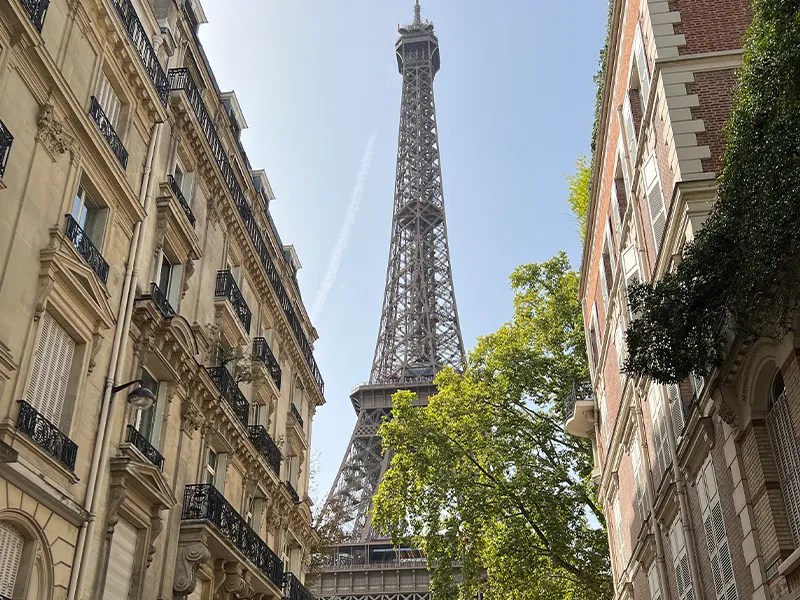
Marvellous, magnificent and mesmerising monuments of France. The biggest and the best, the strange and the quirky, their history, legends and fascinating facts from the Eiffel Tower to a palace built from pebbles by a postman – with his bare hands. Discover 10 must visit monuments in France…
Eiffel Tower
Let’s start with France’s most visited monument the Eiffel Tower. And not just France, it’s the most visited paid to enter monument in the world.
Named after Gustave Eiffel whose company built it, which took little more than 2 years – it opened to the public in March 1889. It was made to showcase French engineering know-how for the Paris World Exposition. The first visitors were Buffalo Bill and the British Royal Family! Thomas Edison visited it and Eiffel entertained royalty and celebrities in his apartment at the top of the tower – which is still there.
Not everyone loved it, many artists and influential people signed a petition to have the building of it stopped – including Charles Garnier who designed another Paris monument – the Opera Garnier… They wrote that it was a ‘giddy, ridiculous tower dominating Paris like a gigantic black smokestack, crushing under its barbaric bulk Notre Dame etc etc.’ They called it a hateful column of bolted sheet metal. Thankfully they were ignored.
The tower was an instant success with most people, though it is, if we’re going to be pedantic, a metal column. 7,300 tonnes of iron, 18,000 parts, were used to build the lattice work tower, held together by 2.5 million rivets.
For 40 years it was the tallest man-made building in the world and the views from its platforms over Paris are marvellous. I remember going up in the lift age 13 – terrifying if you’re frightened of heights like me. But it was worth it. And it certainly beats climbing 1665 steps to the top. On very windy days the tower sways up to 7 inches.
It’s hard to say why we all love it so much. I think it represents overcoming people’s prejudices, and showcases genuis, a radical innovation of its time – and it’s a symbol of Paris and France. I’ve seen people burst into tears when they see it for the first time. I’ve stood there as the famous twinkling lights come on and you can hear a collective sigh all around. Even Parisians are in love with the Tower. And it’s very romantic – if expensive – to head up the tower for a glass of Champagne! The singer Mariah Carey and her husband renewed their wedding vows up the Eiffel Tower about 10 years ago!
Cathedral of Notre Dame
Paris is of course full of monuments – the Arc de Triomphe, the Louvre palace, the Musee d’Orsay, the Conciergerie – so many… and one of the most famous and talked about of them all is of course the great cathedral of Notre Dame. I think many people will remember watching the news in April 2019, horrified at the fire… almost 1 billion dollars was pledged from around the world to restore this symbolic heart of France and of French heritage – which used to be visited by 12 million people a year.
The cathedral is made up of a mixture of architectural styles created over many years. The North Tower was completed in 1240, but the South Tower wasn’t finished for another 10 years. They look as if they match perfectly but look closely and you’ll see the north tower is a little bit taller. The two towers were the tallest structures in Paris until the Eiffel Tower was erected in 1889.
Building of the Cathedral began in 1163 on top of the ruins of previous churches, and before that a Roman temple. Pope Alexander III attended the ceremony in which the first stone was laid. It was completed in 1260, almost 100 years after building first started, longer if you include the addition of the flying buttresses added in 1345.
There are 10 bells at Notre-Dame, all named after Saints. Marie, Emmanuel, Gabriel, Anne-Genevieve, Denis, Marcel, Etienne, Benoit-Joseph, Maurice, and Jean-Marie.
Most of the original bells from the cathedral were melted to make cannons during the French Revolution. New bells were not installed in the cathedral until the mid-19th century. The South tower is home to the largest bell, Emmanuel, installed in 1638. Weighing in at 13-tonnes, it’s clapper alone weighs 1,100 lbs.
I remember sitting at a café just opposite the Cathedral on a cold day, I was drinking hot chocolate and those bells started ringing, it was an extraordinary sound, like the beating heart of Paris. It gives me goosebumps thinking about it.
The restoration of the cathedral really took into account the ‘sound’ of the Cathedral. The French writer Victor Hugo said “its sounds were filled with benediction and majesty that soothed the soul, the organ, the singing, the prayers…” but the fire and destruction affected the acoustics and specialists focussed on restoring it and have done an amazing job.
Palace of Postman Cheval

Let’s move out of Paris and to the south of France, to a small town called Hauterives in the Drôme department, Auvergne-Rhone-Alpes, which is hardly known outside of France. There are around 2000 inhabitants, a friendly bar, a couple of restaurants, a cosy bakery, a few shops, B&Bs and a camp site. It’s a typically French country town – tranquil, sleepy even for the most part. But Hauterives has an extraordinary secret. Drive through the town and you may miss it. Swerve to a side street a stone’s throw from the boulangerie and you’ll discover something quite extraordinary.
A palace, built by hand from pebbles collected by a postman born in 1836 as he performed his delivery rounds. I honestly think it is one of the most amazing monuments I’ve ever seen.He was 43 years old when he started. And he finished that project when he was 76 years old. He spent 33 years, 10000 days, 93000 hours building his ‘palais ideale’ his ideal palace. And he did it at night, after he finished work. By candle light.
It is truly incredible, artistic, quirky, a little bit bonkers but amazingly beautiful with giants and animals, fountains and strange figures, it looks like an Aztec temple, an Indian palace – exotic and not remotely French! His neighbours thought him crazy but he became famous in his own lifetime – Picasso visited and many artists, wowed by his creation and dedication.
Then he built his own tomb in the same style. He finished that at the age of 83 and died the year after.
Incredible. I’ve been renovating my old farmhouse for 19 years and his story is an inspiration to me. And this story deserves an article to itself which you can read here: Postman Chevals ideal palace
Palace of Versailles

There are many palaces in France, and this one is at the complete opposite of the Postman’s Palace. Versailles near Paris, is world famous for its bling bling as they say in France.
When Louis 14th was thinking about how to create the most magnificent palace the world had ever seen, one that truly showed off his glory and absolute power, he can’t have had any idea just how many people would tread in his footsteps and gaze in wonder at his legacy. The Chateau de Versailles is world famous. But, I promise you, nothing you see on the TV or in photos prepares you for the sheer absolute golden glitz and glamour of the real thing. 700 rooms, 1250 chimneys, 67 staircases and 2000 windows. The chateau of Versailles is monumental, a colossus of a building. It was originally six storeys high, but the top layers were levelled off in the 19th century after the French Revolution.
Did you know that during world war II the beautiful wood panelling of the walls was hidden in a coal mine in the Pyrenees to protect it? It’s completely detachable – a sort of tongue and groove!
It wasn’t that comfortable living there. Even though there are more than 1000 fireplaces , they couldn’t keep it warm, it was recorded that in the winter of 1695, the King’s glass of wine froze on the table while he was eating his dinner. In fact dinner here was a problem, hundreds of courtiers lived in little apartments at the palace and they mostly didn’t have a kitchen so they had to send their staff out for food and a sort of town of food booths grew around the castle. And the town of Versailles is even now known for having one of the best markets in France
Versailles is on the UNESCO World heritage list along with dozens more incredible sites including the fortified city of Carcassonne, Bordeaux’s Port of the Moon and the Palace of Fontainebleau and the great Gothic cathedral of Amiens…
Palace of the Popes, Avignon

One of my favourites on the UNESCO world heritage list is another Gothic marvel – the Palace of the Popes in Avignon in Vaucluse, Provence. I’d heard of the Palais des Papes. No photo can ever prepare you for the sight of in person. The sheer overwhelming size and incredible history of this towering palace in which Popes once lived is mind boggling.
In 1309 Pope Clement V established a Papal residence in Avignon making this French city the capital of the Christian world. There were issues within the running of the Catholic Church and the French King pretty much insisted that Clement, a French pope, stayed in France. Successive Popes elaborated and extended the building until it became the soaring, majestic palace we see today with a maze of rooms and chapels and courtyards.
The fourth Pope, Clement VI bought the city of Avignon from the Countess of Provence. Cardinals built grand palatial mansions around the Popes Palace and the old city of Avignon became to all intents and purposes an enclosed city much like the Vatican in Rome. Seven official Popes lived here until the court was moved back to Rome in 1376. Two “anti-popes” continued living and attempting to rule the Catholic church from Avignon for a further 39 years until finally being made to give up.
The Palace then became a residence of the legates of Rome but without investment it became quite dilapidated. Under Napoleon the palace became a barracks – can you imagine that? Soldiers putting up makeshift beds in the huge halls. Sadly some bits of the building were destroyed. But it also saved the building from being knocked down and amazingly some rooms were untouched.
There are extraordinary floor tiles and wall frescoes, the kitchen is still there, big enough to roast up to 50 oxen at a time! And the architecture is wonderful. It is the biggest Gothic palace in the world covering a whopping 15000 square metres. If you go there, pop to the wine bar next door, the Carré du Palais, in an 18th century mansion with a terrace overlooking the palace of the Popes – the perfect spot to view the palace and people watch!
Pere Lachaise Cemetery
Some monuments are a little more unusual. I mean, take the cemetery of Père Lachaise in Paris – it may sound odd but this is a wonderful place to take a stroll and admire the mausoleums. More than 1,000,000 people rest here and some say it is the most visited cemetery in the world.
The name of the cemetery comes from Père Francois de la Chaise, confessor to Louis 14th. At first it wasn’t a popular place to be buried – too far from the then city centre. Even when Napoleon Bonaparte tried to encourage people to choose it as their lasting resting place in 1804 – it wasn’t popular, just 13 graves. So Paris officials came up with a sort of marketing strategy.
They transferred the remains of the great writers Molière and Jean de la Fontaine here from their original graves. The public ceremony attracted the attention of other ‘applicants’. Then in 1817 the remains of the French “Romeo and Juliet”, Pierre Abelard and Heloise d’Argenteuil, were transferred and placed under a canopy constructed from fragments of a well-known Paris chapel. The couple were one of history’s most passionate and romantic true love stories and their nine hundred year old love affair is known throughout France. Lovers or people searching for love at the time, would leave letters under the canopy hoping to find fulfilment for themselves.
The romance eternally associated with Paris spread even to the graveyards. Père Lachaise cemetery became popular. There are many beautiful mausoleums and gravestones lining the tree-filled avenues, and people visit from around the world to pay their respects to those who rest here including Jim Morrison of the Doors – his grave is always covered in flowers (and it’s said some people used to make love on the tomb, as a tribute to Jim, creepy!). Oscar Wild’s grave stone is now behind a plastic cover because so many people left kisses on it, the stone started to deteriorate. There are thousands of little monuments and it’s a lovely place to take a walk, all those beautiful, haunting statues.
Mont-Saint Michel
One of my favourite statues is the gilded Archangel Michael which stands in a gravity defying position atop the abbey of Mont Saint Michel…
Mont Saint-Michel is majestic. It’s one of those places that, although its wiggly cobbled streets might be covered by many visitors (around 2.5 million a year – it is after all one of the most popular sites in France) the magic shines through. A tiny town on a granite island cradled between the coast of Brittany and Normandy, which from a distance looks like a helter-skelter. Lopsided half-timbered houses wind their way round the narrow alleyways, topped by this golden statue of Saint Michael. Victor Hugo, the great French writer called it “the pyramid of the seas” and you can really see what he means when you view it from a distance. It is one of the wonders of the world and has attracted hordes of tourists since the Middle Ages. Read more about Mont-Saint-Michel here
Cairn de Barnenez
But how about some really ancient monuments like the megalithic burial mound, the Cairn de Barnenez, is the oldest structure that is still standing in all of France. The Cairn de Barnenez was originally referred to as the “Prehistoric Parthenon” by French author and politician André Malraux.
Lascaux Caves
There are prehistoric caves and grottoes galore in many parts of France, Lascaux caves Dordogne, Chauvet in the Ardeche and Cosquer caves in Marseille, you can visit the replica caves to protect the ancient originals in an underwater passageway. 37 m under the sea, filled with handprints and images that are 15000 years old, they are named after a diver called Henri Cosquer – he discovered the original caves in 1985 and when he first visited the replica caves he was moved to tears by it as he was so impressed.
Janine Marsh is the author of several internationally best-selling books about France. Her latest book How to be French – a celebration of the French lifestyle and art de vivre, is out now – a look at the French way of life. Find all books on her website janinemarsh.com
Want more France?
Discover more fabulous destinations in France with our free magazine The Good Life France
Love France? Have a listen to our podcast – everything you want to know about France and more!
All rights reserved. This article may not be published, broadcast, rewritten (including translated) or redistributed without written permission.


