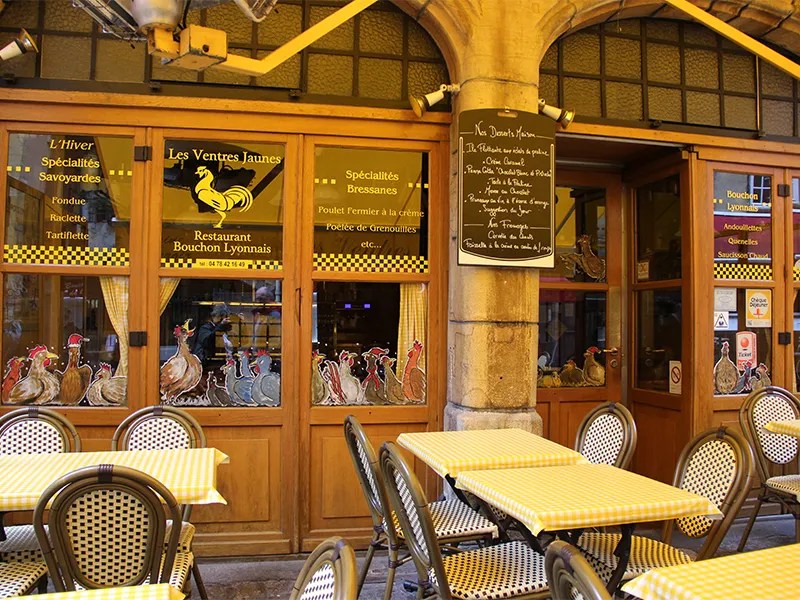
A cultural hub with museums galore, Roman remains, one of Europe’s most extensive Renaissance districts, known as the ‘World capital of gastronomy,’ and flanked by world class vineyards – Lyon is a first-rate weekend destination says Janine Marsh.
Essential Lyon
Start your visit on top of UNESCO-listed Fourvière Hill where Lyon was founded by the Romans in 43 BC – they called it Lugdunum, the Hill of Light. It grew to be one of the largest Roman cities in Gaul and was the birthplace of the Emperor Claudius in 10 BC. The Romans had to take a chest-thumping hike up the steep slopes – save yourself, hop on the fabulous funicular, nicknamed the Ficelle, ‘the string.’ It’s been ferrying passengers up and down for more than 100 years.
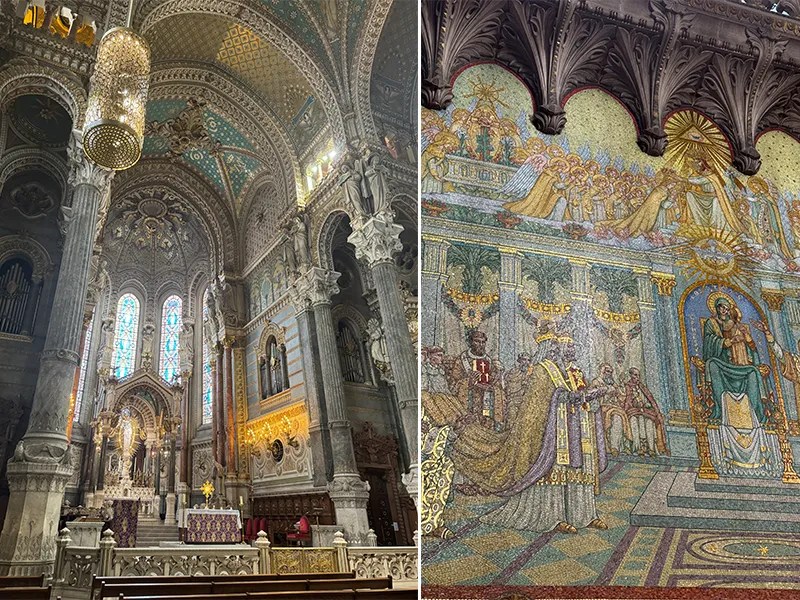
The great Basilica of Notre-Dame crowns the hill, and it’s well worth a visit even if you’re not into churches. “The upside-down elephant” as locals call it (due to its four corner towers), was dedicated to the Virgin Mary in thanks to God for saving Lyon from the Black Death in the 17th century and for sparing the city from invasion during the Franco-Prussian War.
Inside is extraordinary. Colourful mosaics – Neo-Byzantine style – and stained-glass windows vie for attention. It’s a major place of pilgrimage with some two million pilgrims visiting each year. The first Bishop of Gaul was Lyon’s Saint Photunis, and the city is where some of the earliest martyrs of the Christian religion died.
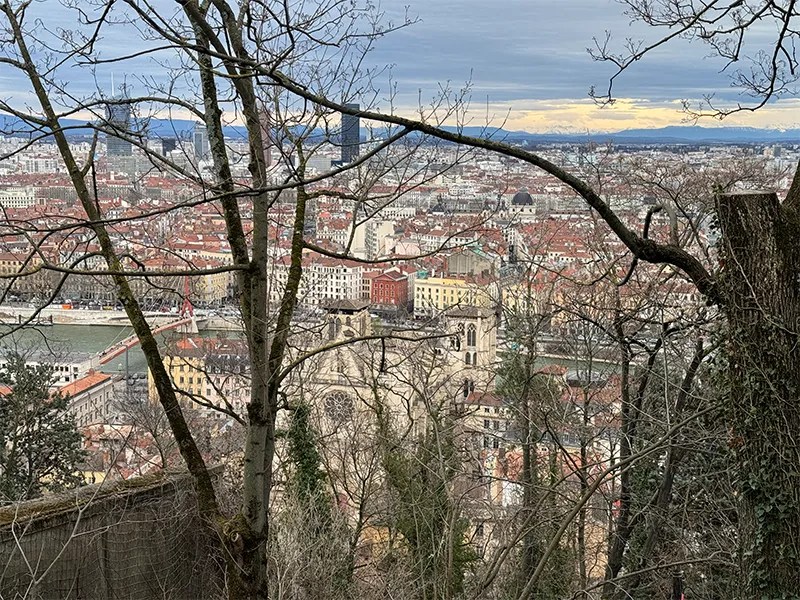
Head behind the Basilica for outstanding views over the city and Lyon’s “Eiffel Tower”, a replica of the top third of the Paris original. On a clear day you can see as far as Mont Blanc in the French Alps.
Roman amphitheatres

A short walk from the Basilica, plunge into the past and explore Lyon’s Gallo-Roman history. It’s an astonishing sight to see the “large theatre”, the oldest and one of the biggest in Roman Gaul. Built into the hill and amazingly well-preserved, it could host 10,700 spectators and put on tragedies and comedies. Right next to it, another amphitheatre, “the odeon”, the “small” theatre, could seat 3,000, and was kept for music and reading. Every summer a festival of music, dance, opera, drama and circus is hosted here. How incredible that more than 2000 years after the theatre first echoed to the sound of applause, it’s still going on. Close by, the Lugdunum Museum is fascinating and full of historic treasures.
From here, you can either hop back on the funicular to go downtown or walk down via the pretty Rosarie Gardens, and a series of steep streets and steps, or take the circa 563 steps of the Nicolas de Lange staircase.
Vieux Lyon and its traboules
At the bottom of the hill, Lyon spreads out around two rivers, the Rhône and the Saône. There are four UNESCO-listed districts in Lyon but if you only have time for one, Vieux Lyon is a must.
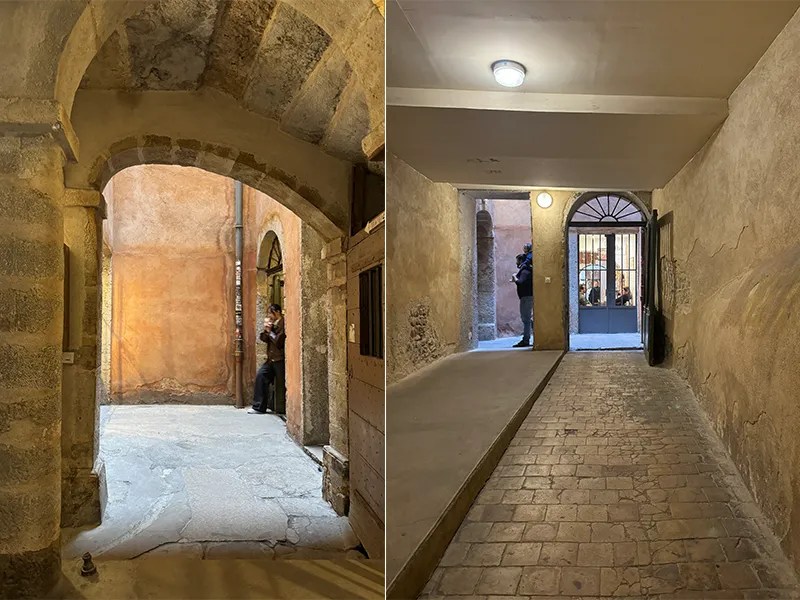
Lyon has long been prosperous which naturally made people want to live there. Up until the 12th century, newcomers simply built somewhere to live. This started to get out of hand so the authorities eventually passed a law to restrict building space, so people began building in gaps between existing houses, which then resulted in a long walk to get around a block. So the canny inhabitants created ‘traboules’, short cuts, between the buildings. You can wander through some of these pickled-in-the-past passageways, and though 90% are private and inaccessible, the rest are open daily from 10h to 18h. These traboules date from the 13th to the 17th century, and they’re lined with buildings, galleries and shops – a genuine medieval labyrinth.
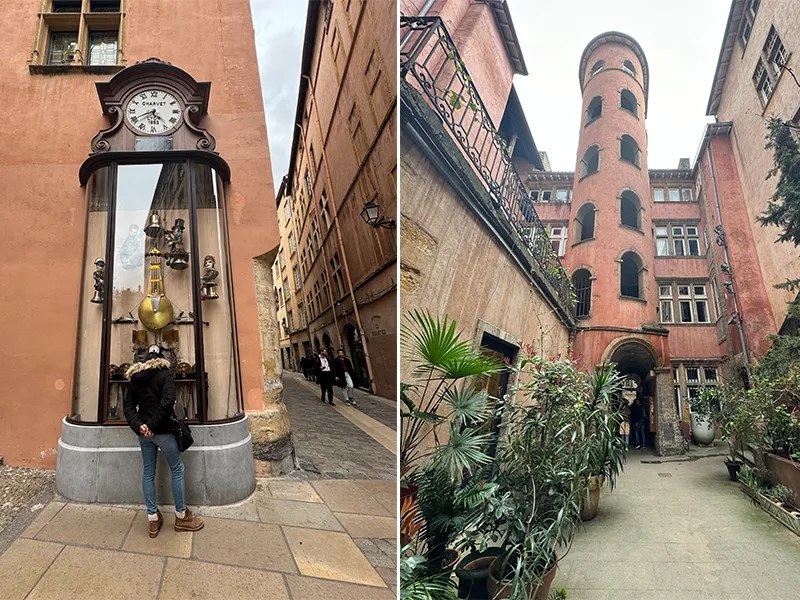
In the 15th century, wealthy Italians arrived to trade at the famous commercial fairs of Lyon. They made fortunes and built beautiful mansions and palaces, many of which survive, like the Palazzo Grandi, which now hosts two museums. They also bought silk with them. And French King Francis 1, who adored silk, encouraged Italian silk weavers to set up shop, and train the French. In 1536, he granted Lyon the right to produce silk and gold thread, making it the silk capital of France, and it still is. In its heyday, centred around the UNESO-listed Croix-Rousse district, up to 18,000 people were employed in the silk industry. Pop into the shop/gallery of the Ames Soeurs (amessouers-edition.com) who bring the work of local artists to life, transforming their art into gorgeous silk scarves.
There’s so much to see and do in Lyon, but if you have time, hop on the tram to the Musée des Confluences in the UNEDCO-listed Presqu’Ile district. Within the architecturally extravagant building – a tangle of metal and glass that makes you think a UFO has landed in the city – lifts, escalators and stairs take you from one level to another for the most extraordinary exhibition of the history of life, everything from 150-million-year-old fossils to luxury cars and waffle makers. It’s weird, whacky and truly wonderful.
Lumière Museum
Cinema was born in Lyon. A visit to the Musée Lumière, located in the former home of the Lumière family is a must. Here you’ll discover the early history of film, and of movie-making brothers Auguste and Louis Lumière. Le Café Lumière next to the museum is great for a light lunch or early dinner.
And, if you’re a film buff, the Musée Cinéma et Miniature is one-of-a-kind in Europe exhibition that features a wide range of sets and costumes used on film shoots, donated by major European and American film studios. From Darth Vader’s helmet to The Fantastic Mr Fox puppet, James Bond’s suit, Spiderman’s outfit and Ironman’s glove – this place is chock full of astonishing movie memorabilia.
The foodie bit

It’s hard to know where to start when it comes to eating out in Lyon. This city has the most restaurants per inhabitant of any city in France – one per 300 people. Eating well is a way of life here. If you had lunch and dinner out every single day, it would take you more than 10 years to enjoy every restaurant. Luckily for you, I have done the hard work and tried several, all that walking up hills gives you an appetite!
Les Halles Bocuse: The covered market named in honour of Lyon’s late great chef Paul Bocuse, typifies what gives Lyon its nickname “world capital of gastronomy.” I’ve been to a lot of markets in France but never one quite like this, the most mouth-watering food stalls managed by stars of the food world and multiple MOFs, Meilleurs Ouvriers de France, the crème de la crème of their profession from cheese to meat and everything in between.
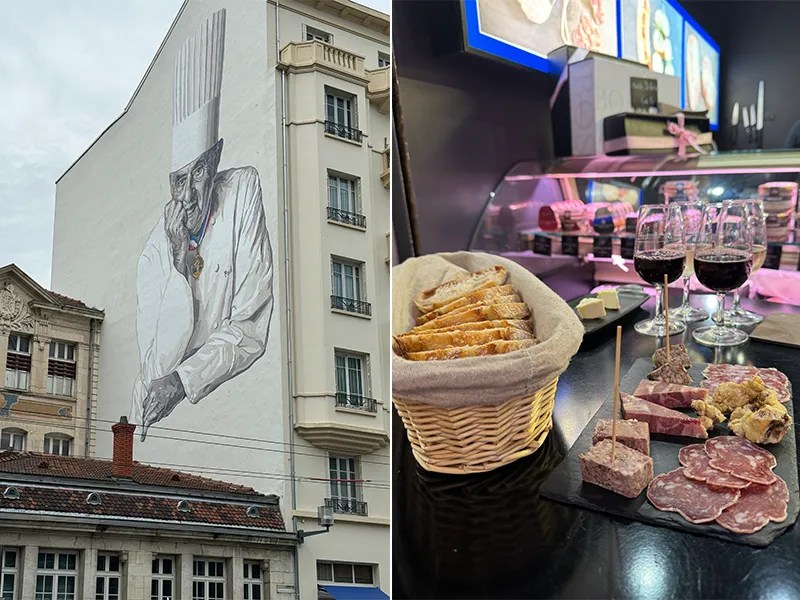
At 10am I found myself seated at a table at Boucherie Bobosse for a tasting tour which started with a glass of Beaujolais red followed by gourmet plates of food – starting with rosette and saucisson of Lyon. A sausage called Jesus (apparently years ago it was popular at Christmas) followed. Then more wine, terrine, Ardêche Paté and grattons, fatty pork scratchings, known as the ‘peanuts of Lyon’ – I was beginning to feel a bit porky myself!
Shoppers drifted by admiring our table of food and wine and wished us bon apetit. I could tell they thought I was wise even if I’m not French, I mean what could be better than gluttonous indulgence – before lunch. Believe me you will think you won’t want anything to eat after this… but you’re in Lyon, you’ll give in, it’s futile to resist its culinary charms. (Book a tour and tasting experience via the tourist office, details below).
Experience a true bouchon: There are hundreds of bouchons (restaurants which specialise in homemade regional Lyonnaise dishes) in the city, but only those with an official symbol are considered the ‘real deal’ by the locals. Poêlon d’Or (lepoelondor-restaurant.fr) is one of them. Expect traditional Lyonnais fare such as quenelle (the best in Lyon I was told by a customer), made with pike and puff pastry, andouillette sausage with old-fashioned mustard sauce, and the sweet specialty of Lyon – pink praline tart.
Locals love: Bleuvert bistrot (bleuvertbistrot.fr), run by two young chefs who create tapas style, seasonal, local and outstandingly good food. Added to a great ambience, this is a fabulous restaurant.
The Legendary Paul Bocuse restaurant Auberge du Pont de Collonges

Auberge du Pont de Collonges: I’ve saved the best for last. The restaurant of one of the world’s great chefs, Paul Bocuse (1926-2018), AKA “the Pope of Gastronomy” continues his legacy. It was here that as a young chef won his first Michelin Star in 1957. Paul Bocuse went on to win many more stars and become a star himself. Jean-Philippe Merlin, the dining room manager of the restaurant for 44 years assured me that the chef would most certainly recognise the restaurant today – little has changed. And many of the customers here have been coming for years, as did their parents and their grandparents.

This two Michelin-starred restaurant is an institution, and as a foodie, coming here was for me a bit of a pilgrimage. The dishes are extraordinary, works of art, sigh-inducing taste sensations. A lemon-infused croissant, tiny jewel-like amuse bouches, sculpted mushrooms, black truffe soup a l’Elysée, created for President Valery Giscard d’Estaing, when Bocuse received the Chevalier de la Legion d’honneur and went to dinner at the Elysée Palace. And the wine list is divine.
This restaurant is expensive. Very. But it is a most incredible experience. A team of 80, led by Gilles Reinhardt, Olivier Couvin and Benoît Charvet, two Meilleurs Ouvriers de France and a World Champion, ensure that guests are spoiled rotten and fed like Gods. If chef Bocuse is looking down, I’m sure he must be delighted with how his legacy is being upheld by a who’s who crew of some of the finest chefs in France.
Where to stay in Lyon
Recently opened, the 4* Hotel Pullman 4 (pullmanlyon.com) is seriously funky, and right next to the train station (with direct access) though the big, comfy rooms are silent, it’s in a brilliant location. There’s also a great restaurant with a South American vibe – and the breakfast buffet is seriously generous.
For a country feel within the city itself, the Lyon Country House (lyoncountryhouse.com) is a secret oasis. A castle within a park, you enter via a door in a residential street and have absolutely no idea what lies behind. With various B&B options including perched cabins, I stayed in a B&B room in the former guard tower. Run by the lovely Jean-Max and wife Louise, it’s an under the radar treasure.
Hotel de l’Abbaye (hotelabbayelon.com is in a quiet area of Lyon and easy walking distance to the heart of the city. Boutique, bijou, cosy, arty – it’s a little gem!
Getting there: By fast train to Lyon Part-Deux (in the centre of town) from Paris the journey takes from 1h 52m. Regional trains are served from Lyon-Perrache station, also in the city.
Lyon-Saint Exupéry International Airport is the third biggest in France and is 25km from the city centre.
Public Transport: Excellent metro, bus and tram network.
Private chauffeur/airport transfers: Teleporta Lyon (teleportalyon.com)
Website for Lyon Tourist Office where you can book guided tours, tasting tours and find out what so see and do in Lyon: visiterlyon.com
Tip: Get a city pass which gives you access to transport and museums.
Janine Marsh is the author of several internationally best-selling books about France. Her latest book How to be French – a celebration of the French lifestyle and art de vivre, is out now – a look at the French way of life. Find all books on her website janinemarsh.com
Want more France?
Discover more fabulous destinations in France with our free magazine The Good Life France
Love France? Have a listen to our podcast – everything you want to know about France and more!
All rights reserved. This article may not be published, broadcast, rewritten (including translated) or redistributed without written permission.


