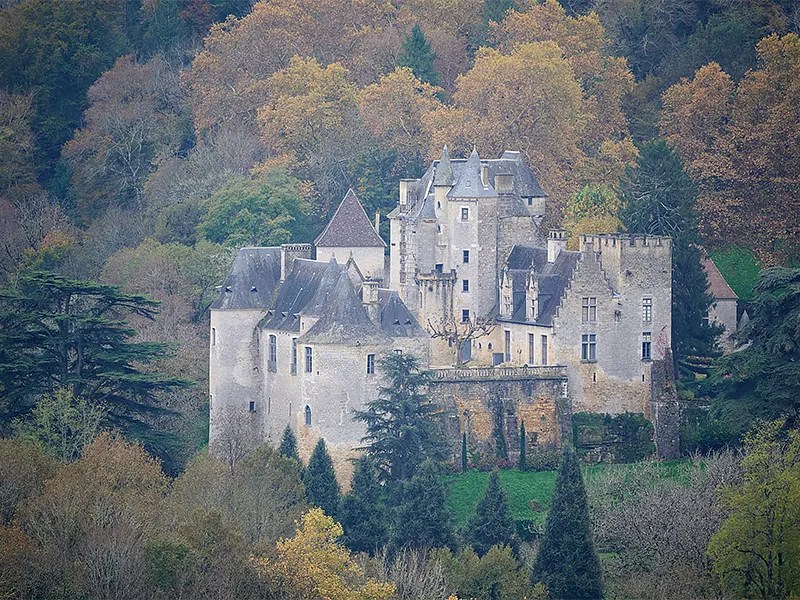
Discover the Dordogne Valley: If you have a taste for history – the Dordogne Valley with its ancient towns and foodie vibes will satisfy your soul says Rudolf Abraham.
Brive’s busy Saturday market is the one of the largest and most vibrant in the Dordogne Valley, with some 200 stallholders or gueules de marché offering a panoply of wonderful local produce. There are sweet-smelling strawberries, crates filled with crisp greens, rows of plaited garlic, exquisite cèpes (porcini), mouth-watering cheeses, and – one of the reasons I’m here in the beautiful market town of Brive-La-Gaillard – walnuts.
Discover the Dordogne Valley
The market largely takes over the car park on one side of Avenue du 14 Juillet, next to the Halle Brassens which is used as a livestock market or, if you arrive on a weekend in early November as I did, to house the huge annual book fair. You’ll no doubt be wondering about the 22m-high lighthouse nearby, rising above what is now the Tourist Office and looking as if it somehow got lost and accidentally found itself some 200km or more from the sea. It’s actually a former water tower, built in the 1830s for the livestock market, apparently with a stylistic nod to the fact that, once upon a time, this was all the floor of a prehistoric ocean anyway.
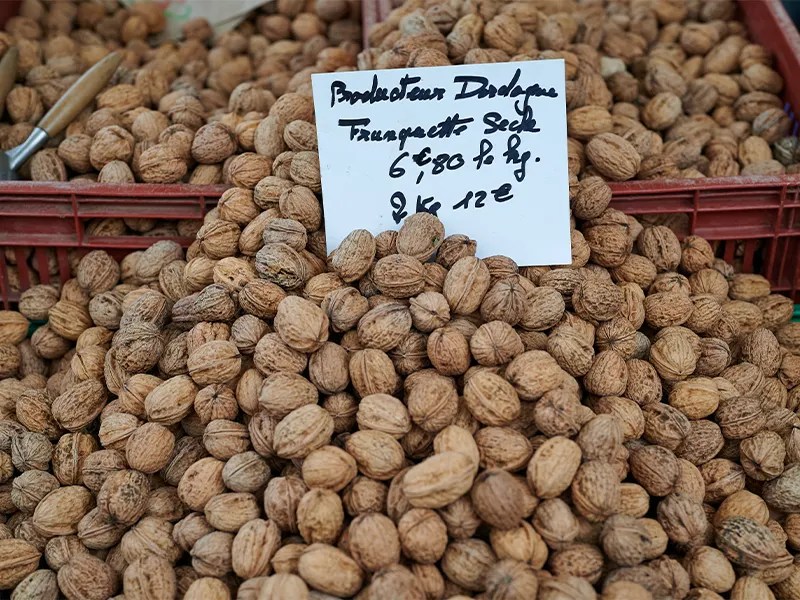
Along with the area beside Halle Brassens, Brive’s market also occupies Halle Gaillarde, a modern, covered hall surrounded by and filled with yet more stalls, including some mouth-watering food stalls, one of which – Le comptoir de Clément – we stop at for a quick bite of lunch. Then it’s off to learn more about noix in the Dordogne Valley by way of one of its favourite tipples.
Walnuts have been cultivated in the Dordogne Valley since the 10th century, although they arrived in France several hundred years earlier, probably brought by the Romans who founded Brive in the 1st century. Today the Dordogne Valley is the largest and most prestigious walnut-growing region in France, and the four varieties grown here – Franquette, Corne, Marbot and Granjean – enjoy AOP (Appellation d’Origine Protégée) status.
Walnut specialities of Dordogne
Along with the mountains of unshelled walnuts on market stalls, you’ll find the Dordogne’s AOP noix making an auspicious appearance in the region’s heavenly gastronomy, of which it’s just as much an essential part as the more celebrated Périgord truffle. At the Abbaye d’Echourgnac west of Perigueux, the Cistercian nuns make Trappe d’Echourgnac, a delicious soft cheese where the affinage (maturation) includes the addition of local vin de noix.
And whether in Brive or further afield in the Dordogne Valley, you’re unlikely to have to go very far before finding yourself with another opportunity to indulge in some Gâteau aux noix – more a tart than a cake, unspeakably moreish and incredibly light. The two quintessential walnut products of the Dordogne however are its walnut oil, and vin de noix (walnut wine), the fortified wine already alluded to. Obviously, you should aim to go home with a bottle of each.
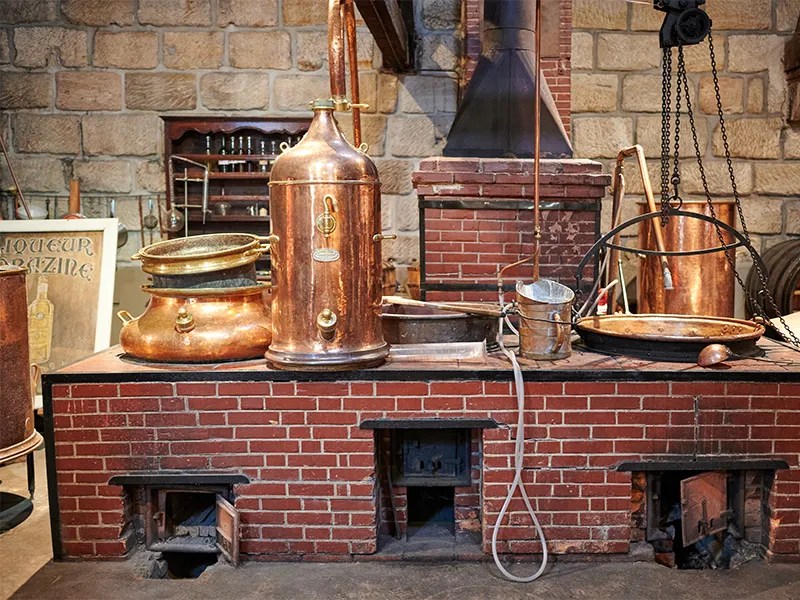
With this in mind, my next port of call in Brive is the Denoix Distillery. Founded in 1839, this is the oldest distillery in Brive, built on the success of its Triple Sec Curaçao and Suprême Denoix – both of which are still produced to the original recipes, along with a number of other drinks, and the company’s Moutarde Violette de Brive. Suprême Denoix, you’ll be pleased to know, was championed in the 19th century for its beneficial qualities which were said to include aiding digestion, reducing fevers, combating cholera and (best of all) its superlative deworming properties. Which wouldn’t sell it as well these days, I agree.
If the 40% strength Suprême isn’t your thing, try their Quinqui Noix, a deliciously smooth vin de noix – served chilled, this is the perfect Dordogne aperitif. The walnuts used for producing vin de noix are harvested in July, when they’re still green and the shells haven’t yet formed (the usual walnut harvest is in October). After being crushed to extract their juice, the latter is mixed with alcohol and aged for six years in oak barrels, before being added to a red or white wine base (white, in the case of Quinqui Noix). For the Suprême Denoix, the distilled and aged walnut juice is blended with Armagnac, Cognac and sugar syrup. The Denoix Distillery is now in its sixth generation, with Paul Bastier along with his wife Marie Denoix having taken the reigns in 2019.
Brive
Before heading out of town to visit Maison Castagné, a walnut oil press on the outskirts of the mind-bogglingly photogenic village of Martel, I wander through the narrow streets of Brive’s old town centre, taking in the Renaissance-era Tour des Èchevins, and the Collégiale Saint-Martin with its striking 13th century nave – look up at the elaborately sculpted capitals on the columns.
The real surprise however is the Musée Labenche, housed in the Hôtel Labenche (one of the finest examples of 16th century Renaissance architecture in the Dordogne). The collections include an astonishing group of six large-scale 17th century tapestries, the work of England’s celebrated Mortlake Tapestry Works near London, along with several more from the Aubusson tapestry workshop in France. And to top it off you’ll find a 19th century baby grand piano which once belonged to Claude Debussy just around the corner in the next room.
Wind your way along the walnut route

On the way to Martel, it would be almost unthinkable not to visit the extraordinary Jardins de Marqueyssac – frankly, some of the most fabulously beautiful gardens I’ve ever seen, with their elaborate boxwood topiary, clifftop paths and strutting peacocks – along with the imposing Château de Beynac and the exceptionally well-preserved Château de Fenelon. Any of these make for an easy day trip from Brive, or you could follow La Route de la Noix, a somewhat less eclectic route than mine which ties together many of the region’s walnut-themed highlights.

Romain Castagné rakes his fingers through the pale, sand-coloured powder, pauses mid-sentence, and brings it up to his nose. It looks for all the world like a pile of sawdust – but the sweet, heavy scent of walnuts gives it away, filling the air to the extent that, if I closed my eyes, I might be standing in a cake shop. There’s a large millstone on one side of the room, and a fire, just stoked, glows orange through the open door of a stove.

Romain is a sixth-generation walnut grower at the Maison Castagné organic farm and walnut mill, together with his brother Adrien who also runs the extremely good Le Petit Moulin restaurant in nearby Martel. Before we head back into the shop for a tasting, he talks me through the process of making walnut oil. After the walnuts have been shelled and sorted, the kernels are crushed by that no-nonsense, 800kg granite millstone – which moves at an alarming pace, pulverising them relentlessly for half an hour and turning the kernels into a dough-like paste. This paste is then roasted in a large tray above a wood stove – the degree to which it is roasted gives the oil its particular flavour – before being placed in a hydraulic press to extract the oil. The oil is left to settle for three weeks in stainless steel tanks before bottling, and the dry, oil-less ‘cake’ left in the press is sifted and sold as walnut flour.
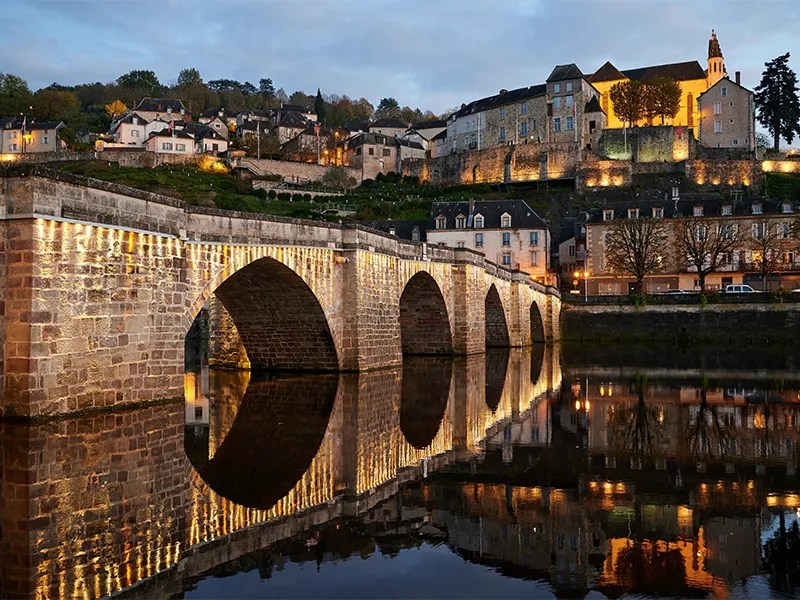
I stop for dinner in Terrasson-Lavilledieu – which looks fantastic in the late evening light, seeming to levitate above the Vézère – and in the morning pay a visit to the hugely impressive 17th century Château de Hautefort, with its immaculate gardens. Then it’s time to head back towards Brive, and my train to Paris – the roads lined with walnut orchards, planted in neat rows and casting long shadows in the sun.
Rudolf Abraham is an award-winning travel writer, photographer, author of over a dozen books and has contributed to many more, and his articles and images are published widely in magazines. rudolfabraham.com
Want more France?
Discover more fabulous destinations in France with our free magazine The Good Life France
Love France? Have a listen to our podcast – everything you want to know about France and more!
All rights reserved. This article may not be published, broadcast, rewritten (including translated) or redistributed without written permission.


