
Visit Narbonne, AKA “the daughter of Rome” on Occitanie’s Mediterranean coast.
Clinking glasses over the first lunch of the holiday, Liz and I already know we have made a good choice. Decades after our first joint venture to France, we are enjoying a bistronomie lunch at Les Tapas de la Clape (tapas-narbonne.fr) within Narbonne’s Art Nouveau indoor food market. And we are toasting the latest in a long line of Best Buddy adventures.
You never forget your first trip abroad with a friend, in our case a teenage language course to Paris. We endured spartan dormitory accommodation and unimaginative food in a rambling 19th century boarding school, but for both of us it was the start of an enduring love affair with France.
So where better to celebrate our latest zero-birthday than back in our favourite country? But for our big birthday celebration, we wanted to feed body and soul with a mix of city break and seaside, culture and gastronomy. So we settled on the heritage city of Narbonne, near the Mediterranean coast of the Occitanie region.
Narbonne, established in 118 BC as Narbo Martius and second most important Mediterranean port in the Roman Empire.
From here we added on visits to Perpignan, once Spanish and still steeped in Catalan culture. And finally Béziers, made prosperous by the Canal du Midi and the 19th century wine trade. Plus some seaside chill-out time at local beach resorts.
All are easy to combine whether you travel by car or, like us, with an Occitanie Rail Pass that allows unlimited regional travel for just €10 a day, pre-bookable online.
Fly into Béziers and it takes just 20 minutes by taxi or shuttle bus from the airport to the station where we board the train for the 13-minute journey to Narbonne in the Aude department. Ten minutes’ walk and we arrive at the 3-star Hotel la Résidence (hotelresidence.fr), a 19th Century mansion in the historic centre. With its twin windows and contemporary décor, our cosy room could not be further from that Parisian lycée!
Narbonne lies behind a large lagoon, bisected in Roman times by manmade dykes leading to the sea. Today, locals head to the nearby resorts of Port-La Nouvelle, Narbonne-Plage and Saint-Pierre-la-Mer for their Mediterranean fix.
Historic Narbonne

The centre of historic Narbonne is bisected by the Robine canal, which links to the Canal du Midi. In the 1880s, this was the only area of France to escape the phylloxera aphid that ravaged vineyards, so the town cashed in, ornate properties springing up along the tree-lined waterway.
We enjoy a glass or two of chilled local rosé over dinner on the terrace at Chez Lulu, where I dine on Medieval-style black pig and lemon meringue tart, all from locally sourced produce. Liz receives good advice on gluten-free options from the staff here, but France generally lags behind Britain in flagging up GF dishes on menus, breakfast being a real issue.
Full marks then to La Résidence who not only serve up a delicious organic breakfast with minimal food miles, but also come up with freshly baked GF bread (advance order appreciated). But as the holiday progresses, few hotels prove equally enlightened, so we advise buying a sliced GF loaf to feed into hotel toasters!
Dominating the historic centre of Narbonne, the Archbishop’s Palace and St Just Cathedral sit side-by-side in the area once occupied by the fortified town. Begun in 1272, the Gothic church boasts the third highest vaulted ceiling in France, soaring to a neck-cricking 41 metres. Construction ground to a halt in 1355 during various adversities and the church was never finished, the back of the chancel still formed by the town wall. Book a guided tour to look down into the 14th century cloister from roof level.
The adjacent Old Palace dates from the 13th century and the New Palace from the 14th, repeatedly modified as the archbishop grew in power. But religious influence came crashing down with the Revolution and the last archbishop went into exile in 1791, his grand palace used first for military purposes, then as a museum and finally as the Town Hall, the neo-Gothic façade added by fanciful architect Viollet-le-Duc who also embellished the fortress at Carcassonne. Discover the ornate apartments by visiting the museums or take a guided tour to discover hidden courtyards and architectural anomalies.
Roman footprint in Narbonne

In the square outside, a section of the Via Domitia or Domitian Way is visible below today’s ground level. Look closely and you can still see the grooves made by Roman cartwheels along the highway from Italy to Spain, an interesting juxtaposition with the branch of Monoprix that occupies the ornate building opposite the Town Hall and was once home to the local Viscount.
Just around the corner, the Promenade des Barques is a delightful place to enjoy a drink beneath the plane trees that fringe the canal. Browse the outdoor market stalls every Thursday and Sunday morning and soak up the daily sights, sounds and smells of the wrought iron and glass covered market on Cours Mirabeau opposite. “It was voted favourite indoor market of the French in 2022. We love to have a tapas style lunch here” say locals Mark and Kay Williams of Real South of France Tours.
Take a cruise
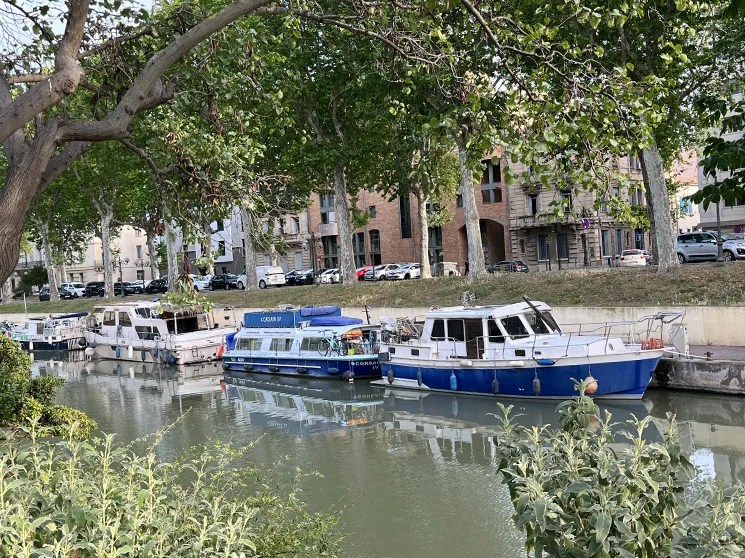
See the town from water level too. On our teenage trip to Paris, Liz and I felt hugely glamorous cruising down the Seine on a tourist boat. Here we toy with the idea of a self-drive electric craft, but opt instead to let someone else do the driving and buy tickets for the Solal (lesolal-narbonne.fr) cruise with commentary in a traditional flat-bottomed boat.
We pass beneath Narbonne’s Pont des Marchands, last remaining residential bridge in France, but today sporting just one arch instead of the seven during the Middle Ages. Beyond the bridge, we pass the home of crooner Charles Trenet, gliding between banks once lined with industries that supported the local wine trade.
Narbo Via

Having grown up in a Roman town in England, our last stop is Narbo Via, a must-see museum of Roman archaeology that opened in 2021 in a building designed on the plan of a Roman Villa designed by Foster + Partners of London.
First things that strike me are the calm atmosphere, the natural light and, opposite the spacious entrance hall, the eye-catching Lapidary Gallery. Composed of 760 funerary blocs arranged warehouse-style on racking, this unique display echoes the streets lined with necropoli that marked the entrance to Roman cities. Each block is accessible in close-up via interactive video screens and we spend ages zooming in to rotate intricate carvings of bulls’ heads and breast plates, floral garlands and coats of arms. Stunning does not even come close.
And the craftsmanship continues. Room after room. Vivid painted walls, intricate mosaics and stone faces so detailed I half expect them to turn and look at me. A married couple hand in hand with age lines on their foreheads. Scenes of daily lives engraved around a rich man’s tomb. Spine-tingling insights into the lives of a rich Roman colony twenty centuries ago, all enhanced by short films in Roman ‘rooms’. We spend an hour absorbed in the exhibits and then set out on a second lap.
We are still talking about Narbo Via as we relax over an al fresco dinner at O Juste bistro beside the canal where a genius formula offers each dish in starter or main course size.
Read about the next leg of this trip – to Perpignan and Collioure in the free The Good Life France Magazine issue no. 40.
By Gillian Thornton, one of the UK’s leading travel writers and a regular writer for The Good Life France Magazine and website.
Want more France?
Discover more fabulous destinations in France with our free magazine The Good Life France
Love France? Have a listen to our podcast – everything you want to know about France and more!
All rights reserved. This article may not be published, broadcast, rewritten (including translated) or redistributed without written permission.


