
Discover the Arts of France. And I don’t just mean paintings and sculptures – I mean the official classified arts of France.
One of the things that I love most about living in France is how the arts and culture are honoured, traditions and history revered. But what I didn’t know before I lived here was that there is an official and surprising classification of the arts that includes some things I’d never have imagined.
Liberté, Fraternité, Egalité, Arty…
The French embrace culture wholeheartedly, learning, creating and cultivating knowledge – it’s a way of life from the first days of school. Cultural pursuits are valued in France and there is a concerted effort by government authorities to support the arts – not just paintings in museums or sculptures in parks – it goes way beyond that.
From a lecture by an expert at a local museum to the grand public buildings that are preserved and cherished all over France, the French take pride in the rich culture and heritage of their country. There is a very deep-rooted support of the arts in France, and I have often stood in a queue for a vernissage, a formal preview of an art exhibition, and been amazed to see even very young children standing in line. Art and culture are a family affair here. Cities and towns are proud of their museums and galleries and even small towns with small populations often feature museums.
Art is everywhere, in every city and every town where many different architectural styles decorate the landscape, from Medieval to Gothic, Renaissance to Romanesque, Rococo to Neoclassic, Haussmannian to Contemporary.
French art is officially categorised
But now, let’s talk about that official classification of the arts that I mentioned, and I think you might be surprised! When I first came to France, a friend mentioned an exhibition of the ‘7th art’. I had no idea what she was talking about, but I soon learned.
To the French, culture and the arts are as essential to living life well as good food and wine. And in France, the arts are officially classified. This is all down to a German philosopher by the name of Georg Wilhelm Freidrich Hegel who was born in 1770. His thesis stated that art is a uniquely human activity. That the product of this activity or the idea that one has of it deliberately addresses the senses, the emotions and the intellect. He concluded that art is unique to man, distinguishes man in nature and that the activity of art has no clearly defined functions.
The origins of categorising art go back to Greek antiquity and the nine muses, the daughters of Zeus and their arts: eloquence and epic poetry, history, lyrical and choral poetry, music, tragedy, rhetoric, dance and choral singing, comedy and astronomy. Hegel’s work classified the five major arts – a perspective that was received with huge enthusiasm in France. Since then, the list has been expanded and the arts are commonly referred to by their place in the list, like my friend talking to me about an exhibition of the 7th art.
Discover the arts of France
French Architecture

Let’s take a look at them in order starting with the First Art – Architecture as an expression of culture. It’s about buildings that have beauty, fulfil a function, and enhance the social environment and more. They can be religious buildings, commercial, institutional, castles, churches, houses. The first art refers to architecture that can be old or new – prehistoric to modern day. You’re so surrounded by amazing architecture in France, the palace of Versailles, the buildings of Bordeaux, the Flemish facades of Lille, the modern style of Le Havre, the medieval buildings of Sarlat, the citadel of Carcassonne, the Cathedral of Notre Dame in Paris…
Sculpture

The second art is Sculpture. The word comes from the Latin word sculpere which means to “cut” or “remove pieces from a stone”, reflecting the idea of stone modelling that was common in Roman times, but the second art includes welded sculptures – and all forms of sculpture. It’s really really hard to choose a favourite French sculpture – there’s the Statue of Liberty which resides in New York. There’s Rodin’s Thinker which you can see at the Rodin museum in Paris, and I really love to walk in the Tuileries Gardens in Paris, by the Louvre which is packed full of statues and sculptures, as are the city’s bridges and parks.
Visual Arts

Now to the third art: Visual arts – paintings and drawings. And where do I start? France has literally thousands of museums including the Louvre, the world’s biggest museum with about 400 rooms, if you were to look at every piece of art on display in this museum alone and spend just 30 seconds looking and you didn’t stop for lunch or anything – it would still take you more than 12 days to see it all.
Music
The 4th Art is Music. And France loves its music. Pretty much every town has a music venue, concerts and live performances are a way of life, there are music festivals galore and even a nationwide day of music – the Fete de la Musique every June.
Literature

On to the 5th Art: Literature, poetry and writing in general. A topic close to my heart – I practice the 5th art as a writer. I love that in France writers are really appreciated. The longest book ever published was by Frenchman Marcel Proust. Called A la Recherche du Temps Perdu which means remembrance of things past it has an estimated 1.3 million words and it also has one of the longest sentences – at 958 words without a full stop!
Performing Arts

The 6th Art – the Performing arts, which includes dance, theatre, mime and circus. The art of miming, performing without speaking, is very popular in France which I find a tad strange since French people just love to talk!
Mime is an ancient art and French people love it. When you ask people to describe an image of a French person, they will often describe a man with a moustache in a stripy t-shirt and beret, perhaps with white face paint and white gloves, and deep red lips and painted on eye lashes – they are describing a mime artist. Frenchman Gaspard Deburau who was born in 1820 is seen as the father of French mime but most people know it through Marcel Marceau who created the persona Bip the Clown. You often see mime performed in the streets of French cities to this day.
The art of cinema

The 7th Art is cinema – the one my friend mentioned that led to me looking to this whole art classification business. Cinema is a big part of French culture, and filmmaking, considered an art, is supported by the Centre National du Cinéma. It’s claimed that Paris has the highest density of cinemas in the world. And of course, we have the French to thank for cinema in the first place, thanks to the Lumière Brothers, Louis and Auguste. They combined cutting edge picture breakthroughs at the time to create the first film in spring 1895 called “workers leaving the Lumière Factory.” They worked in photography already and their dad saw a machine Thomas Edison had invented which was on show in Paris which people could peep through a hole to see a strip of photos that looked like they were animated, like film. He told his sons about it and hey presto – they invented film!
The very first public film screening was in Paris on December 28 1995 at the Grand Café – it was an absolute sensation. They later made a film of a moving train and people were said to panic and run out the door as it seemed so real. It was only about 50 seconds long and there’s no evidence that people really stampeded but it must have seemed absolutely incredible to people then. The Lumière Brothers also presented the very first newsreel which was about a French photography conference, and the first documentary – about Lyon’s Fire Department (the brothers lived in Lyon). They sent teams of camera men around the world to make, and show films. Movie lovers shouldn’t miss Lyon for its museum and Paris for its amazing cinemas including Studio 28 in Montmartre which is the one that you see in the film Amelie. Salvador Dali used to go there, and artist Jean Cocteau designed the projection room, and it has a lovely little garden too!
The Media as a form of art
The 8th Art – the Media – radio, television, photography. Media arts is a relatively new art on the list and dates to 1941. Did you know that by law in France, at least 40% of the music played by radio stations must be French.
Comic art

The 9th Art is – and this might surprise you – Comics. Yes, comics are a respected art form in France where it is called bande desinée – literary a strip of drawings but it means comic strip. In the city of Angouleme in the Charente region there is a world-famous museum dedicated to this art: La Cité Internationale de la Bande Dessinée et de l’Image. And every year at the end of January the city hosts a huge annual comic festival. And the street signs are like comic strip speech bubbles! One of the most famous heroes in France is Asterix, a character in a series of comic books that tell tales of a small Gallic village on the coast of France attempting to defend itself from invaders, namely the Romans. He’s seen as the ultimate Frenchman and is so popular there’s even an Asterix theme park!
Comics in France became popular at the beginning of the 20th century when a magazine editor in Paris used a little drawing of characters with words to use as a filler for a blank space and people thought it was great and the practice spread. In America comics generally had humourous story lines so they called it comic which sounds like it’s not to be taken seriously. While in Europe it’s called bande desinée – strip art and it’s considered a serious art – graphic story telling.
Video games and digital art
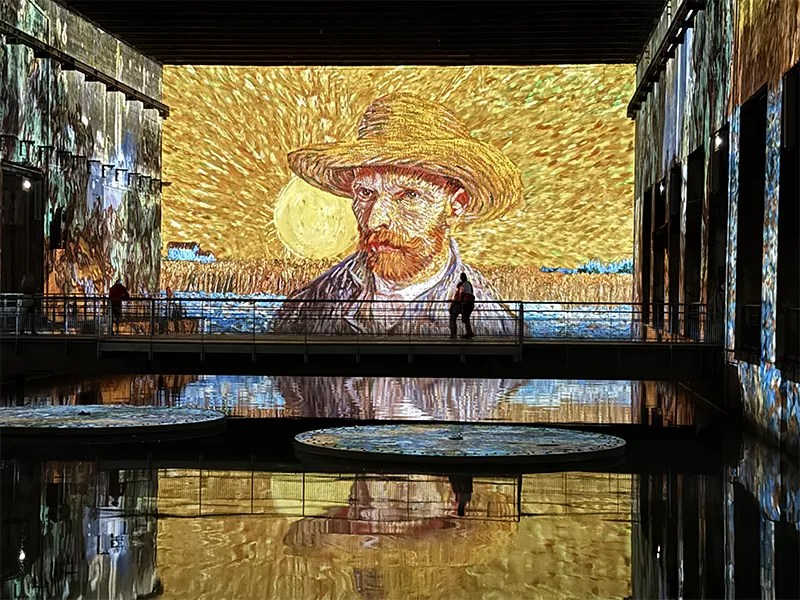
The 10th Art is also a very new one, it covers video games or digital art forms. And my favourite place in France for understanding digital art is the Bassin des Lumières in Bordeaux. A former U-boat station, the watery basins are now a huge and incredible art venue. The first time I went there, I was so overwhelmed by the beauty of the art projected into the walls it actually made me cry.
The arts and culture of France are fiercely protected by the academies of France, which include L’Académie française, set up in 1736 by Cardinal Richelieu to watch over the French language; l’Académie des Inscriptions et Belles-Lettres Academy, set up in 1663 to promote historical and classical knowledge; l’Académie des sciences, created in 1666; l’Académie des Beaux-Arts, which has been going since 1816; and l’Académie des Sciences Morales et Politiques, founded in 1832.
From the silver screen to literature, the French love to honour the artists who have helped to shape their nation, each leaving their own mark on the country’s psyche and how the French consider themselves and the world, whether they’re reading a comic or listening to the radio.
And I love that these classifications of the arts pretty much makes artists of us all – from taking photos, to learning how to play a musical instrument, drawing comic strips, painting, pottery – almost everyone practices one of these arts, we’re all artists, but in France, we know it!
Janine Marsh is the author of several internationally best-selling books about France. Her latest book How to be French – a celebration of the French lifestyle and art de vivre, is out now – a look at the French way of life. Find all books on her website janinemarsh.com
Want more France?
Discover more fabulous destinations in France with our free magazine The Good Life France
Love France? Have a listen to our podcast – everything you want to know about France and more!
All rights reserved. This article may not be published, broadcast, rewritten (including translated) or redistributed without written permission


