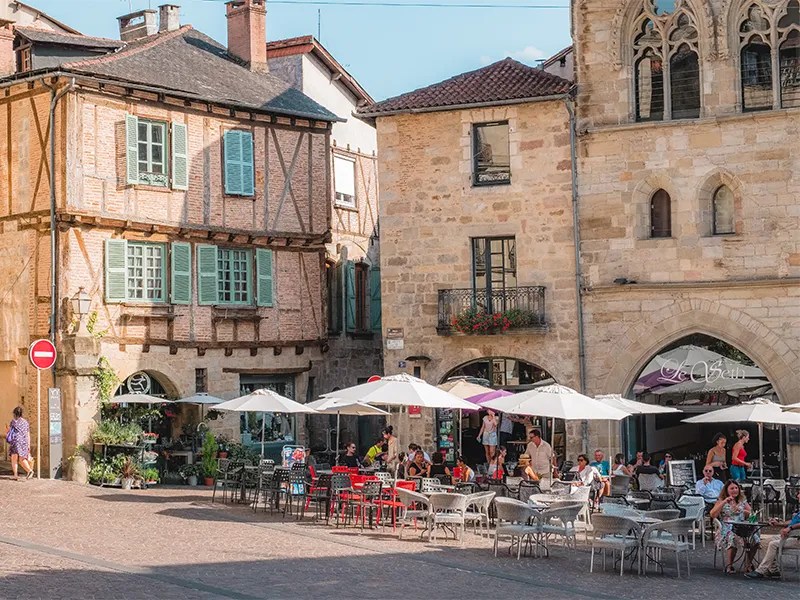
Explore the pretty town of Figeac and the surrounding countryside of the glorious Célé Valley – and you’ll find a slice of authentic France that’s just brimming with beauty, culture and history…
A modest market town in rural Lot isn’t the first place you might expect to find connections between Napoleon Bonaparte, Ancient Egypt and the British Museum. But thanks to the inquisitive mind and dogged determination of 19th century linguist and puzzle supremo Jean-François Champollion, the medieval town of Figeac in Occitanie provides a link to all three.
This buzzing town of around 10,000 inhabitants lies just north of the Lot river in the valley of the Célé, the surrounding area of Grand Figeac designated a Pays d’Art et d’Histoire. With its wealth of medieval buildings, Figeac is a gem for heritage fans, but it has Champollion to thank for its place on the world stage.
The Rosetta Stone is deciphered
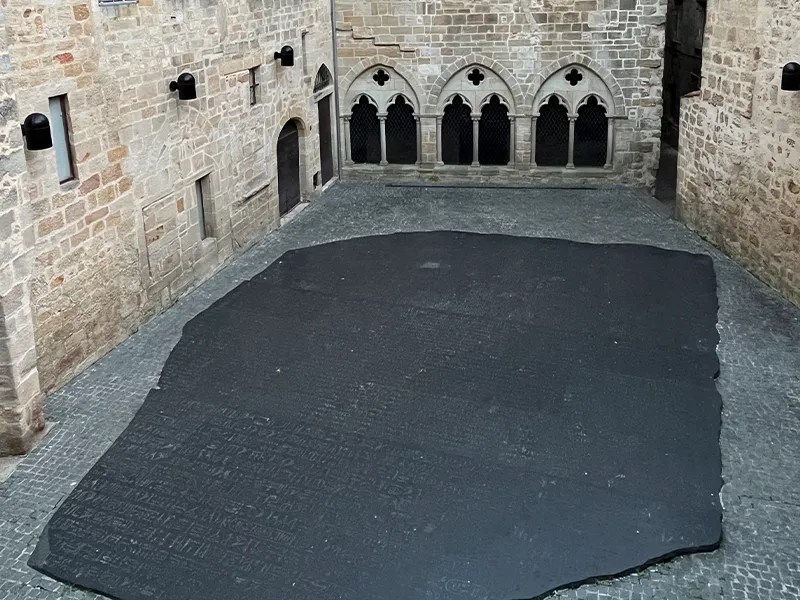
I’m looking down from a high-level garden in the town centre onto a small pedestrian square surrounded by stone buildings. Little more than a courtyard, the Place des Ecritures is empty apart from an irregular slab of black granite covering most of the floor. A dignified celebration of Figeac’s most famous son.
In 1798, Napoleon launched a campaign in Egypt and Syria to defend French trade interests and carry out scientific research. But when the British Navy put paid to the Emperor’s dreams of a Middle Eastern empire, the collection of Egyptian antiquities amassed by his scientists was signed over to the British, including the Rosetta Stone that now stands in the British Museum in London.
Once part of a much larger stone tablet, this precious fragment was engraved with three incomplete texts in different scripts, but nobody knew what they said. Academics puzzled for years, but it was more than 20 years before the youngest son of a Figeac bookseller eventually cracked the code. Born in 1790, Jean-François Champollion had left home at 11 to live with his older brother in Grenoble, where he quickly developed a passion for Middle Eastern languages, and at 17, he moved to Paris, determined to decipher the mysterious tablet.
‘Je tiens l’affaire !’ (I’ve got it!) he declared in September 1822 on realising that the system of Egyptian hierogylphs is in fact a complicated mix of sounds, words and ideas. It had taken 10 years of painstaking study, but Champollion now understood that the Rosetta Stone was inscribed with a royal decree. The discovery enabled him to identify many temples during an expedition to Egypt; pass his skills on to other keen Egyptologists; and become conservator at The Louvre in Paris, but in 1832, Champollion died suddenly of a stroke, aged just 41.
Today, the square in front of his family home is named in his honour and his birthplace transformed into the fascinating Champollion Museum, that showcases not only his own discoveries but also the history of written communication across the world. From the upper storey, the museum balcony looks out over the rooftops of medieval Figeac; behind it, accessed down a narrow alley, lies Place des Ecritures.
Figeac town

The neighbouring squares of Place Champollion and Place Carnot have been the centre of local life since medieval times. From Carnot, head to the Tourist Office in Place Vival to pick up a free annotated map highlighting 30 key heritage buildings around the historic centre. Palais Balène, for instance, largest medieval house in Figeac. The Abbey church of St Saviour, begun in the 11th Century. Renaissance town houses and the 17th Century town hall.
And to fully experience that medieval atmosphere, book a room at the Mercure Figeac Viguier du Roy, home to the King’s representative in Figeac for more than four centuries. Gradually expanded to take in adjoining buildings, this unique hotel just off Place Champollion overlooks tranquil courtyard gardens and an outdoor pool, combining ancient stones with modern interiors that reflect Champollion’s work on Egyptian hieroglyphs.
As evening falls, the café terraces are buzzing when I head out for dinner at Le Safran, a spacious restaurant in a vaulted stone dining room. Specialising in seasonal fish, ‘The Saffron’ takes its name from the spice grown here in the Quercy region since the Middle Ages and the word for the rudder of a fishing boat.
What to see and do near Figeac
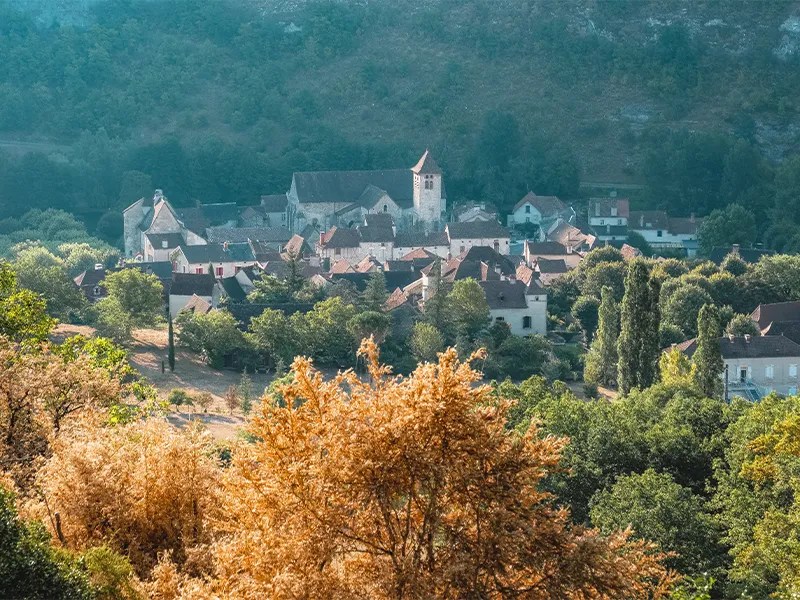
Next day, I head out into the surrounding countryside. Figeac is a scenic 2.5-hour train ride from Toulouse, but travellers who arrive by car can pootle along the delightful Célé Valley that wriggles its way westward from Figeac through a succession of sleepy villages to join the Lot close to St Cirq-Lapopie.
I stop first at Espagnac-sur-Célé, relaxing over coffee in the courtyard of the ancient priory beneath a turreted bell tower, a landmark for pilgrims on the GR65 route to Compostela as well as for local hikers and bikers. A few meanders further on, I stop again to explore the bijou community of Marcilhac-sur-Célé, a tranquil spot to chill out on a riverside bench or wander amongst the ruins of the ancient abbey.
And I’ve been recommended to take the broad path up to a viewpoint above the nearby village of Sauilac-sur-Célé. In the 19th century, this track led to a clutch of properties nestled beneath the sheer limestone cliff, but today the only reminders of the original village are ruined masonry and a period photo beside the trail, the inhabitants having long since relocated to the flat land below.
Pech Merle
West of Sauilac, after a series of tight bends, the Célé flows through Cabrerets to join the Lot on its journey to Cahors. Don’t carry on without visiting Pech Merle, a series of prehistoric painted caves that make the civilisation of Ancient Egypt look like a newcomer. This is my second visit, but I’m just as bowled over by the variety of the artwork, the geology of the caverns, and the story of how Paleolithic paintings were discovered in 1922 by three local teenagers.
Some 800 motifs of various sizes and levels of completion decorate the walls, including more than 70 animals. Mammoths are the most popular subjects with 28 individual images but there are horses, bison, aurochs and even a lone bear. Human representations too including a wounded man and mysterious ‘bison-women’. The subterranean circuit stretches for around 600 metres with stairs between various levels, and expert guides ensure that visitors see the most important images, tracing some of the less distinct outlines with their laser pens.
The experience is so vivid, so strangely in the moment, that I find I’m constantly expecting to round a corner and find a Paleolithic painter hard at work with his red and black paints. I’m fascinated by the handprints, large and small, made by blowing powdered pigment at a palm placed on the wall, and by the Black Frieze depicting 25 animal figures on a 7-metre panel. But my imagination goes into overdrive as I look down on a child’s footprint, preserved for millennia in fossilised mud. Who was this young person and did he or she mischievously make those handprints whilst mum or dad was busy painting a mammoth?
It’s all humbling stuff, guaranteed to stay in the mind long after you are back out in 21st century daylight. And as I look at the vibrant frieze of spotted horses, a mere 29,000 years young, I can’t help wondering what Monsieur Champollion would have made of it all. Heads held high, the spotted equines trot proudly across the rock face into eternity, a snapshot of the past that even he would have struggled to decipher.
Useful info: visit-occitanie.com/en; tourisme-figeac.com
By Gillian Thornton, one of the UK’s leading travel writers and a regular writer for The Good Life France Magazine and website.
Want more France?
Discover more fabulous destinations in France with our free magazine The Good Life France
Love France? Have a listen to our podcast – everything you want to know about France and more!
All rights reserved. This article may not be published, broadcast, rewritten (including translated) or redistributed without written permission.


