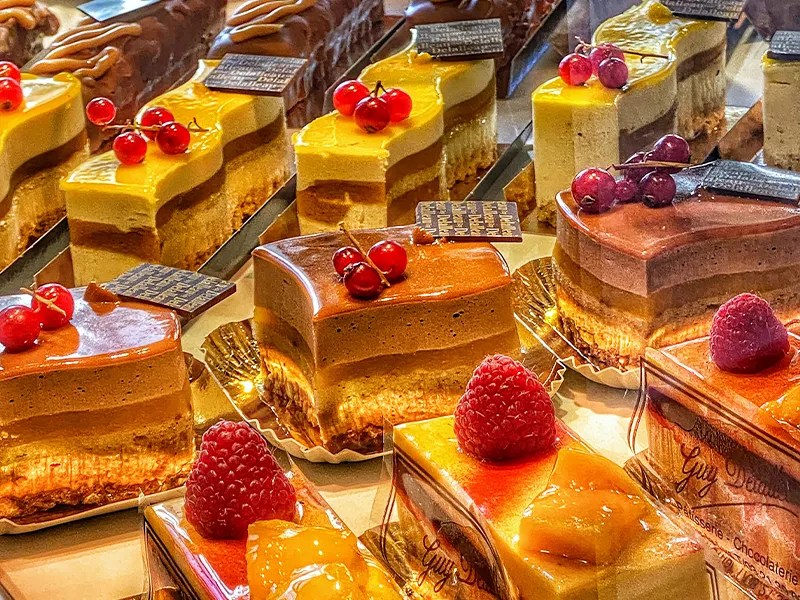
If there was an award for the country producing the world’s best pastry, France would steal the prize, a cliché in its predictability. But while we all love to indulge in the sweet delights of French patisserie – many of the greatest cakes came into being by pure good luck says Ally Mitchell.
Let’s take a look at three iconic cakes of France – crowning achievements, glittering in buttery splendour, and sugary sumptuousness – to assess just how amazing it is that we have these legendary cakes at all!
Kouign Amann

Described as “de l’or en beurre” – gold in butter – the kouign amann (kween a-mahn) is likely to be the best pastry most visitors have never heard of. While its Breton name reveals its origins, it easily confuses non-French speakers as the ancient language is so dissimilar to anything resembling classic French. Kouign means “cake” or “bread”, and amann means “butter”, getting to the crux of the pastry’s ingredients.
The kouign amann originates from Finistère, literally meaning “end of earth” at the very tip of Brittany, where in 1860, in a boulangerie in the port town of Douarnenez, history was made – almost by accident.
Baker Yves-René Scordia had run out of cakes to sell, so decided to improvise with leftover flour, butter and sugar, laminating the layers as he did with croissants, twisting them into puff pastry swirls. Their success was immediate thanks to the custardy soft centre and the caramelized, chewy crust. Equal parts butter and sugar, it is far more calorific than it looks. The New York Times even described it as “the fattiest pastry in all of Europe”. It is, after all, the ideal crunchy, sticky vehicle to flaunt the region’s gold – Brittany’s salted butter. The ratio is still followed to this day: 30% butter, 30% sugar, 40% flour.
While there has been inevitable dispute over the kouign amann’s exact origins, in 2017, a plaque was unveiled in Douarnenez stating that the pastry “was invented right here, in 1860, in the Crozon bakery by Yves René Scordia.”
Determined to preserve the pastry’s heritage when faced with poor modern-day copies, Douarnenez’s boulangers united in 1999 to form an association for the “authentic kouign amann”, forever marking this delicious happenstance with a strict list of specifications. They also choose not to participate in Brittany’s annual competition for the best kouign-amann, as, even though the competing pastries are acknowledged to be excellent, they are “not kouign amann”.
Paris-Brest
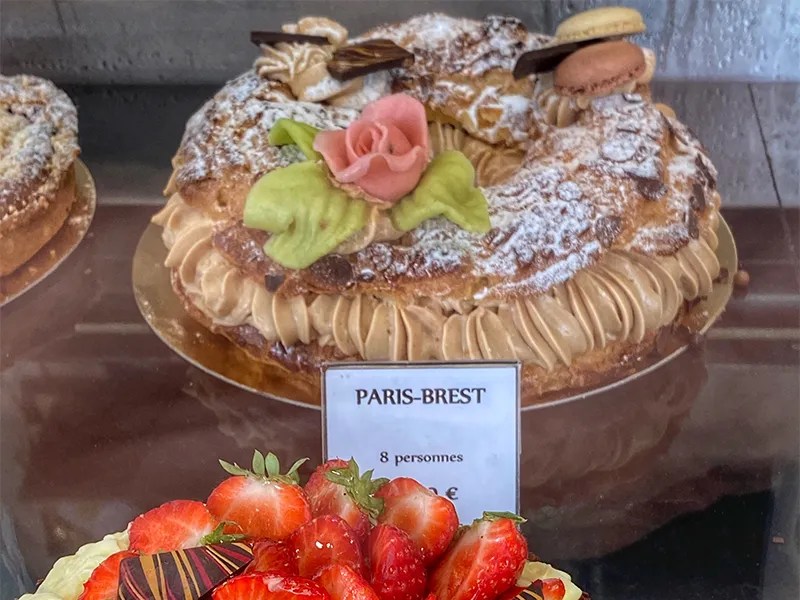
A crème-filled pastry honouring an intensive sporting event reads like a juxtaposition, but this is precisely how the famous Paris-Brest cake came into being.
In 1891, Pierre Giffard, a sports journalist and editor of Le Petit Journal newspaper, wrote La Reine Bicyclette – a four-page article on the virtues of cycling. That same year, he founded the Paris-Brest bicycle race, totalling 1,200 km of road from Paris to Brest in Brittany and back again. 200 racers participated in what is now considered to be the oldest cycling race in the world (today up to 8000 riders take part in the race held every four years), and forerunner to today’s Tour de France.
In 1910 Giffard asked pâtissier Louis Durand from Masions-Laffitte near Paris to concoct a pastry in the race’s honour. Durand took inspiration from the bicycles themselves. He piped and baked a wheel of choux pastry, which he then halved and filled with hazelnut crème mousseline – a velvety blend of vanilla crème pâtissière, hazelnut praline and whipped butter – which he piped with a fluted tip, possibly to evoke the bicycle spokes.
The Paris-Brest pastries were an immediate success, not only for their delicious sweet nutty flavour but also because of their high calorie content – which is something those of us not racing 1,200 km should dare think about. Legend goes that the finishing racers were showered in pastries as they crossed the finishing line, the perfect reward for a victorious finish!
A moment of creative innovation resulted in one of the most beloved pastries in France, spreading beyond the cycling community and now devoured worldwide – although the original recipe still resides in Masions-Laffitte.
Macarons
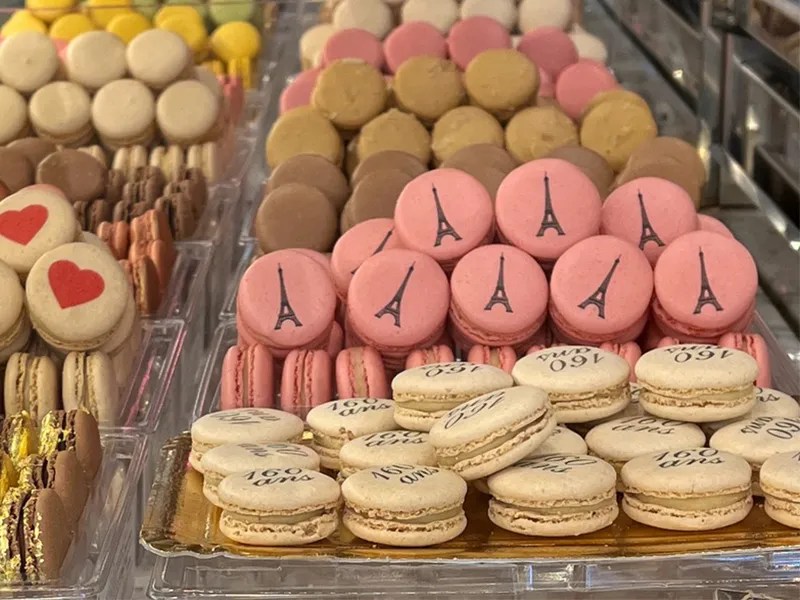
Pretty pastel-coloured macarons – made with egg whites, ground almonds and sugar and sandwiched with ganache – have long been in vogue. When the iconic Maison Ladurée opened in New York in 2011, queues formed around the block. The Parisian branch of the patisserie had developed a cult following thanks to their stylish interiors and, of course, their macarons, which were said to have inspired the spring collections of 2013’s New York Fashion Week.
These iconic “Paris style” sandwiched macarons do not indicate their humble origins. Some speculate that the almond biscuits came from the Middle East. According to one theory, in the 16th century, Catherine de Medici brought macarons with her from Italy when she came to marry French King Henri II in 1559. At some point, however, the macaron became a national treat, popping up in Picardy, Ardèche, the Basque Country, Saint-Emilion and Nancy as the regional “speciality”.
That said, Maison des Soeurs in Nancy may have the final say. In the 18th century, two nuns, Marguerite Gaillot and Marie Morlot, lived in the city’s abbey until the revolution when a decree abolished religious congregations. The nuns managed to escape by finding sanctuary with a local doctor and sold macarons to pay for their keep, becoming “the macaron sisters”. The recipe was passed down through Marie’s niece and hasn’t changed in those 230 years since.
Unlike modern macarons, these are pale brown and cracked across the surface. It wasn’t until 1930 when Parisian pâtissier Pierre Desfontaines – incidentally a cousin of the Ladurée founder – sandwiched them with ganache. Flavours and fillings followed, leading to our modern international craze of the macaron as haute patisserie. All thanks to the sharp wits, and some could say good fortune, of two nuns claiming asylum.
Three of France’s most decadent and famous pastries came about because of – what seems to be – fortuitous timing, but really, I think it’s because the French simply understand their patisserie. The kouign amann, the Paris-Brest and macarons are completely different specimens, but altogether, they represent a refined palate and a dedication to a form of art.
And this is the reason why France would take home the pastry gold – every time.
Ally Mitchell is a blogger and freelance writer, specialising in food and recipes. She lives in Toulouse and writes at: NigellaEatsEverything.
Want more France?
Discover more fabulous destinations in France with our free magazine The Good Life France
Love France? Have a listen to our podcast – everything you want to know about France and more!
All rights reserved. This article may not be published, broadcast, rewritten (including translated) or redistributed without written permission.


