
Time travel via France’s imposing and varied places of worship. Gillian Thornton looks at the sacred architecture of France…
Step back in time – the sacred architecture of France
No religious beliefs of any kind are needed to appreciate the monumental cathedrals, intimate chapels, and fortified churches that have been the hub of community life across the centuries. Some carry UNESCO World Heritage Status, but all are testament to the skills and dedication of architects, stonemasons, and labourers.
Who were the men who erected those massive towers with only medieval technology; carved intricate stonework high above the ground; and created dazzling stained glass windows in jewel colours? Centuries on, we can only wonder and look on in awe at their handiwork.
Cathedrals and stained glass
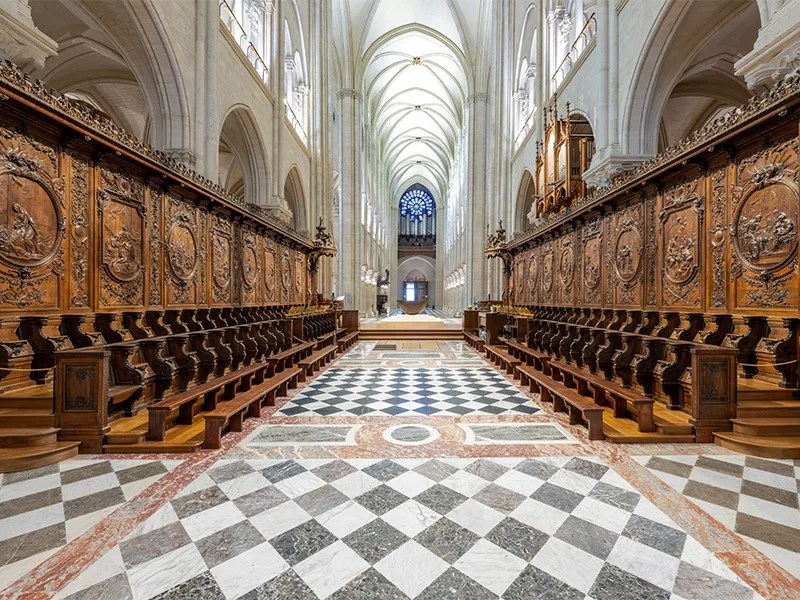
The world watched in horror on 15 April 2019 when fire broke out in the roof space of Notre-Dame de Paris, destroying the spire and burning through the roof timbers. It’s now beautifully restored, and Paris has other important churches too. Almost every French king from the 10th to the 19th century is buried at the Basilica-Cathedral of Saint-Denis, one of the earliest examples of Gothic architecture. But whilst royal funerals took place in Paris, coronations were celebrated at Reims Cathedral in the heart of Champagne, a jewel of Gothic art where Clovis, King of the Franks, was baptized in 498.
Reims Cathedral is home to 2,303 statues and some outstanding stained-glass windows, the medieval way of bringing Biblical stories to a population that mostly could not read. Discover the skills of the artisans at the Stained Glass Centre in Troyes and the International Stained Glass Centre in Chartres before admiring their work in the cities’ churches. And for a contemporary slant, don’t miss the rainbow of glass panels set in the concrete tower of the Church of Saint Joseph in Le Havre.
With their towers and spires, flying buttresses and carved facades, Gothic cathedrals grace many northern French cities including Amiens and Bourges, Strasbourg and Laon. But head south and churches take on a very different style. The Romanesque-Byzantine Cathedral of Saint-Front at Périgueux in the Dordogne is topped with five 18th century cupolas, whilst the Cathedral of Sainte-Cécile at Albi in Occitanie has a different aspect again.

Largest brick cathedral in the world, Albi’s unique church was begun in 1282 and took 200 years to complete. It is also the largest painted cathedral in Europe and the wow-factor ramps up even more as you step inside. Expect bible stories and geometric patterns created by Renaissance artists in brilliant colours alongside intricate sculpted figures.
Ancient and modern
Albi may be the largest painted church, but smaller churches can also pack a punch with their rainbow interiors. Amongst my favourites is the Basilica of Saint Julien de Brioude, largest Romanesque building in Auvergne with painted pillars and a mosaic floor made of river pebbles. And in Lower Auvergne, the abbey church of Saint-Astremoine is a masterpiece of 12th century Romanesque art with its forest of painted columns.

Most abbey churches were more sombre, but they still have the power to impress. Take the Royal Abbey of Fontevraud in the Loire Valley, last resting place of English Plantagenet monarchs Henry II and his wife Eleanor of Aquitaine, their son Richard Coeur de Lion, and their daughter-in-law Isabelle of Angouleme, widow of King John. A vast complex headed by an abbess with four priories for both men and women, Fontevraud has been repurposed as a centre for art and culture, complete with art gallery, atmospheric hotel and a Michelin-starred restaurant inside a bijou cloister.
Many French churches still boast a tranquil cloister, but it is hard to top the Romanesque splendour of Moissac Abbey in Tarn et Garonne. One of the most important Benedictine monasteries in the Middle Ages, Moissac is listed by UNESCO for its intricately carved capitals and tympanum. Also classified for its sculptures is the ‘double decker’ cloister of Saint Trophime at Arles in the Rhône Valley; head to the upper storey for some unique ecclesiastical views.
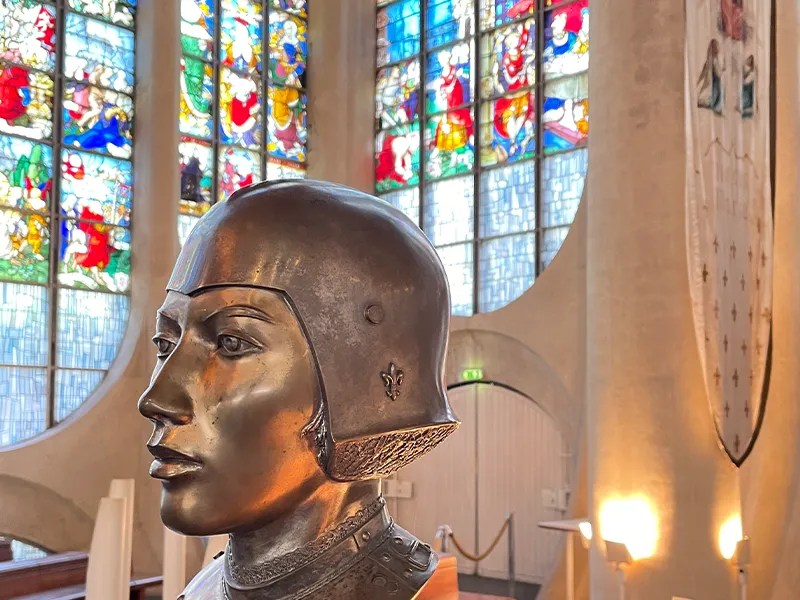
In Normandy, Rouen’s magnificent cathedral – home to the heart of Richard Coeur de Lion – could not be more different from the Church of Saint Joan of Arc, completed in 1979 in the market square where the peasant girl from Lorraine burned at the stake in 1431. The modern design evokes the sea with its slate and copper scales, but inside, visitors are treated to the brilliant stained-glass windows from the Church of Saint Vincent, destroyed by air raids in 1944.
For another striking example of 20th century religious architecture, head east to Franche-Comté to visit Notre-Dame du Haut at Ronchamp, built by Le Corbusier in 1955 in a hilltop woodland clearing between the Vosges and the Jura. Asymmetrical in design, its curved walls support a roof shaped like a crab shell.
Out of the ordinary

The atmosphere at Ronchamp is tranquil in the extreme but religion did not always guarantee a quiet life. In northern France, on the borders between Champagne and Picardy, Hauts de France and Ardennes, the area of Thiérache often came under attack in the 16th and 17th centuries, so locals fortified more than 60 churches with gates, towers and casemates as places of refuge. Check out churches such as Plomion, Parfondal and Montcornet in Aisne, Aouste and Rouvroy-sur-Audry in Ardennes.
Other French churches recall conflict on a truly international scale. Right across Northern France from the Channel coast to the Marne Valley and the Vosges, many battlefield sites from two world wars incorporate a chapel of remembrance. Each one is moving in its own way, but one that particularly sticks in my memory is Notre Dame de Lorette at the French national cemetery near Arras. Here in the tiny chapel overlooking lines of headstones, a tablet commemorates Francois Faber from Luxembourg. Winner of the 1909 Tour de France, Faber died in 1915 but his name lives on here more than a century later.
Other churches are memorable for the sheer beauty of their location. On the Atlantic coast of Charente-Maritime in the walled village of Talmont-sur-Gironde, the 12th century church of Saint Radegonde watches over the largest estuary in Europe, nestled within the ramparts that encircle the promontory. Built in 1284 on the orders of Edward I of England, Talmont is today classified amongst Les Plus Beaux Villages de France and is a stop on a pilgrims’ route to Santiago de Compostela.
Nor is Saint Radegonde the only ecclesiastical building with a sea view. The small church of Saint-Valery at Varengeville-sur-Mer in Normandy not only boasts a commanding position, but also an association with leading artists. Impressionist maestro Claude Monet painted here and George Braque, a pioneer of Cubism, designed the church windows. Braque died in Paris in 1963 but rests here in the clifftop cemetery of Saint-Valery.
So, wherever you roam in France, take time out to investigate the local churches, however grand or humble. Within their sacred walls lies the history of a nation.
By Gillian Thornton, one of the UK’s leading travel writers and a regular writer for The Good Life France Magazine and website.
Want more France?
Discover more fabulous destinations in France with our free magazine The Good Life France
Love France? Have a listen to our podcast – everything you want to know about France and more!
All rights reserved. This article may not be published, broadcast, rewritten (including translated) or redistributed without written permission


