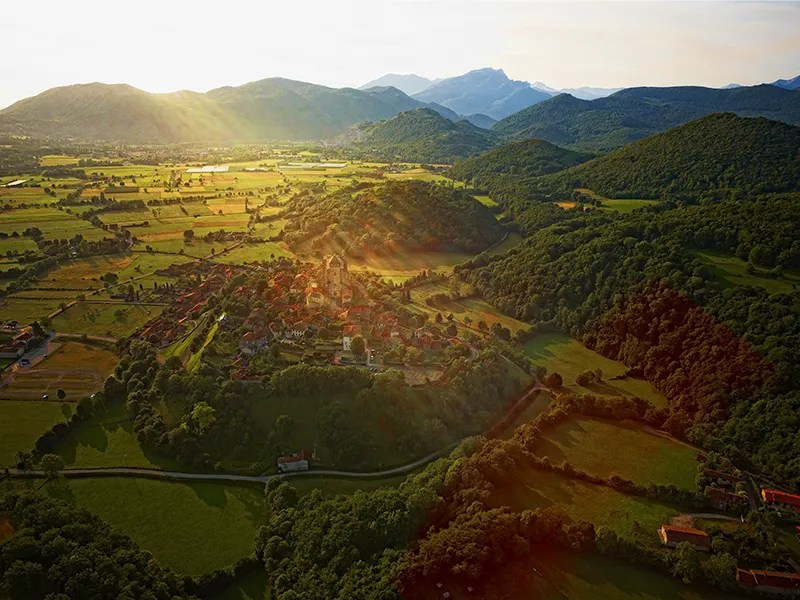
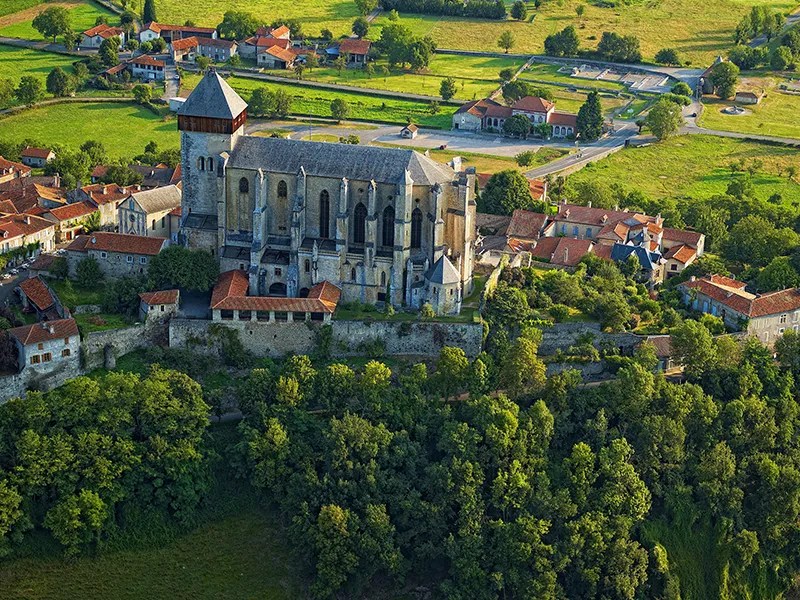
It’s an unforgettable sight: the teensy village of Saint-Bertrand-de-Comminges squeezed on an isolated promontory under a mightily-buttressed Gothic church. Before Lourdes, this inland Mont-Saint-Michel was the religious centre of the Pyrenees. Today it’s an ideal spot for a tranquil stay says Dana Facaros.
Salome woz here
Saint-Bertrand-de-Comminges in Haute-Garonne, southwest France, is officially one of the prettiest villages of France (Plus Beaux Villages). The ancient Celts called it Lugdunum, the ‘Citadel of the Sun’ for its temple dedicated to the sun god Lug. By 76 BC, the only tribes left in the area were the Iberian Convenii, ‘robbers of souls’, hombres so tough that even a great Roman general like Pompey preferred to win them over by kindness; he declared them to be Romans and granted them the territory, henceforth called Lugdunum Convenarum.
The Convenii turned out to be excellent citizens. Lugdunum thrived, and was important enough to host the exiled Herod Antipater, wife Herodias and her daughter Salome. Some six centuries later, in 1083, Bertrand de l’Isle-Jourdain, cousin of Count Raymond IV of Toulouse (leader of the First Crusade) was appointed bishop of Convenarum, now called Comminges and was canonized in 1175.
In the late 1200s, Bertrand de Got of Bordeaux (later Pope Clement V) rebuilt the cathedral of Sainte-Marie and encouraged pilgrims to visit St Bertrand’s tomb. Today, the pilgrims are back, it’s a stop on the Piedmont Pyrenees Way to Compostela and a World Heritage Site.
Plus a crocodile and a unicorn
Few cathedrals enjoy such a majestic setting. At night, when it’s illuminated, it appears to float like a golden ship over the mountains. Walk up through the medieval gate and note the pagan tombstones from Lugdunum embedded in the tower.
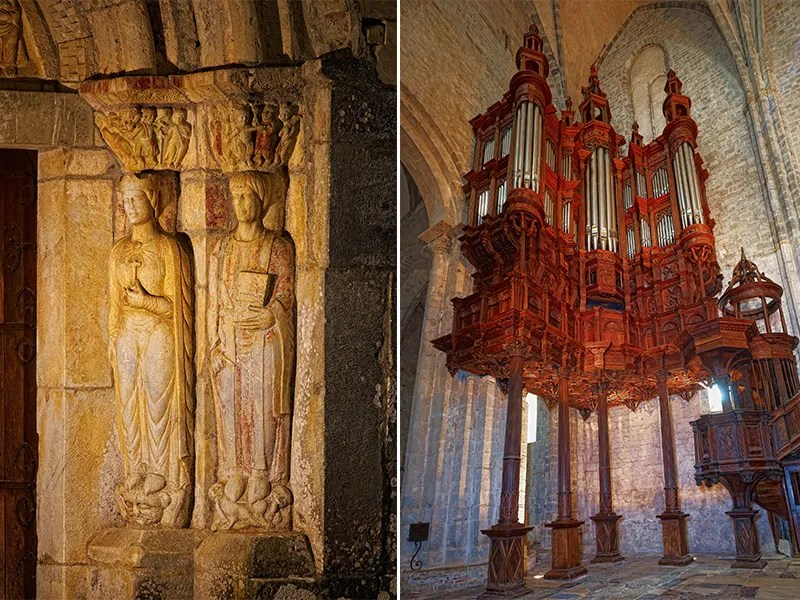
The interior is full of marvels, starting no less with the ‘Third Wonder of Gascony’ – a 3,000 pipe organ perched on columns, inaugurated in 1535. It still blasts out a wall of sound, especially during the summer music festival. Opposite, an embalmed crocodile is bolted to the wall, reputedly slain by St Bertrand when it swam up the Garonne.
An opulent Renaissance rood screen closes off the choir. You’ll need to fork out a few euros to see the rest, but it’s worth it.
Start with the cloister. Built by St Bertrand, it sits on the edge of the promontory, with an open gallery overlooking the mountains. Among the tombs is one belonging to a Canon Vital d’Ardengost (d.1334) of the pungent epitaph: ‘Here lies a rose of the world, but no longer a rose intact. She no longer perfumes, but smells of what she should smell.’
Sculptors from Toulouse carved Sainte-Marie’s 66 magnificent choir stalls between 1523-51, whose Renaissance humanistic view of the universe includes sibyls, prophets, Christian virtues, knights, imaginary beasts — and an abbot caning a naughty bare-bottomed monk.
St Bertrand is buried in his own chapel, decorated with folksy 15th-century paintings of his life. The last scene shows Pope Clement V. Because of his importance, the painters made him the size of the Jolly Green Giant.
Upstairs, the Treasury’s exquisite hoard includes the alicorne, a ‘unicorn’ (actually a narwhal) horn. Water filtered through it was considered a sure-fire antidote for poisoning. In 1594 a band of Huguenots under Corbeyran d’Aure stole it, but even Corbeyran feared the vengeance of St Bertrand, and he returned the horn in exchange for amnesty.
Lastly in the nave don’t miss the tomb of Hugues de Châtillon, the wealthy 14th– century bishop whose fine alabaster effigy lies on a slab sculpted with 70 figures in a funerary procession.
An ancient shopping mall
Sainte Marie overlooks the excavated sections of the ancient Lugdunum Convenarum. Although the ruins are basically foundations, it appears life in this town of 10,000 was pretty jammy 2000 years ago. The forum temple (c. 15AD) is opposite the school, by the Thermes du Forum, built about the same period; you can make out the hot and cold rooms (caldaria and frigidaria) and much of the plumbing. Roman bathing was a long-drawn-out social ritual, a place to talk business and politics.
Across the D26 stood the commercial heart of Lugdunum: a once-covered shopping mall or Macellum, from 15 AD with 26 boutiques paved with black and white mosaics. At over 500 square metres, it is among the largest covered markets ever discovered in the western Roman Empire. Towards the car park, a raised circular sanctuary marked the main crossroads. The municipal baths, the Thermes du Nord complex, included an early sauna.
South of the Macellum, Lugdunum’s Palaeochristian Basilica dates from the 5th century, making it one of the oldest in southern Gaul. It had a green, red and white mosaic floor; it was used even after the Merovingians trashed the place in 585. Nearby, Saint-Julian was rebuilt in the 12th century over the original cemetery chapel. Little remains of the Roman theatre on the slope—it was just too convenient to quarry.
Into the Valley of Goats
Valcabrère’s name, ‘valley of goats’ comes from a trick pulled by the Vandals in 407 AD. When they found Lugdunum too well defended for their tastes, they gathered all the goats they could find and tied torches to their horns, and at night drove them towards the city gate. Everyone rushed to ward off the attack, leaving the other gates undefended for the Vandals to waltz in and overturn the wagons, break the windows and paint their names all over the walls.
There’s one last must-see. Isolated in a field, the 12th-century Basilique de Saint-Just is a crazy quilt of cannibalized Roman and Merovingian stones. The portal was inspired by the Roman models so near at hand and it features an unusually pudgy Christ in Majesty and Evangelists clutching their emblems. Serenely elegant figures of Saints Stephen, Just, Pasteur and Helen guard the door, under capitals showing cartoonish scenes of their lives. If it’s open, stand near the altar and sing a few notes: the acoustics are well-nigh perfect.
For more info: visit-occitanie.com/en
Dana Facaros has lived in France for over 30 years. She is the creator of French Food Decoder app: everything you want to know about French food, and co-author of the Bradt guide to Gascony & the Pyrenees and many guide books to France.
Want more France?
Discover more fabulous destinations in France with our free magazine The Good Life France
Love France? Have a listen to our podcast – everything you want to know about France and more!
All rights reserved. This article may not be published, broadcast, rewritten (including translated) or redistributed without written permission.


