
Immerse yourself in the rich history and culture of what is said to be the oldest city in France, Beziers was founded by the Greeks in the 7th Century BC. Gillian Thornton explores the charms of Beziers and what to see and do nearby.
Beneath the walls of my hilltop hotel, high above the Hérault countryside, terracotta tiles and pastel properties give way to an unrivalled panorama of vineyards and distant hills. A magical setting whether seen from the hotel’s spacious restaurant or through a bedroom window.
So imagine the frustration of looking out not as a hotel guest, but as a resident of the prison that formerly occupied this unique building in Béziers, capital of the Languedoc vineyards. The last prisoner left only in 2009 and, in 2023, this atmospheric property reopened as Hôtel La Prison (hotellaprison.com.
Today guests enjoy every modern comfort, albeit it in cosy quarters. I’m travelling with a friend and we share a cell that is compact but en-suite and infinitely more comfortable than the spartan school dormitory we dubbed ‘the prison’ on our first teenage study week to France. A fitting finale to our sea-and-city rail trip through the far south of Occitanie.
What to see and do in Beziers

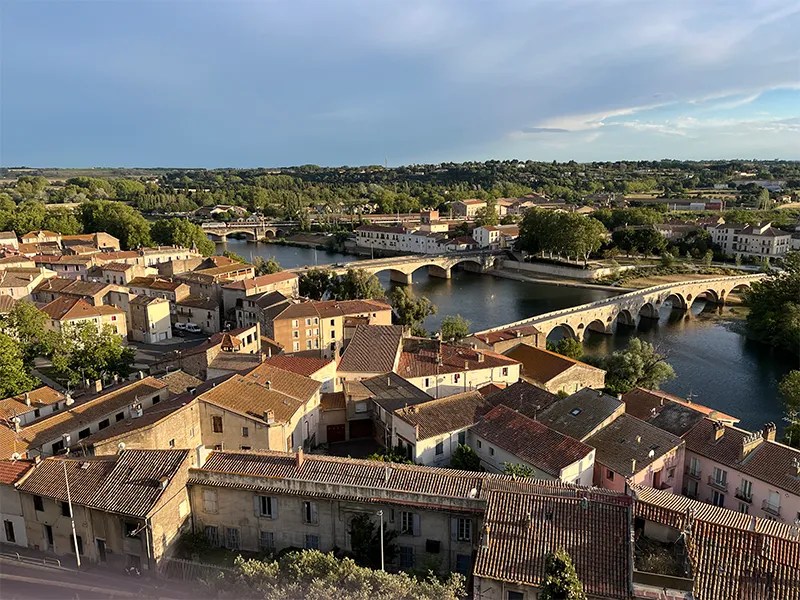
La Prison clings to the edge of a rocky promontory above the river Orb, next door to the Cathedral of Saint-Nazaire and Saint-Celse. Built on the site of a Roman temple, the original Romanesque church was burnt down in 1209 by Simon de Montfort during the Albigensian Crusade against the Cathars or Albigensians after the town of Albi where the movement began. Denounced by the Pope, this strict Christian sect suffered a turbulent history that still reverberates throughout the area.
Included in the first official list of classified Monuments Historiques in 1840, Béziers cathedral was rebuilt as a Gothic ‘fortress’ and offers even loftier views than La Prison for those tough enough to brave the 162 steps to the roof gallery. Outside, the Place des Alibgeois was pedestrianised in 2023 as part of the city’s regeneration initiative and is now a favourite spot for locals to relax beneath the trees in the heat of the day or to gather for a sunset selfie against that panoramic backdrop.
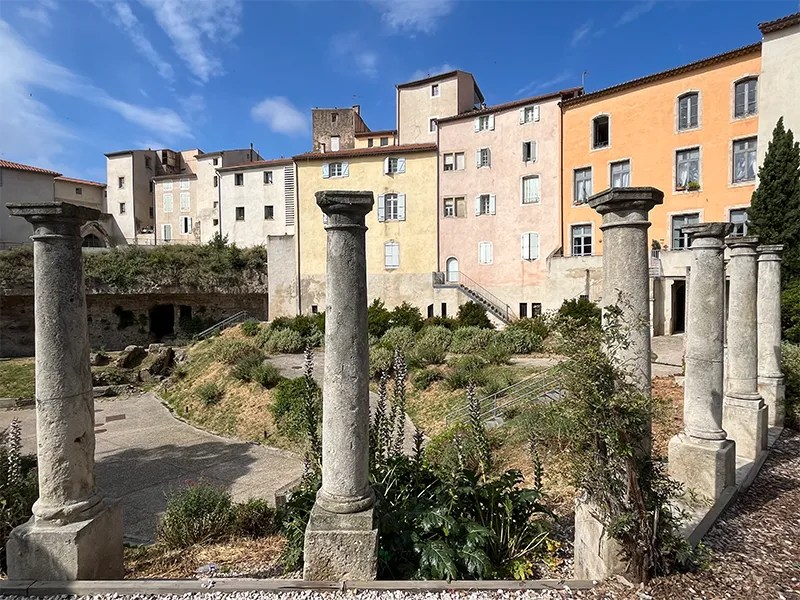
Turn your back on the Cathedral to explore the historic quarter of Béziers. Founded by the Greeks in the 7th century BC, a few years before Marseille, it is generally recognised as France’s oldest city. Romans followed Greeks and you can still wander through their amphitheatre, built in 80AD to seat up to 13,000 spectators. But most of the city’s earliest monuments exist in name only. Place du Forum is today home to the Tourist Office and surrounded by facades dating from the 17th century.
Beziers owes its elegant city centre architecture to a 17th century visionary and a 19th century epidemic. Salt tax collector Pierre Paul Riquet was born here in 1609 in the reign of Louis XIV, the son of a local businessman. At the age of 58, with no relevant experience, Riquet began one of the most ambitious engineering projects of the age, the Canal du Midi, to provide the missing link in a waterway joining the Atlantic with the Mediterranean.
The city grew wealthy from the new trade route and today his statue stands in the Allées Paul Riquet, a tree-lined boulevard linking the Municipal Theatre with the Parc des Poètes. Flanked by ornate town houses, Riquet’s beautiful boulevard and the adjacent square have also enjoyed a recent makeover, a shallow water feature now flowing symbolically to the foot of his statue. Béziers prospered again in the mid-19th century as vineyards in other parts of France were ravaged by phylloxera aphids.
Soak up the atmosphere of the historic streets by following the Trompe l’Oeil trail of 19 painted walls that celebrate key people and events in the city’s history. Having studied Molière for our teenage French exams, we were pleased to find a mural honouring the performance of his first ever play here in 1656. Camille Saint-Saëns is represented too in Place Saint-Esprit, commemorating a local performance of his opera Déjanire.
And just off the Allées Paul Riquet we loved the wonderful café window, L’Arlésienne, that recalls a true story about a man jilted by his fiancée. Told by Alphonse Daudet in Les Lettres de mon Moulin, it was later performed on stage with music by Georges Bizet, but Daudet moved the action to Arles, hence L’Arlésienne, but in real life, the central female character was from Béziers and therefore une biterroise.
We also find sculptor Jean-Antoine Injalbert, whose bust of ‘Marianne’ – or ‘La République’ – was created in 1889 to celebrate the centenary of the Revolution and now graces town halls all over France. Born in Béziers in 1845, Injalbert died in 1933 and rests in the Old Cemetery in a tomb decorated by a figure he carved himself.
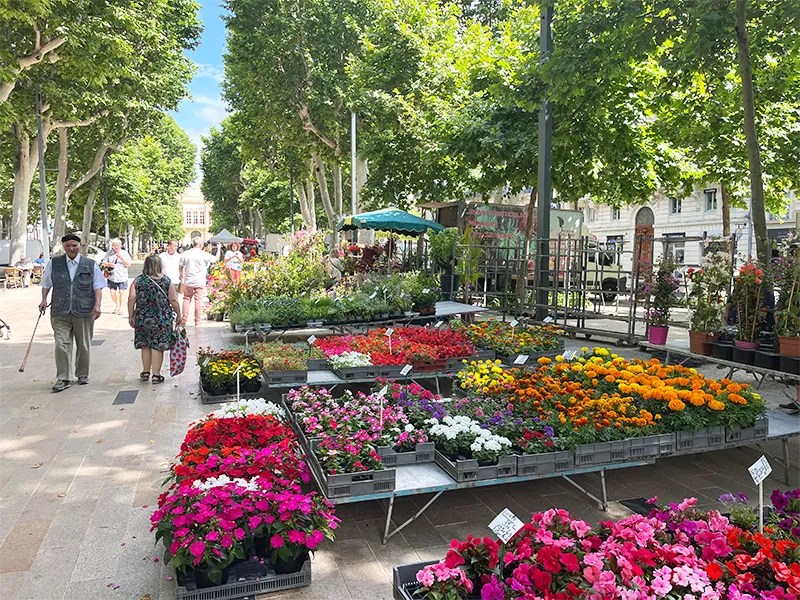
With its sunny climate, Beziers is a delightful spot to people-watch from a café terrace, sit beneath the shade of Riquet’s stylish boulevard, or search out a back-street bistro. Alternatively, sit down to a picnic in Parc des Poètes opposite the station. A symbol of the town’s 19th century prosperity, this 5-hectare green space showcases plants from five continents amongst busts of famous Occitan poets and a grand fountain of Titan sculpted by – guess who – Monsieur Injalbert.

In fact green space is never far away in Béziers. From Hotel La Prison and the Cathedral, it is just a 30-minute walk to the Canal du Midi and the spectacular Fonserane Locks, now accessible to all thanks to a series of lifts, ramps and level path. One of the most impressive feats of engineering on the Canal du Midi, this extraordinary ‘staircase’ was originally made up of nine locks although only seven are still in service, allowing boats to cover a 13.6 metre elevation in just 300 metres. Take a towpath walk down to the Pont-Canal, a bridge inaugurated in 1858 to carry the canal over the Orb and avoid crossing the river in times of high water.
For food with a view, book a table at Le Restaurant des 9 Ecluses (le9.fr) beside the locks for a sweeping panorama back to the cathedral; discover the story of Riquet’s extraordinary feat in a 14-minute immersive theatre experience; and maybe take a guided cruise excursion on this world-famous waterway. United States President Thomas Jefferson, former US ambassador to France, spent nine days cruising on the Canal du Midi in May 1787 to see how such a canal could meet the transport needs of his own country. The result? The Erie Canal in New York State, inaugurated in 1827, one year after Jefferson’s death.
When you feel like a breath of sea air, the beach is in easy reach too. For the ultimate in sustainable travel, hire a bike in Béziers and follow the 20km cycle path to the Orpellières nature reserve at the mouth of the river Orb, close to Valras-Plage. Relax on the sands, explore the salt marsh trails, and refuel at the café in the new visitor centre at Sérignan-Plage where you can also book guided walks, paddleboard excursions and summer jazz evenings at the heart of this tranquil wetland.
Or jump on a train or shuttle bus in Béziers and head to historic Agde and the buzzing modern resort of Cap d’Agde launched in the 1960s and home to France’s only museum of underwater archaeology. A sea-and-city break that can be as active or passive as you choose.
By Gillian Thornton, one of the UK’s leading travel writers and a regular writer for The Good Life France Magazine and website.
Want more France?
Discover more fabulous destinations in France with our free magazine The Good Life France
Love France? Have a listen to our podcast – everything you want to know about France and more!
All rights reserved. This article may not be published, broadcast, rewritten (including translated) or redistributed without written permission


