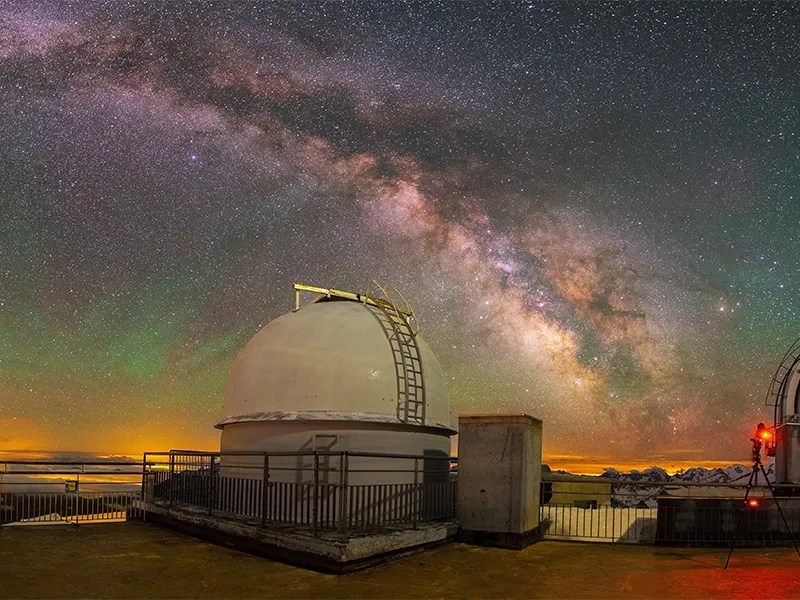
Fancy a galactic break in France? Dana Facaros goes stargazing at Pic du Midi Astronomical Observatory in Hautes-Pyrénées, Occitanie, southwest France.
The 2,877m/9,439ft Pic du Midi isn’t the highest mountain in the Pyrénées, but as we drove south of Tarbes, capital of the Hautes- Pyrénées, it certainly looked like it: a pyramid towering high over its neighbours. Closer, we clocked some odd-looking bits on the summit. That was where we and 25 other lucky souls were going to spend the night.
A starry night on the roof of the Pyrénées
The Pic du Midi’s astronomical observatory has a hallowed history. It was here that scientists mapped the moon in preparation for the Apollo landings. Its Bernard Lyot 2m telescope is the biggest in France.
Yet in 1995, the Ministry for Higher Education and Research announced it would close for lack of funds, sending scientists, academics and the regional government scrambling to find a way to fund it and keep it open. First, they built a new cable car to make the summit accessible to the paying public for the first time, then in 2006 they added the chance to spend an astronomical night on top. These Nuits au Sommet have become so popular you have to reserve a year or so in advance, I learned when I tried to book one as a surprise for my astronomy-loving husband’s birthday – so we ended up going for his next birthday instead.
At La Mongie, the scrappy resort at the base, the road was covered with faded graffiti from the Tour de France’s recent ascent of the Col du Tourmalet. We boarded the jaunty white and blue cable car, and within minutes were speeding up towards what looked like a clutch of eggs under a giant needle, casting a racing shadow over tiny white dots of sheep far, far below.
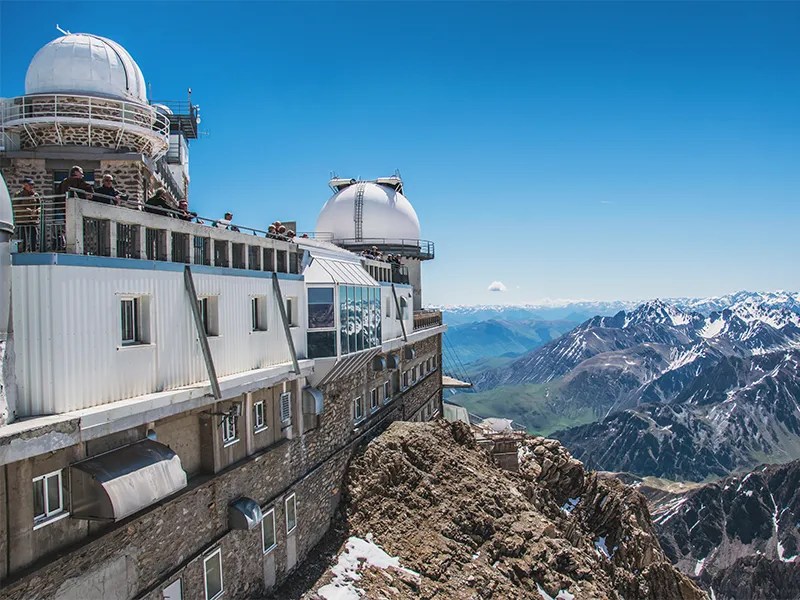
Fifteen minutes later, the car docked with a reassuring click and out we clambered. Up close, the eggs and needle proved to be a massive, fortified bunker draped over the summit, bubbling with mysterious white domes, towers, instruments, and an enormous antennae, the perfect lair for a James Bond villain, hidden away above a breathtaking sea of primordial peaks. The air and light were crystal clear—you could see forever, or more precisely, for 300km, as far as Catalonia and the foothills of the Massif Central.
A young guide led us to our room through a labyrinth buried inside the mountain, past ©intriguing No Entry doors. ‘Don’t get lost,’ he warned (too late). ‘There are 4km of underground corridors, so the technicians can work year-round without going outside. In winter, the temperature can drop to -30C and the winds can blow at 180kmph. If they’re over 85kmph, the cable car can’t run.’
‘Then what happens?’ I asked.
‘You get to stay. We had a group stuck up here for ten days once.’ He saw the look on our faces. ‘But don’t worry, we have plenty of wine! At 6pm we meet up in the bar to hydrate ourselves.’
‘We ‘hydrate ourselves?’ Like astronauts?’
‘Mais non! Like Gascons!’
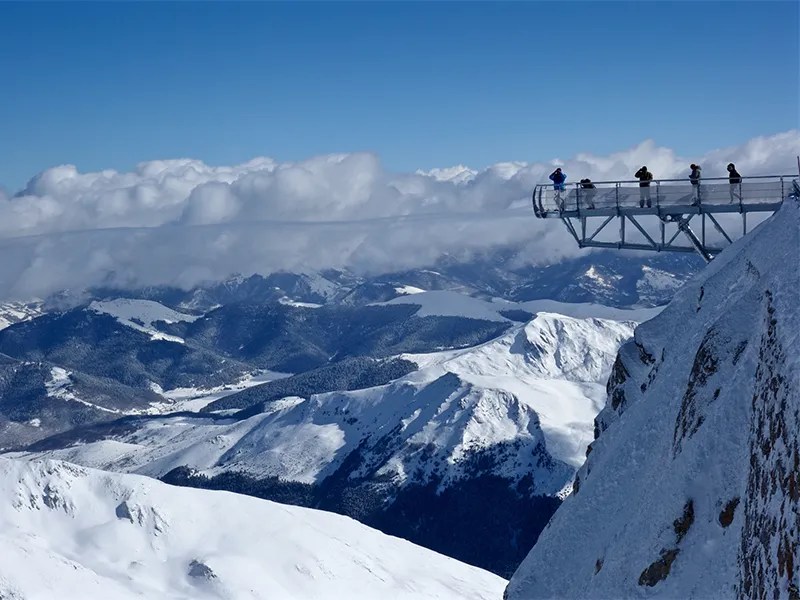
Our room in the technicians’ dormitory was snug and minimalist but the stupendous mountains views through the thick window beat any hotel room hands down. Outside the air was already nippy; we grabbed our coats and scampered through the maze, although it wasn’t long before we slowed down to a light-headed trudge. After all we were nearly two miles high. We watched brave souls immune to vertigo take selfies on the Pontoon of the Sky, a narrow 12m walkway extending alarmingly over the void.
But once the day the last day visitors descended, the observatory seemed to come into its own. We joined the other overnighters for cocktails, then took the lift up to visit the highest museum in Europe, complete with astonishing photos of how the thing was built on top of a mountain, starting nearly 150 years ago.
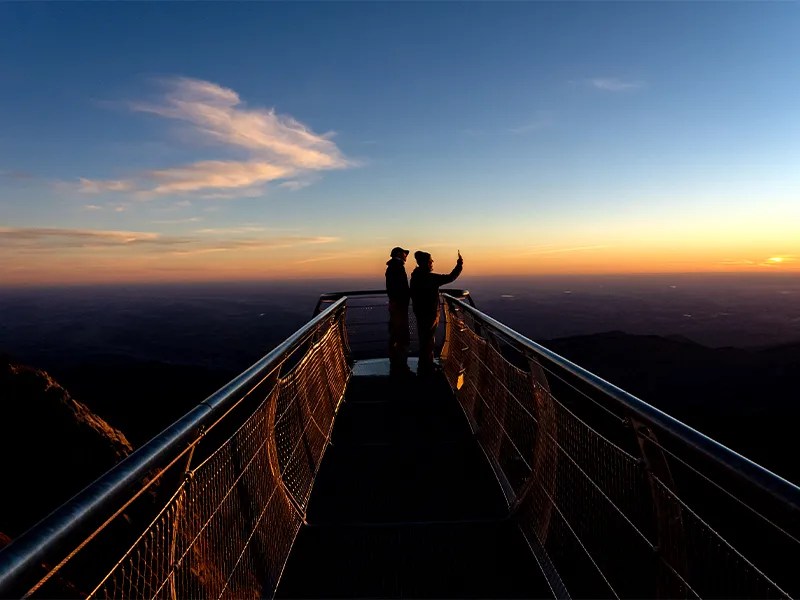
We returned to the terrace in time to watch the sunset paint the peaks lipstick red, outlining the gleaming white domes against the darkening sky. As if on cue, roiling clouds appeared out of nowhere, turning the valleys into a frothy white sea and the surrounding summits into islands, leaving the observatory floating like a ghost ship under a 101m mast.
It was so hypnotic it was hard to go in for dinner, but the food, Gascon garbure and black pork of Bigorre, was delicious. We washed it down with a robust local wine, Madiran, that at that altitude had double the usual oomph!
By the time we waddled back outside with our astronomer guide, the half-moon was sinking. Starlight filled the enormous dome of the sky, the constellations blazing with Van Gogh fire, the swirling veil of the Milky Way shimmering with a hundred billion stars.

In 2013, the Pic du Midi became the sixth place in the world to be accredited by the International Dark Sky Reserve (IDSR), the first in Europe and the only one in France. Puddles of light—including Lourdes, Tarbes and sprawling Toulouse on the horizon—marked the crazy, cockamamie world far below. We tour turns peering through the telescope at the moons of Jupiter, double stars and distant stars in their death agony. A shooting star fell in slow motion, leaving a vivid blue streak across the sky, so close we could hear it go phhhhhht!
Every so often a cloud would grip the observatory in bone-chilling mist. Ghostly tendrils played hide and seek with the glittering sky, making the observatory eerie and dreamlike and strangely romantic. Close to midnight the mist lingered for so long that we trundled off to bed.
We set the alarm to be up in time to watch the satisfyingly dramatic sunrise. This was followed by a private tour behind the scenes, where we could watch the astronomers at work. One job they do is study the surface of the sun. It’s been a busy time for solar flares, hence all the recent Northern Light shows. ‘Are we due for another Carrington Event?’ the husband asked—referring to the massive geomagnetic flare that wreaked havoc in 1859, and would likely cause a worldwide catastrophe today.
‘You never know!’ the astronomer said brightly.
Find our more: picdumidi.com/fr/nuit-au-sommet/
Dana Facaros has lived in France for over 30 years. She is the creator of French Food Decoder app: everything you want to know about French food, and co-author of the Bradt guide to Gascony & the Pyrenees and many guide books to France.
Want more France?
Discover more fabulous destinations in France with our free magazine The Good Life France
Love France? Have a listen to our podcast – everything you want to know about France and more!
All rights reserved. This article may not be published, broadcast, rewritten (including translated) or redistributed without written permission


