
Discover the fascinating history of French cakes and sweets starting with a classic cake whose origins are, to say the least, a little unusual. Marmoutier Abbey outside Tours was famous for its cuisine in the 16th century and one day, the nuns were busy preparing a feast for the visiting archbishop when, as Jean-Camille Fulbert-Dumonteil wrote in France Gourmande: ‘Suddenly, a strange, loud, rhythmic, prolonged noise, like the dying moan of an organ, then the dying wail of the breeze sighing in the cloisters, struck the indignant ears of the nuns with astonishment.’ The nuns all turned to stare at Sister Agnès, who in her embarrassment, tripped and let fly a spoonful of her chou pastry dough into a pot of boiling fat, and the doughnut-like pet de nonne, ‘nun’s fart’ was born.
Dana Facaros investigates the confectionary chronicles of France.

Discover the fascinating history of French cakes and sweets
Probably only the French would so joyfully commemorate a prodigious breaking of wind (or make up such a good story about it!). And there have been other moments of serendipity: there’s the sister who left the apples on the stove until they caramelized and invented tarte Tatin, the apprentice who accidently dropped mint in the lozenge dough and created Bêtise de Cambrai bonbons, and a malfunctioning machine in Margaux that twisted up the chocolate bâtonnets meant to go inside pains au chocolate and produced instead to Bordeaux’s first ‘vine cuttings’, Sarments de Médoc.
French cakes inspired by a bike race, marvellous ladies and popes
But aside from happy accidents, France’s pâtissiers and confiseurs have often been inspired by events or people, so that (if you know the story) there’s a bit of history in every bite; Escoffier’s Pêche Melba, created in 1892 for Australian soprano Dame Nellie Melba after her triumphant performance of Lohengrin is now served around the world.
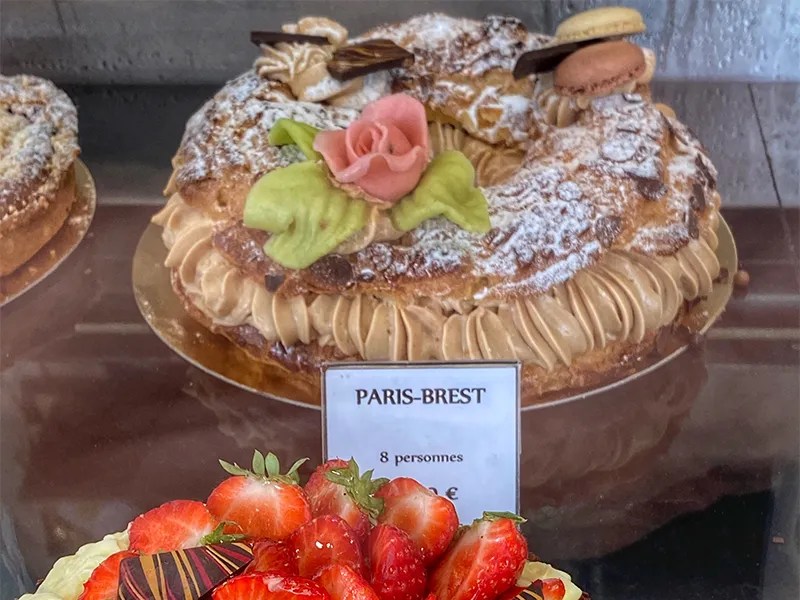
And many sweet souvenirs are almost exclusively French, starting with the Savarin, the syrup-soaked ring cake invented in 1845 by Arthur and Auguste Julien in honour of the ‘father of French gastronomie’ Jean Anthelme Brillat-Savarin. We owe the popular bike wheel-shaped Paris-Brest to Louis Durand who in 1910 concocted the first ones when he heard the cycling race was passing in front of his shop (now renamed Paris Brest) in Maisons-Laffitte (Yvelines).

The aristocratic ladies of the Directory (1795–99) celebrated their escape from the guillotine by dressing in flimsy white gowns and enormous hats. Known as the Merveilleux, their brief day in fashion’s sun is recalled by the eponymous meringue and whipped cream pastries from Flanders, best of all from Aux Merveilleux in Lille.
Avignon remembers its medieval popes with Papalines d’Avignon: dark chocolate balls filled with Origan du Comtat liqueur, wrapped in white chocolate tinted cardinal red. For Palm Sunday, Valence’s Suisse biscuits shaped and decorated like Swiss Guards, recall how they protected Pope Pius VI after Napoleon kidnapped and sent him to Valence, where he died in 1799; Maison Guillet is famous for them.
Historic French cakes inspired by royalty, plus a cat, goat and dog
When you travel around France, local bonbons make great souvenirs (who really needs another fridge magnet?) In Angoulême’s Chocolaterie Duceau, seek out Marguerites, daisy-shaped chocolates named after Marguerite d’Angoulême, the brilliant sister of François I. In Nevers, head to Au Négus for a box of Négus de Nevers—soft chocolate and coffee caramels in a hard candy coating named after the Négus (Ménélik II, emperor of Abyssinia) who visited Nevers in 1902.
In the same year in Nantes, Charles Boho invented fruity Rigolettes Nantaise, immortalizing his cat Rigolette who was in turn named after his favourite opera, Rigoletto. In the French Alps, the Dahu, the mountain goat with one set of legs longer than the other, leaves milk chocolate-covered raisin poop, the Crottes de Dahu — solid proof for les enfants that the Dahu really exists, available in most souvenir shops.
A grimmer tale inspired the dark chocolate and praline Crottes du Chien de Montargis made by Douceurs Montargris. In 1371, Aubry de Montdidier, a favourite of Charles V, was walking in the woods when he was assassinated by a jealous knight, Robert Macaire. The king’s search party found Montdidier’s dog scratching the ground over his master’s shallow grave. They brought body and dog back to court, when the dog, the only witness to the murder, attacked Macaire. The king then ordered a duel between the man (armed with a club) and the dog (who had a barrel to hide in). The dog won, Macaire confessed and was hanged.
When Russia was à la mode
For a couple of centuries Russia and France were best buddies, in spite of Napoleon trying to take Moscow. When Tsar Alexander III turned up in Paris for the 1855 Exposition Universal, he was honoured with an almond and hazelnut cake dubbed the Russe.
In 1893, a confiseur in Chartres came up with praline chocolates in Swiss meringue that he named Mentchikoff after Peter the Great’s favourite, Prince Alexandre Danilovitch Mentchikoff—who was reputedly the son of a pastry chef. In 1905, just before Diaghilev’s Ballets russes were to take France by storm, wealthy Russians in Biarritz inspired chocolatier Jacques Damestoy to named his new chocolate caramels Kanougas (after Kalouga, a town in Russia), which are nothing less than the ‘world’s finest caramel’ according to the New York Times. His descendants make them at the Maison Pariès.
Sweet victories and romance

On 17 June, 1434, during the Hundred Years’ War, the locals of Mont Saint-Michel sent the besieging English troops of Thomas de Scales packing so quickly they left behind two bombards nicknamed Michelettes, their shape and name echoed in striped cigarettes russes (Russia again!) stuffed with chocolate ganache. The St Michel company sells them across France.
You’ll need to go to Montauban, however, to find Boulets de Montauban (chocolate-covered toasted hazelnuts). Frustrated by his long siege of Protestant Montauban of 1610, Louis XIII asked his astrologer what to do. He suggested scaring the city into surrendering, so Louis ordered 400 cannons to fire their boulets at Montauban at the same time. In the silence that followed, the Montalbanais laughed so hard the king could hear them. Hence the expression ‘Faire les quatre cents coups’ (which literally means to give 400 blows but means – to live a wild life!)
On the other hand, the Boulets de Metz, balls of dark chocolate filled hazelnut pieces and almond paste with a touch of Grand Marnier were invented in the 1930s and named after a very rude song, L’Artilleur de Metz (about a soldier who mooned at the enemy).
Other bonbons evoke more tender feelings. Food historians may argue over the origin of the name of Aix-en-Provence’s famous Calissons (candied melon, blanched almonds and orange zest) but the most charming has it that Good King René’s confectioner invented them in 1454 for the King’s bride Jeanne on her wedding day, and she exclaimed ‘di calin soun!’ (‘they are cuddly!’ in Provençal).
In Pau, seek out Coucougnettes (roasted almonds coated in dark chocolate, then rolled in raspberry, ginger and Armagnac-flavoured marzipan) at the Maison Francis Miot, which were awarded the Best Bonbon prize in 2000. The name comes from coucougner, the southwest French word ‘to pamper a beloved’, referring to Pau’s native son Henri IV, the ‘Vert Galant’ who avait coucougné at least 57 known mistresses and fathered an estimated 24 children.
Dana Facaros has lived in France for over 30 years. She is the creator of French Food Decoder app: everything you want to know about French food, and co-author of the Bradt guide to Gascony & the Pyrenees and many guide books to France.
Want more France?
Discover more fabulous destinations in France with our free magazine The Good Life France
Love France? Have a listen to our podcast – everything you want to know about France and more!
All rights reserved. This article may not be published, broadcast, rewritten (including translated) or redistributed without written permission


