
French bread made by an artisan to a traditional and authentic recipe is unique. It never tastes the same anywhere else in the world. And never as good as it does in France. Discover the rich history of bread – and especially the French baguette – the King of bread in France! Janine Marsh explores the history, legends and fascinating facts about the French baguette, an edible icon of France.
The origins of bread
Bread in France is more than just food, it’s a cultural cornerstone. It’s about community, tradition, and the French way of life. You simply can’t overestimate the role of bread in daily French life and how it reflects the values and rhythms of French society. There is a saying in France Un jour sans pain, c’est un jour sans soleil – A day without bread, is a day without sun…
Let’s start with the origins of bread in general. According to some historians, it was being made by the time of the stone age 14000 years ago. There’s evidence that our ancient ancestors used grains from wild wheat and barley, mixed it with plant roots and water and baked it. Around 8000 BC in Egypt bread started to become a bit more like we know it now. Grain was crushed and Egyptian bakers produced something similar to Indian chapatis or Mexican tortillas. Bread caught on around the world, and by the time of the Romans, the rich enjoyed a fairly refined sort of bread. By the Middle Ages it was a staple of the daily diet in Europe. In the days of the Knights of old they would cut a thick slice of bread instead of a plate – bonus – no washing up, you just eat your plate!
French bread is a ‘thing’

For the French, bread has long been a ‘thing.’ The Gauls, France’s Celtic ancestors, baked bread using a variety of cereals. Few quotes are as well-known as Marie Antoinette’s “let them eat cake” when she was told that the peasants had no bread (actually very very unlikely she said that at all, there’s no proof). Up until about 1800 French peasants ate bread made from wheat, rye or buckwheat. Bakers often added all sorts of materials as fillers to make the flour go further: sawdust, hay, dirt and even dung were all used. The vast majority of a peasant’s diet came from bread, and an adult male could eat as much as two or three pounds of it a day.
In the old days, communal ovens were set up in almost all French villages and towns to bake the town’s bread – they were the centre of community life. I live in an old farmhouse and there’s a little sort of shed, a stone room, in the front garden looking onto the road and it has an ancient bread oven in it. Basically an open stone box with a chimney and it’s where the villagers would have bought their dough to be baked, a sustainable way of cooking as they didn’t have to use precious firewood just to bake a loaf.
French bread love
It’s fair to say that French people love bread. There are dozens of different types of loaves of bread, un pain rond – a round loaf, pain complet – whole wheat bread, pain de seigle – rye bread (typically served with oysters), pain aux graines – French bread loaf with whole pieces of seeds, pain aux lardons, aux olives – bread with bacon and olives and épis – read you can tear into pieces. That’s just a few. There are loads more French breads named according to the shape, ingredients, the type of flour used, the way it was prepared… There’s even a bread called “Une biscotte” which sounds like biscuit! It’s a dry sort of bread which almost every French home keeps in the cupboard, in case you run out of fresh French bread! “Les biscottes” are also a common French breakfast food slathered with jam.
In France bread is an art
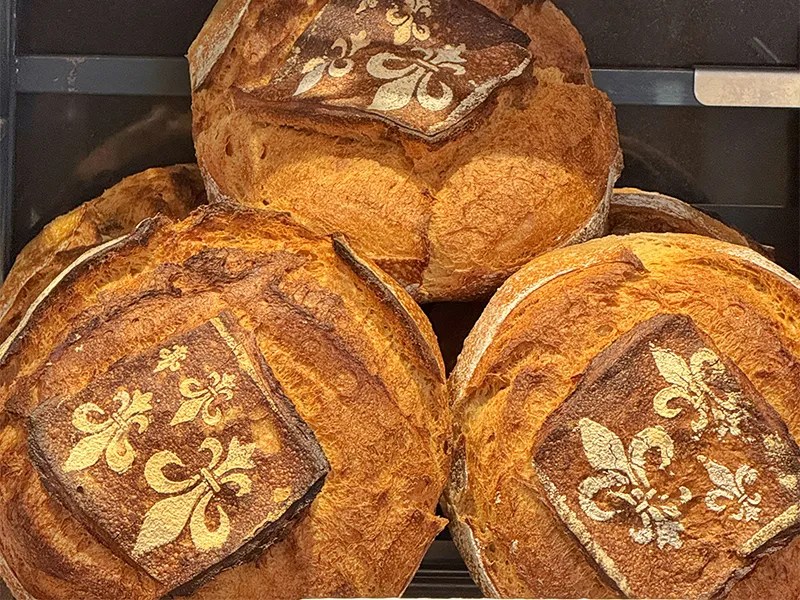
In France, bread is an art, and bakers are the artists. Boulangeries are revered – French bakeries where each loaf is a masterpiece. All of the different breads tell a story of regional diversity and traditional methods. And there are even sweet breads “les viennoiseries” – like a pain au raisin – round pastry with cream and raisins or a pain au chocolat – chocolate croissant. And of course there’s une brioche – sweet and fluffy sweet bread, and many more… un palmier, un beignet, un sacristain… and local specialities as well!
The baguette – King of bread in France
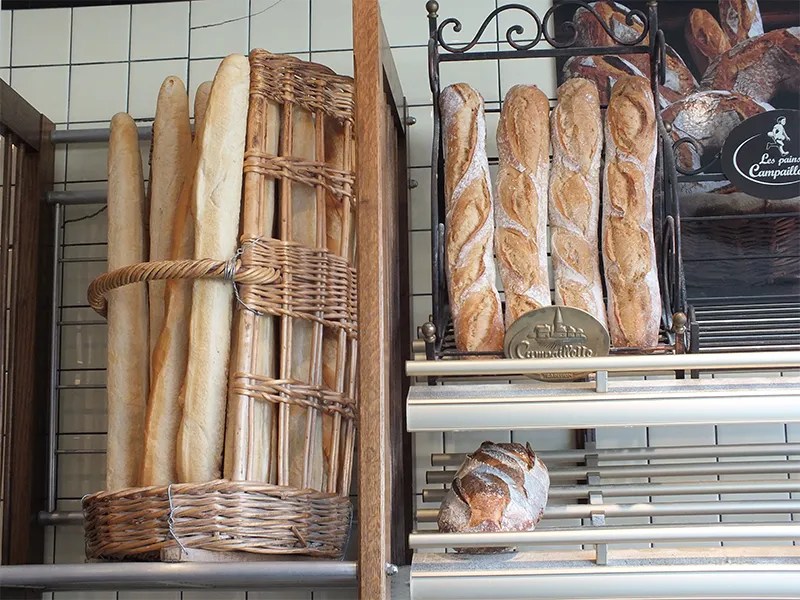
But perhaps the most important loaf of France is the baguette. The King of the Bread in France. It is so important, so special, so unique – that it was given UNESCO Intangible Cultural Heritage status in 2022. And it deserves that award. UNESCO say on their website that the “crisp crust and chewy texture result in a specific sensory experience”. Somebody at UNESCO really likes baguettes! But they are right, there is nothing to beat a fresh cooked baguette, straight out of the oven, especially a wood oven, crispy on the outside, the French call it La croute, soft on the inside, the white part which is called La Mie.
And the end of the baguette is called Le croûton or the quignon– the favourite baguette part for French people: the very end, with all the crust! When you go to buy your baguette from a boulangerie and you walk down the street with it under your arm – or in a special long baguette bag, you have to eat the end of the baguette – it’s almost the law!
There are even special long wooden box made for keeping baguettes fresh at home though they never last that long!
Who invented the French baguette?
Long wide loaves have been around since the time of Louis XIV in the 1600s, and long thin ones seem to have been made starting in the mid-18th century. But where did this long skinny loaf of bread come from? The truth is, no one is completely sure. The word “baguette” means wand, baton, or stick and refers to the shape of the bread. But the term only became attached to the thin sticks of bread we know today, in the early 20th Century. However, the baguette’s history may go back much further.
For whatever reason, the first wand-shaped breads were everywhere by the mid 1800s in Paris. But these weren’t the French loaves that we see today. No, they were baguettes on steroids. Many foreign visitors marvelled at the extraordinary lengths of the Parisian bread they saw: “…loaves of bread six feet long that look like crowbars!” someone wrote in 1862. They described loaves of bread 6 feet (2 metres) long being delivered by women carrying them stacked horizontally, like firewood, in a frame on their backs. It was common to see housemaids on the streets at 6 o’clock in the morning carrying the long loaves home for their employer’s breakfast. In the afternoons, young boys could be seen using the long loaves as pretend swords and engaging in mock battles before the bread made its way to the family table.
One visitor to France said that he sat in a restaurant and watched as the baker came in and stacked loaves 6-8 feet (2-2.5 metres) long in the corner like a bundle of sticks. Another described the bread having to be laid on the dining table lengthwise because it was longer than the table was wide.
Those long breads that made such an impression on 19th Century tourists were the forerunner of today’s more manageably sized baguette.
In the late 1800s wheat got cheaper so by the end of the 19th century white bread was no longer just for the rich. The development of steam ovens also meant it was possible to bake loaves with a crisp crust and a white, airy centre, like today’s baguettes.
In 1920 a law was passed preventing bakers from working between the hours of 10:00 o’clock at night and 4 o’clock in the morning. This made it impossible to get the bread cooked in time for breakfast. The problem was solved by focussing on loaves of bread that were longer and thinner because they cooked faster!
Although there had been long, thin breads in France for around a century before this, they hadn’t been called baguettes – that also happened in 1920, though it’s not known who came up with the name. The word baguette comes from the Latin baculum which became baccheto (Italian) meaning staff or stick.
And although one knows exactly when or why this French loaf took on its current shape, there are several stories, and even some laws that give us clues to the baguette’s heritage.
Did Napoleon invent baguettes?!
Some say that it’s all thanks to Napoleon that we have the baguette shaped bread of France. Allegendly he ordered bakers to make loaves his soldiers could fit into a special pocket on their uniforms so that they could carry it with them when they marched. Highly unlikely – but yes, maybe possible!
Another legend is that when the metro system was being built in Paris, the workmen came from all over France and the project manager, concerned that they would be fighting in the tunnels instead of getting on with their work, ordered bakers to make loaves that didn’t need cutting. We will most likely never know the real reason.
How big is a baguette?
Today’s baguettes are typically about 50-60cm long – even up to a metre. Sometimes they are shorter. Sometimes baguettes are thin. Sometimes they are not. Because this is France – and of course there must be lots of different types of baguettes.
Whatever size it is, a traditional baguette must have only four ingredients. Flour, water, salt and yeast. And that is the law. It’s traditional to buy a baguette fresh, daily. Apparently – according to an unimpeachable source – the Internet – French people eat 30 million baguettes daily. More than 10 billion baguettes are produced each year in France, that’s a staggering 320 baguettes per second. The French are besotted with baguettes.
They pretty much have it with every meal, each course – except desert – at least sometimes because there are several desserts made with bread including pain perdu! And for breakfast, the French like to dip bread in their coffee or hot chocolate!
Baguette etiquette
And there is bread etiquette too. Baguetiquette! Help yourself, then put the bread directly on the tablecloth, close to your plate – not on your plate, only at formal dinners bread plates might be used. You tear your bread into a small bite-size piece before eating it. If you are eating cheese or pâté, cut a piece with your knife, then put it on the bite size piece of bread you have torn – don’t spread the cheese or paté on a big piece of bread.
Never place the bread face down on the table – it’s an old superstition. In the Middle Ages it indicated death, because the baker kept the one loaf of bread for the village executioner face down. Finally, apparently you’re not supposed to finish up the sauce with your bread, but everyone does.
Best baguette in France
There’s even a “best baguette” contest each year in Paris? All the bakers taking part submit 2 baguettes. They must be between 55 and 79 centimetres long, weigh between 250 and 300 grammes, and contain 18 grammes of salt per kilo of flour. The loaves are judged by other bakers, journalists, previous winners and a few lucky members of the public (I want that job!). The winner gets a great reputation of course, everyone will want to go to their boulangerie – and they also supply baguettes to the Elysée Palace, the home of the French president, for a year!
How to cook a baguette
The French also debate about whether a baguette should be bien cuit – well cooked, or ‘blanc’ not so well cooked. A French journalist posted a simple photo of two baguettes on his Twitter account – one of the baguettes was much more cooked than the other and he wrote “The baguette on the left (the well-cooked one), is obviously much better than the baguette on the right and I challenge anyone to a duel who would dare to claim otherwise.” Well that set everyone off – hundreds of people wrote comments, 5.3 million people viewed the photo – yes 5.3 million. The majority, like the journalist, preferred the bien cuit baguette. It was a very very French debate with people claiming that cooking the baguette longer “brings out the special aromas”… only in France!
Boulangeries rule

Whatever you do – when you go to buy your baguette or your French bread – go to a proper boulangerie. It’s a little more expensive than a supermarket, but real baguettes from a boulangerie have a whole different taste and they are so worth the extra centimes. It’s also a cultural experience to go to a boulangerie, queuing up with the locals, listening to them chat, exchanging kisses, sometimes someone might ask for a demi-baguette, a half baguette and often – bien cuit!
Whatever its origins, the baguette has become a symbol of French culinary prowess. More than four hundred years of practice, a revolution and much more have gone into making the baguette the bread we all know and love today! The baguette is an edible icon of France. It’s as French as the Eiffel Tower!
Find more fun and fascinating facts about the history of the baguette by writer Margo Lestz
Janine Marsh is the author of several internationally best-selling books about France. Her latest book How to be French – a celebration of the French lifestyle and art de vivre, is out now – a look at the French way of life. Find all books on her website janinemarsh.com
Want more France?
Discover more fabulous destinations in France with our free magazine The Good Life France
Love France? Have a listen to our podcast – everything you want to know about France and more!
All rights reserved. This article may not be published, broadcast, rewritten (including translated) or redistributed without written permission.


