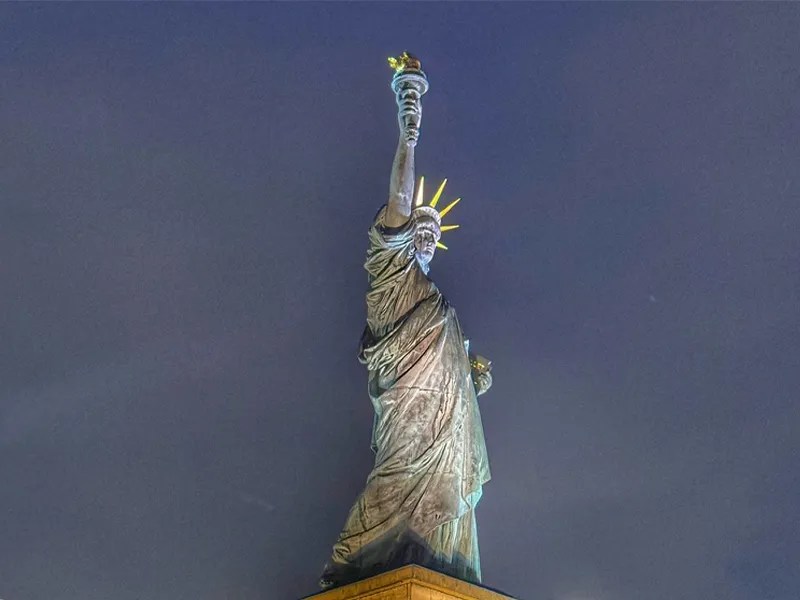
The French history of the Statue of Liberty is a tale of friendship and citizenship between two nations. She is an iconic landmark with a 4′ 6″ long nose, and one of the most recognised symbols of the United States. But did you know that this most American Lady Liberty is actually an immigrant? She was born in France…
There are hundreds of Statues of Liberty
Replicas of the monument are to be found throughout the world including in Paris on the Ile aux Cygnes (the island of swans). It’s a small artificial island in the heart of Paris in the river Seine and close to the Eiffel Tower. It was built to support the three bridges that cross it. This Lady Liberty faces her sister in America, albeit a quarter of the size, cast from the original mould. In fact there are hundreds of Statues of Liberty all around the world including in Ireland in County Donegal, Spain, Canada, the UK, Ecuador, China, Japan, and Peru to name just a few!
The origins of the Statue of Liberty
But before we get to some of those fascinating facts, lets go back to when it all started. It was the year 1865. A Frenchman called Edouard de Laboulaye, a French jurist, poet, author and anti-slavery activist, wanted to create a monument to the liberty – he was a great admirer of the United States Constitution and chaired the committee of the Franco-American Union. He came up with the idea of offering a Statue of Liberty for the celebration of the hundredth anniversary of American Independence, and it would be a gift of friendship from one people to another, not from the government. The ordinary people of France would produce the statue and the people of America would provide need to provide a plinth on which the statue would be erected.
Laboulaye, who is known as the “Father of the Statue of Liberty,” enlisted the help of a sculptor friend – Frédéric-Auguste Bartholdi. He was born in Colmar in 1834 (there’s a museum dedicated to him in the town and a Statue of Liberty on a roundabout there) and he was a bit obsessed with building something colossal. When the Suez Canal was being built he proposed that a huge statue of a woman to serve as a lighthouse would be a great idea, but no one wanted to know. When Laboulaye and Bartholdi got together, they planned and waited for the right time to start their monumental project. Ten years later (1875, the year in which Bartholdi filed a patent for the statue) the project to create the Statue of Liberty was officially announced. Bartholdi’s dream to build something monumental was about to come true.
But there was a snag. An honourable gift it might be, but Laboulaye and Bartholdi’s bold plan had a flaw. They needed teh Americans to collaborate with them to build a pedestal for the statue, and they never even considered the possibility that the Americans might not want to be a part of the partnership.
How the Statue of Liberty was funded
Bartholdi went to New York and met with influential business leaders. He shared his plan, a free gift that glorified the liberty that both America and France valued. There were smiles and handshakes all round – what a great idea they said.
But when he asked them to fund the plinth, the smiles stopped. A gift that cost money, that was a different proposition altogether – unless they could make money from it. They proposed to advertise their business on the base perhaps. If a way could be found to make money from the gift they’d go ahead and there was a half-hearted effort to find funds for the plinth.
Meanwhile in France, a committee was founded to collect donations to fund the statue at a grassroots level. People from around the country sent in whatever they could, and events were held to raise money – even schools got involved. They hit their target – crowd funding of the best sort – and construction began. To raise more funds, the unfinished statue was exhibited, including at the 1878 Paris World Fair, and the committee sold miniatures of Lady Liberty.
Who made the Statue of Liberty?
The internal structure was originally assigned to Eugène Viollet-le-Duc, a prominent architect who restored the great Cathedral of Notre-Dame and the citadel of Carcassonne. But he passed away unexpectedly, so one Gustave Eiffel was employed to take his place.
Eiffel modernised the plans and designed a tall central pylon which actually looks a bit like the Eiffel Tower! The statue’s skin, made of copper, was then attached to metal bars bolted to the pylon which gives it flexibility with temperature changes, high wind etc. The statue was constructed between 1884 and 1885 at a foundry in rue de Chazelles in the 17th arrondissement of Paris.
Bartholdi planned to present the completed statue at the American Centennial Independence celebration in 1876, but the project was incomplete. Keen to keep up the momentum, instead he decided to present the most symbolic part of the statue – the 42 feet long arm holding a 16 feet long torch and 12 feet long arm. Unfortunately that plan also failed as the ship carrying it arrived to late for the centennial celebration.
However in Philadelphia, the Centennial Exhibition in Philadelphia was still ongoing, so Bartholdi took the giant arm to Philadelphia where he exhibited it and charged people 50 cents to climb up to the flame. It was a big hit – the public were intrigued by the enormous arm which then went on to Manhattan to be displayed in Madison Square Park.
Construction continued in Paris and by 1878 the enormous head was displayed at the 1878 Paris World’s Fair.
As for that iconic face, strangely no one actually knows for sure who Bartholdi based her on. Some say it was his mother, others say it was a French woman named Isabelle Boyer the wife of Isaac Merritt Singer of sewing machine fame. Or perhaps someone else…
The pedestal of the Statue of Liberty
In 1884, after 9 years of construction, the statue was finally complete – but without a plinth she couldn’t be raised. The French were outraged at the lack of enthusiasm from the Americans and launched a petition to keep her. Bartholdi refused and sent the statue to New York with the hopes that the Americans would so impressed they’d get the job done. The French government covered the cost of transportation, the only state cost for the whole project. The statue was packed into a whopping 213 crates and sent to New York on a ship called Isere, and arrived in New York Harbour on June 17, 1885.
The project got the backing of Joseph Pulitzer (of Pulitzer Prize fame) then editor a popular newspaper called New York World. He created drive for donations from his readers, 120,000 of whom sent in contributions averaging less than a dollar – even a kindergarten in Iowa raised £1.35. The $102,000 collected was enough to complete the construction of a vast plinth. In return for their donation, Pulitzer printed the name of every contributor in his newspaper, yet another great example of crowd funding.
Bartholdi was said to have started a rumour setting off rivalry between Philadelphia and New York which helped kick start the campaign as New Yorkers didn’t want Philadelphia to have the statue!
At last the boxes containing the statue were unpacked and the statue assembled and finally in October 1886 she was set upon a pedestal.
The inauguration of the Statue of Liberty
A million New Yorkers turned out to watch the official unveiling on a wet and foggy day. There were parades on land and sea, Bartholdi removed the cover from Liberty’s face and cannon fire roared accompanied by steam whistles from hundreds of ships in the harbour. And the 46 metres (151 ft) tall Liberty on her pedestal which is 47 metres (154 ft) tall was finally home.
The statue that started as an idealistic French plan, and was unwanted by the Americans has become one of the most important symbols of the United States of America and today, people often forget that Lady Liberty is a French woman.
And here are some fascinating facts about the Statue of Liberty!
The name given to the statue by the sculptor was La Liberté éclairant le monde, or “Liberty Enlightening the World”.
The robed female figure represents Libertas, the Roman goddess of freedom and that’s why she is named Liberty.
The seven spikes on the crown represent the seven oceans and the seven continents of the world, indicating the universal concept of liberty.
At the time it was finished, the Statue of Liberty was the tallest iron structure ever built. Then of course came another tall iron structure from France – The Eiffel Tower.
The Statue of Liberty holds a torch and tablet with the date July 4 1776 inscribed in Roman numerals: JULY IV MDCCLXXVI – the date of American Declaration of Independence.
The crown of the statue has 25 windows and can be reached via 354 steps.
The statue functioned as a lighthouse for a while – from 1886 to 1902.
Strong winds cause the Statue to sway up to 3 inches and the torch sways even more – up to 6 inches.
he Statue’s original torch has been replaced by a new copper torch covered in 24K gold leaf which is lit by floodlight at night. The original torch is located in the lobby of the monument.
The length of the statue’s nose is 4’6″ (1.37m).
The Index finger of the statue is a whopping 8 feet long (2.44m).
The Statue of Liberty was designated a National Monument in 1924 and a World Heritage Site in 1984, and more than four million people visit her each year.
Thanks to Margo Lestz who inspired much of this article – she blogs at thecuriousrambler and is the author of several fascinating fact books of France and the UK
Janine Marsh is the author of several internationally best-selling books about France. Her latest book How to be French – a celebration of the French lifestyle and art de vivre, is out now – a look at the French way of life. Find all books on her website janinemarsh.com
Want more France?
Discover more fabulous destinations in France with our free magazine The Good Life France
Love France? Have a listen to our podcast – everything you want to know about France and more!
All rights reserved. This article may not be published, broadcast, rewritten (including translated) or redistributed without written permission.


