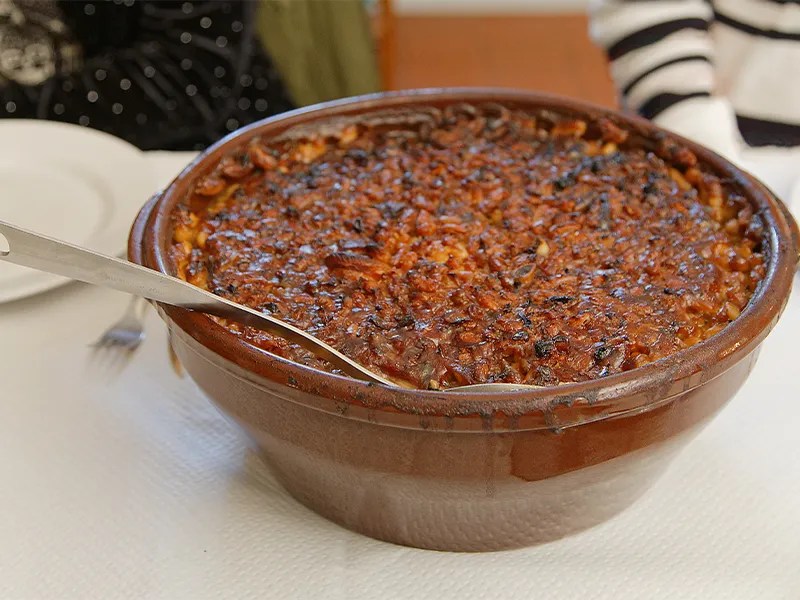
Discover the history of cassoulet – a bean and meat dish that is an obsession in France, and a delicious and tasty tale…
As war was raging around the town of Castelnaudary, the townspeople faced starvation. The English surrounded them, the town’s soldiers were dwindling fast, and it looked like this southwestern commune would be just another notch on English belts in what would become the Hundred Years’ War (1337-1453). But the people rallied. Gathering all they could find – beans, bacon, sausages – everything was chucked into a cauldron and simmered. This communal effort was rewarded, and the southwest’s most famous dish was born. Thanks to this newly invented cassoulet, their revived energy sent the English packing! Defeat could wait another day.
This is all according to legend anyway.
And is it any wonder that a dish of such extraordinary fortifying effect, so much so that it somehow prevented occupation, has gone down as the iconic taste of southwest France? Little does it matter that this siege probably never happened – the Black Prince (son of English King Edward III) led a massacre of Castelnaudary in 1355 – but legends have a sneaky way of becoming fact. Especially when it comes to cultural identity.
For a meal that was apparently made during battle, the cassoulet is understandably modest; made in a conical clay pot called a cassole, hence the name cassoulet, full of white beans and certain obligatory meats that must amount to 30% of the ingredients. This is in accordance with the 1966 ruling of the Etats Généraux de Gastronomie Française, a quality recognition board for French cuisine that evidently doesn’t take cholesterol into account. These pivotal ingredients define the terroir, but the cassoulet means much more than a bowl of stodgy comfort food.
The cult of Cassoulet

Within the walls of Carcassonne, red-robed and hatted congregants meet, watching their newest initiates take their vows before officially marking them as members by slipping ribboned amulets over their heads. We haven’t stumbled into a witches’ coven, no, this is the Académie Universelle du Cassoulet. And that amulet is a miniature cassole.
Founded by chef Jean-Claude Rodriguez in 1998, the Académie’s purpose is to honour and promote ‘true’ cassoulet around the world. To the Académie, canned ‘industrial’ cassoulet is sacrilegious, and the members have taken on a mission to uphold standards and respect French tradition. The 70 members dress in sweeping robes, has their own cassoulet hymn, and their scripture is the work of French culinary master, Prosper Montagné.
His 1929 book “Le Festin Occitan” celebrates his Carcassonne roots and it was he who declared “God the father is the cassoulet of Castelnaudary, God the Son that of Carcassonne, and the Holy Spirit that of Toulouse,” confirming the three contenders of the unofficial cassoulet competition, doctrine that the Académie still preaches.
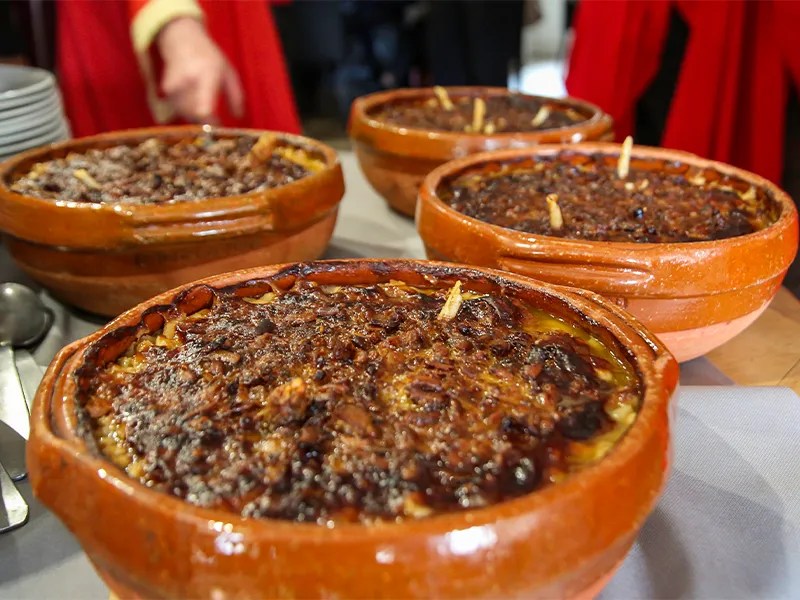
Yet this holy trinity may be a reason why cassoulet has gone down in history. As the chef André Daguin once said, “Cassoulet is not really a recipe, it’s a way to argue among neighbouring villages”.
The history of cassoulet
The ‘true’ cassoulet is constantly up for debate, as each town has a different recipe in their possession. For example, in Castelnaudary, the triumvirate of meat is duck confit, pork shoulder and sausage, while in Toulouse, it is tweaked so that the city’s own Toulouse sausage is celebrated. In Carcassonne, it includes mutton or partridge depending on who you ask, and meanwhile everything you’ve just read is uncertain because no two sources can agree!
Different restaurants within city walls take their own creative inspiration. Some swear by a crumb topping whereas others declare it as heresy, and even the type of beans can cause conflict about whether it is the Tarbais or flageolet bean. Knowing that other local towns claim it as their own injects a sense of possessiveness – usually the honour of the cassoulet’s origins is bestowed on Castelnaudary, allegedly because the town has little else to offer in comparison to its competitors, yet it is clear that this hasn’t put the dispute to rest. Castelnaudary’s La Grande Confrérie du Cassoulet – another cassoulet brotherhood – has admitted how difficult it is to trace its origins “given the inflamed passions it provokes”.

Even so, clues have been traced – medical treatises, historical artefacts, and recipe books – back to the 14th century. The cooking tome “Le Viandier” by royal cook of 60 years Guillaume Tirel honours stews and casseroles, including one in particular that was of pork and beans. La Grande Confrérie suspects the influence of a medieval culinary work by Mohamed of Baghdad who created a spiced mutton and legume stew, meaning that the cassoulet could be Arabic.
However, whichever legumes were used are no longer celebrated in the modern cassoulet as today’s white beans were shipped to Europe from the Americas by Christopher Colombus in the 16th century. The Queen of France, Catherine Medici, then introduced this new ingredient and encouraged its cultivation which was carried out in the southwest of France.
The 17th century was the Belle Epoque of French cuisine, yet cassoulet (at that time known as ‘estouffat’) was the taste of home with housewives simmering the stew over the fire for hours at a time, slowly softening the beans so they could soak up the meats’ fatty flavours. Soon it was named after the pot it was cooked in, officially becoming the cassoulet. In 1836, the first cassoulet factory was opened: Maison Bouissou was established in Castelnaudary, making the town the epicentre of cassoulet production.

Occitanie may be fractured because of the sheer variety of ‘authentic’ cassoulets, but a matter each city can agree on is that cassoulet is an occasion for a good old knees up. Toulouse’s Place du Capitole transforms into a cassoulet banqueting venue every September for aficionados to feast and Castelnaudary celebrates with an annual Fête du Cassoulet – “five days of cassoulet and music”, a reason to party if ever there was one. As Jean-Claude Rodriguez says, “Cassoulet has such a religion… because it’s the plat de partage… it’s Communion around a dish.”
Ally Mitchell is a blogger and freelance writer, specialising in food and recipes. Ally left the UK to live in Toulouse in 2021 and now writes about her new life in France on her food blog NigellaEatsEverything.
Recipe for Castelnaudary cassoulet
Recipe for Carcassonne cassoulet
Want more France?
Discover more fabulous destinations in France with our free magazine The Good Life France
Love France? Have a listen to our podcast – everything you want to know about France and more!
All rights reserved. This article may not be published, broadcast, rewritten (including translated) or redistributed without written permission.


