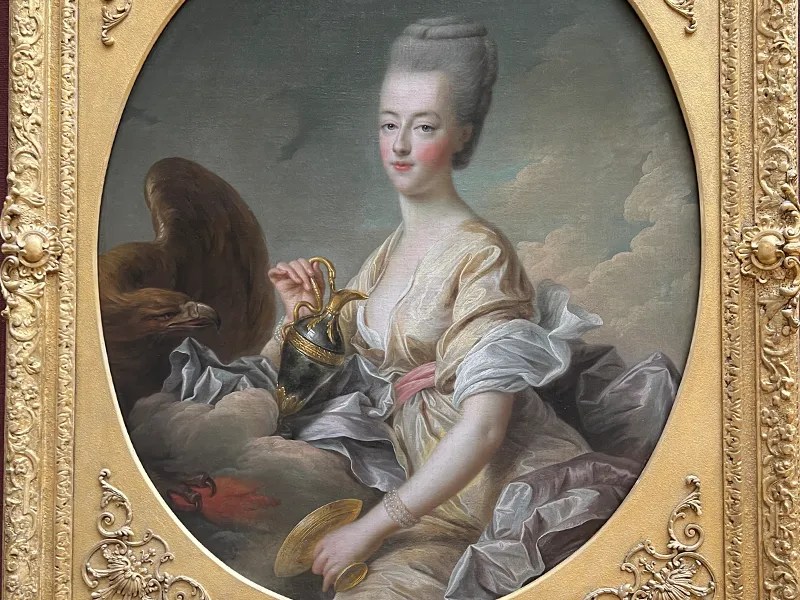
French Queen Marie-Antoinette continues to fascinate people more than 200 years after her death. To this day the opulent world she inhabited captivates us. She is a fashion icon in the 21st century as she was in the 18th century. Discover the life and times of the doomed queen, her fashion style, her family, and where to find traces of her legacy in Paris, from her homes to the shops she frequented…
Marie-Antoinette’s arrival in France
Let’s start with Marie-Antoinette’s arrival in France. She was just 14 years old when she was sent to marry the King in waiting, Louis XVI, who was just a year older than her. Her marriage to Louis was a diplomatic alliance, and their early years were marked by awkwardness and distance – a rocky start for a teenage queen in a foreign court.
Before he was crowned, Louis was known as the Dauphin, which indicated he was the eldest son of the King, and Marie-Antoinette was known as the Dauphine. Louis wrote in his diary on the day she arrived, May 14, 1770: “interview with Madame la dauphine.” It was the first time they had met.
The wedding

Her journey from Austria took almost three weeks. She stopped at several cities along the way including Nancy, Lorraine where she stopped at what is now the Hotel de la Reine. When she arrived in France, she had a beautiful Austrian wedding dress to wear but she was made to change it to wear a French style dress – which people said “made her a 1000 times more charming.” She was cheered all the way to Paris by the crowds that gathered to watch her journey to meet her husband to be and become a queen in waiting.
And here’s a fun fact: the King’s Master of Ceremonies provided 12 gold wedding rings for Marie-Antoinette to try on, which she did one by one until one of them fit her perfectly.
More than 5000 guests were invited to the wedding. As the couple walked through the famous Hall of Mirrors to the Chapel of Versailles, drums rolled, flutes played, the ceremony was followed by days of parties, dances, banquets, opera, masked balls, boat rides on the Grand Canal at Versailles and a firework display of 20,000 rockets watched by 200,000 people.
Louis wrote in his diary: “My wedding, apartment in the gallery, royal feast at the opera hall.”
Not very romantic. No words about love or even liking her.
Life as a queen
Marie-Antoinette’s relationship with the king was in fact not very romantic – at least to start. The bride and groom were both shy and inexperienced which led to bedroom issues. Gossip was rife, nothing at Versailles was secret for long, and their marriage wasn’t consummated until seven years after their wedding night. It was said that that Louis had a physical problem, no one knows for sure, and it seems likely that the young couple were simply clueless (and possibly put off by the amount of prying). But, it’s said that they grew quite fond of each other in the end.
The queen’s daily routine was anything but private. Rising at the crack of dawn, her every moment, from dressing to bedtime, was a public affair attended by courtiers. It was recorded that the Queen bathed daily in her linen dressing gown buttoned up to the neck – who can blame her with all those prying eyes. Louis, her husband was obsessive about recording his daily activities and his diaries and notebooks are preserved in the French National Archives so we know for instance that in 26 years he took just 43 baths. In those days in France it wasn’t fashionable to bathe, people just used to wash the worst bits when necessary! Some even believed that bathing was unhealthy, because so called medical experts at the Sorbonne University in Paris had declared that warm water opened the pores which let disease in.
When the Queen began to lose her popularity with the people, they slandered her for her bathing habits saying it was too “German” for a Queen of France. There were no bathrooms like we know them, no permanent bath. A bathtub would be rolled into a room called a bathroom and filled, bucket by bucket, with hot water. Once full, the queen would add perfumes to the water. She used either a special herbal mixture that included salt, thyme and marjoram, or perfumed sachets of sweet almonds, pine nuts, and lily bulbs which had been designed especially for her baths by her perfumer. Sometimes she ate breakfast in the bath! After that she would go through a public dressing ceremony, though in later years she had it toned down. Which brings us neatly to the queen’s fashion and hair.
Marie-Antoinette’s fashion style

Let’s start with Marie-Antoinette’s hair! She popularised the pouf, a towering hairstyle adorned with anything from feathers to miniature ships! In the eighteenth century, it was fashionable for women to expand themselves. Their dresses were widened with panniers, like upside down baskets under their skirts. And hair was elevated – big, big hair, nothing like the 1980’s penchant for big hair – much bigger than that. Hair was combed, curled, greased with a mix of bear or ox fat – nice, not – and then dusted with powder.
And if you think pink hair and blue hair are a 21st century Kardashian thing – you’re wrong, the women of the royal court often coloured their with powder in shades of blue, lilac, pink and even gold dust!
Cushions or pads made of horse hair were inserted to give height, and false hair clipped on to give length.
The queen and all the woman of the court liked to outdo each other with mad hair styles and big hair. They added toy ships, jewels, even vegetables and vases that contained real flowers. One fashion victim, and I think we can use that word well here, had her stylist weave a concoction on her head that was over three feet tall and included a gilded bird cage with a live, tweeting bird inside! A duchess had a scale model of her son’s nursery in her hair complete with a nanny and servants – not real ones of course, little scale models – like a lego town on her head. Hmmm. How chic…
The problem with hair that big is that often the women couldn’t fit into their carriages and had to kneel on the floor or ride with their heads out the window! And the big hair do’s were definitely a fire hazard at candlelit Versailles.
And what with not bathing and not having particularly good hygiene, fleas were pretty much on every head, so some fashionable women carried long thin sticks with claws for scratching their heads with!
The Queen’s wardrobe was lavish, filled with gowns of luxurious fabrics. Marie Antoinette’s style was extravagant She wasn’t just setting trends; she was a fashion revolution in a corset. Make-up and shoes were a big deal for the queen. She favoured a pale, powdered face with bright rouge.
She loved lipstick, which in those days was a mix of animal fat and red colouring, usually from beetroot or crushed insects. Lipstick was so popular in the 1780s that apparently French women went through two million pots a year.
And she loved her high-heeled shoes. Her shoe collection was so vast that it would make even the most avid collector blush! It was claimed that she had anything up to 3000 pairs of shoes in her wardrobe at one time, though it’s likely it was a more ‘modest’ 500 pairs!
She had tiny feet, size 33 (or 2 and half in the US). And as for dresses, she apparently ordered up to 300 dresses a year. Her clothing allowance was the equivalent of about 3 and a half million dollars a year, but she often spent twice as much – up to the equivalent of 20,000 dollars a day. And it was said that she never wore the same thing twice. All this spending gave her the nickname “Madame Deficit.”
She caused uproar when in 1781 she wore a muslin dress designed by her favourite dress-maker Rose Bertin – she used material not made in France and it was said the queen looked like a milkmaid. And when a portrait of her wearing the dress was unveiled in public, people were angry that she should dress like a commoner for fun, when the real commoners were starving due to food shortages. But the wealthy of England and Europe lapped up this new “simple” fashion which many consider influenced women’s fashions of the 18th century in Britain. And of course, she loved jewellery.
A right royal scandal
A scandal over a stolen necklace worth a king’s ransom, tarnished the Queen’s reputation badly. A thief convinced a cardinal that the Queen wanted him to buy the necklace on her behalf and then promptly disappeared with it. Although the Queen was proven innocent, the mud stuck. Not long later the French Revolution began and the Queen’s excesses at a time of poverty for ordinary people certainly didn’t help. She also wasn’t popular with some of the nobles and they loved to add fire to the smoke of a scandal that involved her. Marie Antoinette’s name was often linked with lovers, but it seems likely that it was fake news of the day. She was watched constantly so she didn’t really have that much of a chance to canoodle. But she is famously said to have had a Swedish lover – one Count Axel von Fersen.
Marie-Antoinette as a mother

While historians debate the true nature of their relationship, their intimate letters suggest a deep connection, but there is no real proof that she was unfaithful to the King. She was a devoted mother and had four children, though only one survived to adulthood.
Her motherly affection was clear in her letters, filled with worries and joys about her children’s well-being. She’s often portrayed as a selfish Queen spending the country’s money on her lavish lifestyle, unconcerned about the suffering all around her. But she had a compassionate side and a special place in her heart for children. In fact, she adopted several children. The first one was an orphan called Armand in 1776 and he lived with the royal family until the French Revolution when he joined the revolutionaires.
Marie-Antoinette gave birth to her first child in 1778 – Marie Therese Charlotte, and the queen asked that her maid’s daughter of the same age act as companion to the young princess. When the maid died, the queen adopted the daughter and instructed that both girls be treated equally.
She also adopted a young Senagalese boy, and three orphaned girls, the two eldest went to a convent and one lived in the palace. And she supported many other children financially. Though she wasn’t perfect, she does seem to have had a good heart.
Of her four children only the eldest, Marie Therese Charlotte survived her mother. Of her two sons, one died aged 7 of tuberculosis, one died age ten in prison during the Revolution and the youngest child, a daughter died aged 11 months in 1787. It was said that she died from convulsions triggered by the pain of her teeth coming through.
A queen condemned
The queen’s inner circle was a mix of nobility and confidantes. She was particularly close to the Princesse de Lamballe and the Duchess de Polignac, women who became her closest friends and companions in the often lonely and cutthroat environment of Versailles. These friendships, however, also attracted criticism and envy, as they were seen as symbols of the queen’s perceived favouritism and extravagance.
Despite her luxurious lifestyle, Marie Antoinette’s life was not without hardships. The French Revolution dramatically changed her fate. From a life of opulence, she faced public hatred, imprisonment, and ultimately, a tragic end. Her last years contrasted starkly with her early life that’s for sure.
Even during her imprisonment, Marie Antoinette maintained her dignity. She wore a simple white dress to her execution, a marked departure from her previous lavish attire, yet it was a powerful statement of her grace under pressure. On October 16, 1793, she died aged 37 by guillotine just as her husband had before her. The crowd cheered and shouted Vive la Republique as her head fell, some rushed to dip handkerchiefs in her blood.
Her body was hurled into an unmarked grave. 22 years later, she and Louis were properly reburied at the Basilica of St Denis in Paris. The guillotine that was used is said to be owned by the Tussaud Museum in London, bought by Joseph, son of Marie Tussaud the waxwork artist from the grandson of the official executioner. Madame Tussaud also created death masks for many of the victims of the guillotine during the Revolution, including Marie-Antoinette, which is in the Chamber of Horrors at the Tussaud Museum.
Where to follow in Queen Marie-Antoinette’s footsteps in and around Paris.
Janine Marsh is the author of several internationally best-selling books about France. Her latest book How to be French – a celebration of the French lifestyle and art de vivre, is out now – a look at the French way of life. Find all books on her website janinemarsh.com
Want more France?
Discover more fabulous destinations in France with our free magazine The Good Life France
Love France? Have a listen to our podcast – everything you want to know about France and more!
All rights reserved. This article may not be published, broadcast, rewritten (including translated) or redistributed without written permission.


