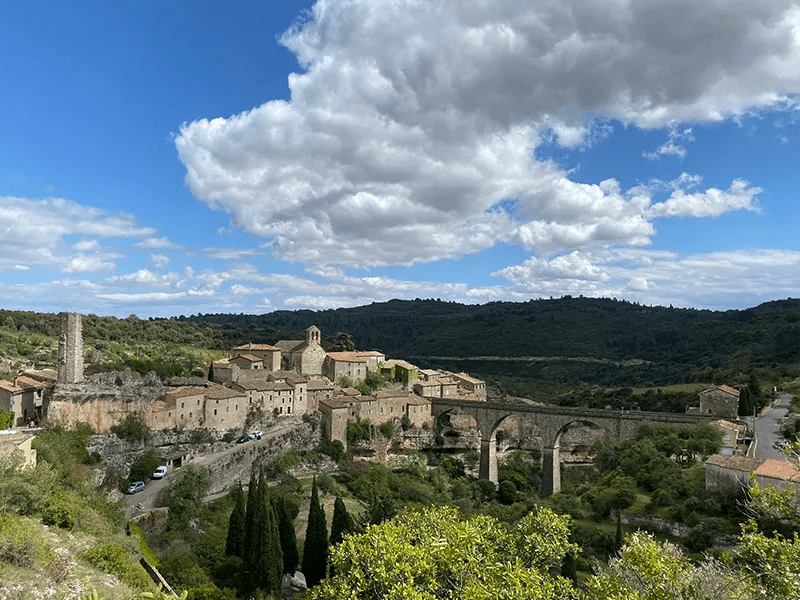
Minerve, in the Herault department, Occitanie is officially one of the prettiest villages in France. Karen Tait plunges into its medieval streets to get a sense of the town’s historic past and discover its charms. Discover what to see and do in Minerve…
As you drive along the road approaching Minerve, it’s hard not to be struck dumb by the sight before you. The medieval village clings to the top of a rocky outcrop high above a spectacular gorge – the view is surely little changed since the Middle Ages. Ok, so the route is now tarmacked for cars, rather than a rough track for horses, and maybe you’ll spot signs for a café or art gallery, but fundamentally this fortified village remains much the same as when it was built in the 13th century.
Its strategic importance is immediately obvious. Its inhabitants would have been able to spot anyone approaching from miles off – whether welcome or not – and the towering stone bridge across the gorge would have been easily defended. And yet, the most infamous event that took place here involved a failed siege.
Minerve past
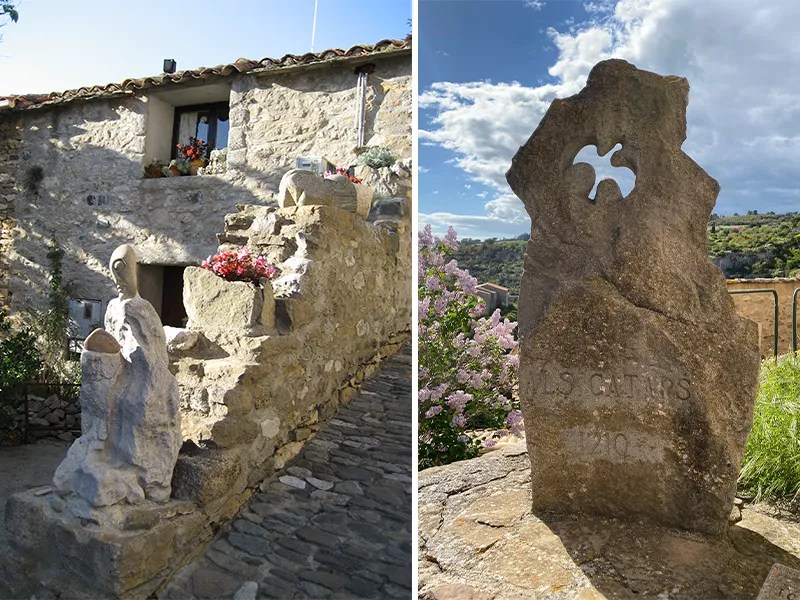
One of the ‘Cathar cities’, the picturesque streets of Minerve hide a most bloody of histories. In 1210, during the Albigensian Crusade, a group of Cathars escaping the massacre of Béziers sought refuge here. The brutal Simon de Montfort, military leader of the crusade against Catharism (considered heresy by the Catholic church) followed them there, setting up four catapults and trebuchets to bombard the double ring of ramparts.
At the time, Minerve was a powerful city, home to the Viscounts of Minerve, and thought to be impenetrable. However, after six weeks, Minerve’s only well, the Puits St-Rustique, was destroyed, cutting off the water supply and forcing the stronghold to surrender. When the 140 Cathars refused to give up their faith, they were burned at the stake in the village square.
There is very little left of the castle today, just the octagonal Candela tower, at the entrance to Minerve below the carpark (the village itself is car-free). Next to the tourist office, the Rue des Martyrs is thought to be the street the Cathars walked on their way to the stake. There is also a monument to the Cathars called the Stèle de Minerve, erected in 1982 – the ‘dove of light’ by the artist Jean-Luc Severac. It’s close to the 11th-century church of Saint-Etienne, whose altar is believed to date back to the year 456.
You can learn more about Cathar history in the village’s Hurepal museum, while the Museum of Archaeology, dedicated to palaeontological discoveries made in the nearby Aldene cave, reminds us that Minerve’s history goes back a lot further than the Middle Ages.
The village was also a base for the Knights Templars; one of the houses on Rue des Martyrs belonged to the Templiers and a stone archway near the bottom of the street features the Maltese Cross belonging to the Order of Templars.
Sadly, the Cathar crusade was not the last conflict to hit Minerve, which suffered again during the Wars of Religion in the late 16th century; the castle was dismantled in 1636.
Minerve present
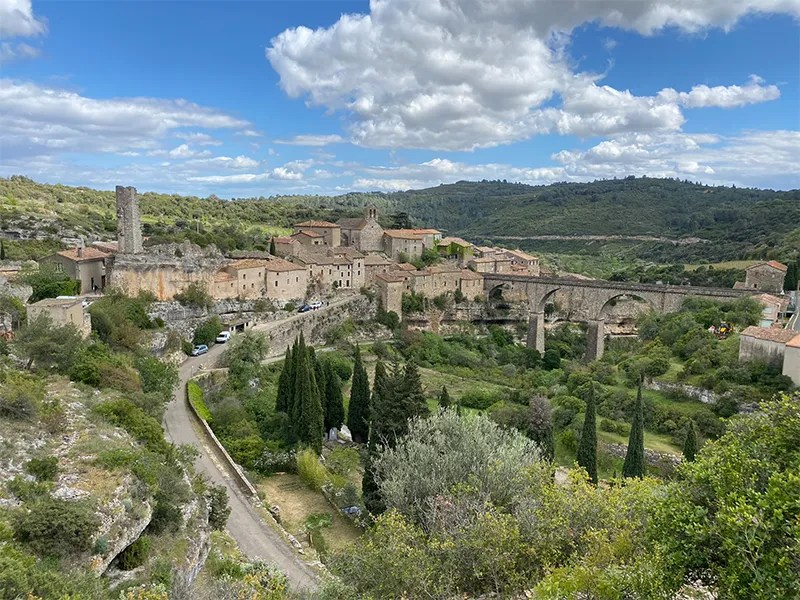
Today, as you explore the maze of cobbled streets, it’s hard to imagine the horrors of the village’s past. It’s now a tranquil and picturesque place, although it gets busy during the peak summer season. One of France’s 178 Plus Beaux Villages, Minerve is the capital of the Minervois wine region, so it’s the perfect place to sample the local wines, in one of the charming restaurants or at the Château Minerve, Domaine Vordy and Domaine Cavailles wineries. Cafés, bars and ice-cream counters are dotted through the streets, some with views of the gorge, while small independent shops and galleries sell artwork, local crafts, pottery and other specialities.
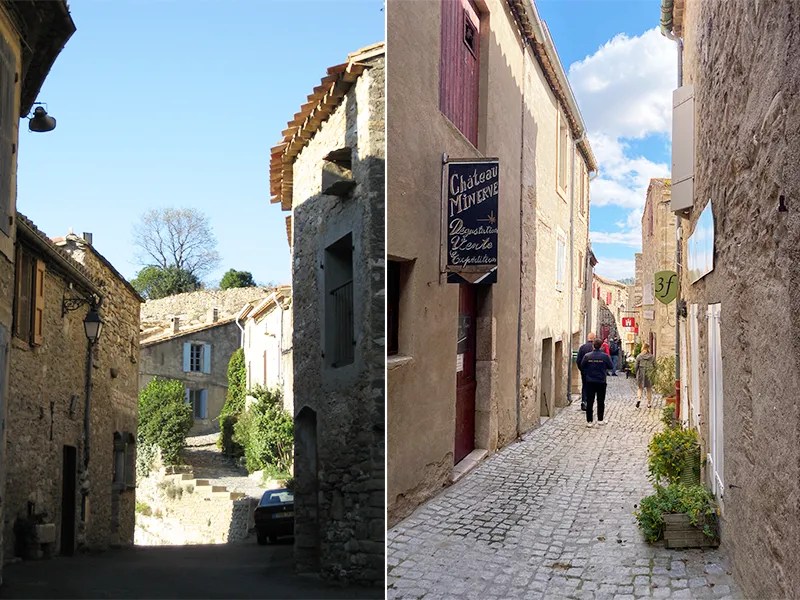
Around every corner, there seems to be a new and spectacular vista, especially from the bridge. From one side of the village, you can admire the valley of the River Cesse, while from the other you can see a section of the fortified walls. Across the river is a reconstruction of a medieval trebuchet, the ‘Malvoisine’, just like the ones which would have flung rocks across the gorge to the walls of the village.
Once you’ve discovered Minerve’s manmade side, if you’re feeling energetic you can continue your explorations to discover the cliffs and caves below the town and its extraordinary natural setting. Head down through the Porta Bassa, one of Minerve’s original two gateways, and follow the path to the river.
The River Cesse, which carved this enormous gorge, disappears underground into a natural tunnel. The waters only flow during winter; the rest of the year the riverbed is completely dry, so you can walk along it before stopping to look up at the soaring old stone bridge above you. In fact, Minerve is built upon a peninsular above the confluence of two rivers, the Cesse and the Brian, both of which have formed deep gorges and natural bridges in the limestone around the village.
Head back up to the village to reward yourself with a glass of something refreshing and another chance to gaze at those amazing views – which like Minerve itself, are unchanged from times of yore.
IN THE AREA:
Minerve is at the gateway to the Regional Natural Park of Haut-Languedoc. Surrounded by vineyards, garrigue, olive groves and chestnut woods, it offers a wonderful landscape to discover on foot or by bike.
Minerve is about 25km from Narbonne,and about 45km from Béziers and Carcassonne, beautiful cities with fascinating histories.
The nearest airports with international flights are at Carcassonne, Béziers, Montpellier and Toulouse.
Karen Tait is a freelance journalist and editor with a penchant for France!
Want more France?
Discover more fabulous destinations in France with our free magazine The Good Life France
Love France? Have a listen to our podcast – everything you want to know about France.
All rights reserved. This article may not be published, broadcast, rewritten (including translated) or redistributed without written permission.


