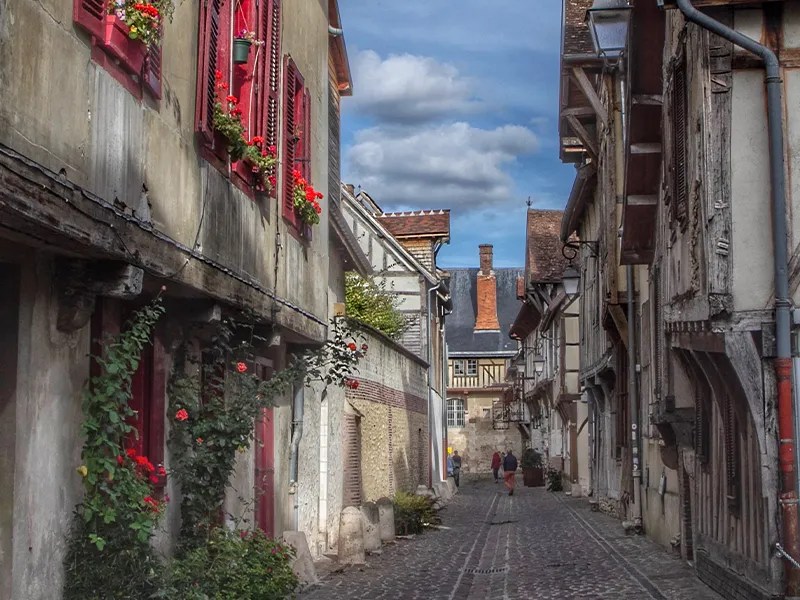
The Champagne cork-shaped town of Troyes in Champagne has oodles of charm. When it comes to what to see and do in Troyes (pronounced trwa), in the Aube department, east of Paris, really has something for everyone. Gothic churches and museums galore, the greatest collection of half-timbered houses in the country, 45% of the planet’s stained-glass, a dynamic city centre, the largest factory outlet in Europe, and three huge lakes within less than an hour’s drive.
So clearly, not a town to visit in one day. But you certainly pack a number of its highlights into a long weekend, perhaps visiting a couple of religious edifices and one museum per day, otherwise you may suffer an indigestion of religious art. You could equally overdose on local favourite “andouillette” chitterling sausage) and Champagne, because Aube is second only to its northern neighbour, the Marne, for the quantities of bubbly produced!
Half-timbered houses of Troyes

Troyes’ greatest enemy has been fire. The Vikings burnt it down in 888, the cathedral was reduced to ashes in July 1188 and in May 1209 large sections of the town went up in flames. But it was a catastrophic two-day fire in May 1524 that destroyed about a quarter of the city, mostly in the affluent merchants’ neighbourhood. Those with money rebuilt in stone, others simply replicated the medieval design of their previous home.
So although the colourful, half-timbered houses, all leaning hither and thither in the city centre look medieval, they are largely post 1524 Renaissance.
Troyes was left almost unscathed by WWII but had become, to quote from tourist office documents “an unattractive city with a serious image problem… a genuine cesspool”! So the most destitute neighbourhoods were pulled down with the loss of the city’s oldest timber-framed houses. But fortunately, in the late 1950s concerned inhabitants founded an association whose volunteers over the past 70 years have convinced successive local governments to restore the city to its former glory.
What to see and do in Troyes
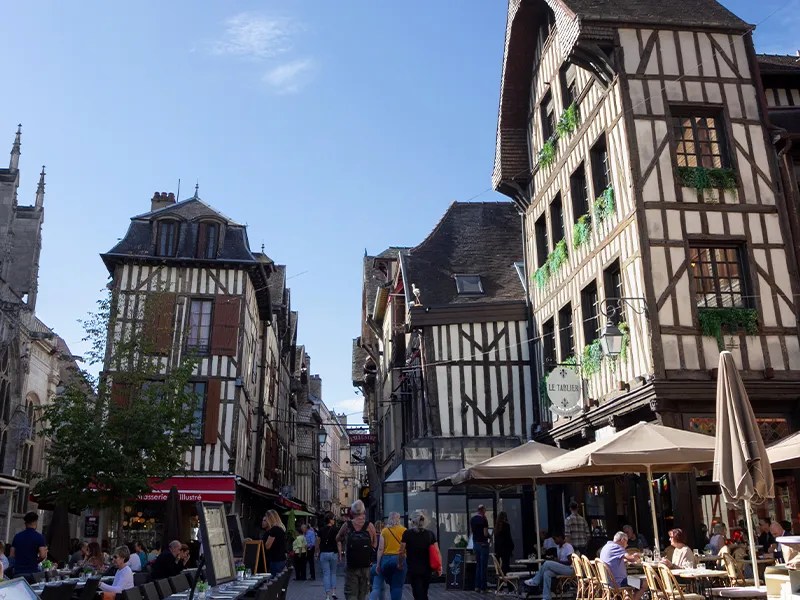
And glorious it is! The city centre is referred to locally as “Le Bouchon” (the cork) because, although it pre-dates the invention of Champagne by more than a thousand years, it is shaped like a Champagne cork lying on its side with the head, fashioned by the Seine, facing east. The Trévois canal with its decorative fountains slices the cork north to south. West of this canal, the parallel sides of the cork’s body lie where the ancient city walls used to be.
Le Bouchon is small (2 km from east to west and 820m north to south), so there’s no need for a car. Use the large (and free!) outdoor carpark in front of Le Cube, the exhibition centre on the south-west corner of Le Bouchon and explore on foot.
As you meander along the cobbled pedestrian streets, look for the Maison des Chanoines on the corner of the rue Émile Zola and the rue Turenne. The front door is now uselessly on the first floor because when the house was moved here in 1969, it was reconstructed on a modern, concrete ground floor to align its roof with others. It is apparently easy to move half-timbered houses as long as you number all the beams in the dismantling phase and put them back up in the right order!
Troyes’ narrowest street, the “ruelle des chats” (cat street) is an ancient misspelling. It should have been the “ruelle des chas” (eye of a needle street) which is much more appropriate! Walk down it to reach Saint Pantaléon church, remarkable for its height, luminosity and statues. Because the nave is narrow, it makes the chestnut-wood barrel-vaulted ceiling seem higher than its 28m (92ft). The glass windows, decorated with grisaille paintings, fill the XVIIth century top half of the nave allowing light to flood inside the building. But its most extraordinary feature is the abundant population of statues, most not sculpted for this church but rehoused here after the French Revolution.
Churches and stained glass

Saint-Pantaléon is one of seven remarkable churches in Le Bouchon. The oldest is Sainte Madeleine, which contains one of only 21 roodscreens in France. This early 16th century stone partition between the chancel and the nave drips with intricate, flamboyant sculptures that were all polychrome until they were whitened in the 18th century.
Saint-Urbain basilica served as a grain silo and then a general store during the French Revolution, but has now resumed its place as a jewel of Gothic architecture, often compared to the Sainte Chapelle in Paris because of its vast expanses of stained-glass which, on a sunny day, make the stone walls and pillars sparkle with colours.
And of course, there’s the single-towered (because money ran out to build the second one!) Saint Peter and Saint Paul cathedral which contains 1,500 m2 of some of the most sublime stained-glass windows in France. As you walk across the Trévois canal on the rue George Clémenceau towards it, look down at the modern sculpture by Belgian artist Tom Frantzen, a dog who has jumped through the bridge railings to chase five geese. On the bridge north (to your left) you’ll see the heart of Troyes, a 2-tonne, 3.5m high sculpture by local artists Michèle and Thierry Kayo-Houël, and on the bridge south, “Lili” by Hungarian artist Andras Lapis.
If you want to see stained-glass et eye-level and learn something about how it is made, then pop into the Hôtel-Dieu-le-Comte, a hospital from the 12th Century until 1988, which today houses the Apothecary Museum and the Cité du Vitrail (stained-glass city).
Museums galore
Just alongside the cathedral is the Modern Art Museum created in 1982 to house the extraordinary collection of Pierre and Denise Lévy who made a fortune in the textile industry. They had discerning taste: Ernst, Dufy, Millet, Rodin, Degas, Courbet, Gaugin, Matisse and Braque are just a few of the artists whose work is exhibited.
But to me one of the jewels in Troyes is the MOPO, Maison de l’Outil et de la Pensée Ouvrière (Tools and trades museum). Now I am not particularly skilled in DIY, nor particularly interested in tools, but am nevertheless enchanted by this establishment.
The museographers have managed to make an interesting, engaging and visually pleasing exhibition of more than 12,000 handmade tools from the 12th, 18h and 19th centuries. The tools are beautifully showcased in 65 displays organised by theme and divided into four families: wood, iron, animal and mineral. Explanatory panels are in French but there is an excellent audio guide in English (and other languages).
Shop until your drop
Many visitors to Troyes come here first to visit a modern sanctuary: the factory outlets! Troyes’ inhabitants have been weavers, drapers, dyers and launderers since time immemorial and the city became a European centre of excellence in the manufacture of hosiery. At its peak in 1970 the industry employed 24,397 and monopolised the French knitwear and hosiery sectors: stockings, socks, underwear, polos, and world-famous brands such as Lacoste and Petit-Bateau were founded and still manufacture here. Imperfect items were sold to factory employees at much reduced prices and then in the 1960s a centre was created where all these seconds could be sold in one place, and hey presto: the factory outlet was born! Today there are four factory outlet zones around Troyes with a total of 148 shops.
And if you’ve shopped till you drop and can’t take any more culture then head for one of the three lakes Great Lakes of the Forêt d’Orient where any manner of water sports and beach activities are on offer, or bring some binoculars and observe the thousands of birds who stop here on their migratory route. A lovely spot to relax by the water with a picnic and a glass of local Champagne!
Useful website: troyeslachampagne.com
Christina McKenzie is a Franco-British journalist who writes in both English and French. Married to a Frenchman, she settled 30 years ago near Fontainebleau.
Want more France?
Discover more fabulous destinations in France with our free magazine The Good Life France
Love France? Have a listen to our podcast – everything you want to know about France and more!
All rights reserved. This article may not be published, broadcast, rewritten (including translated) or redistributed without written permission.


