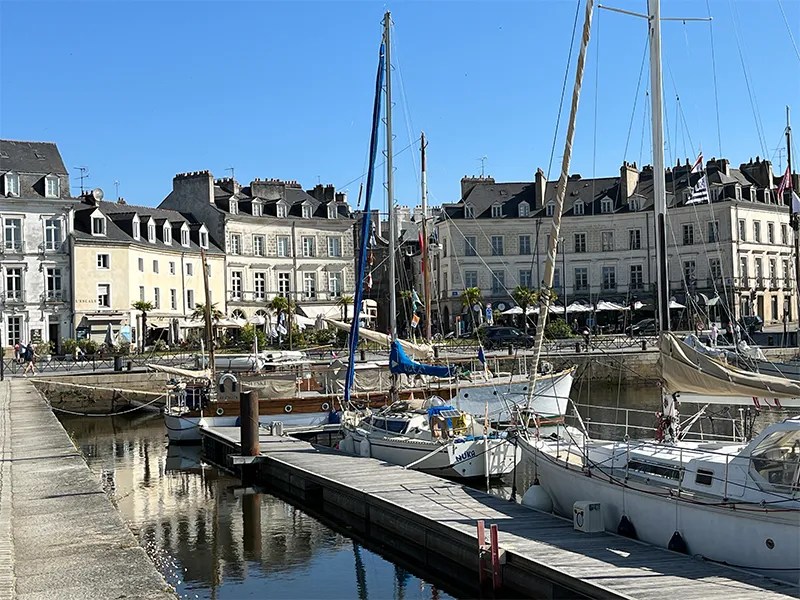
Think of a sea that’s almost entirely surrounded by land and chances are that your thoughts will go to the Mediterranean. But deep in the south-east corner of Brittany lies a surprising alternative that packages outdoor activities, heritage sites and seaside scenery into one neat bundle. Discover what to see in Vannes and what to see close by…
Discover Vannes
The Golfe du Morbihan, from the Breton word for ‘little sea,’ is a tidal basin created 2,000 years ago when the Atlantic Ocean surged into low-lying land through a gap in the coastline. Today, this unique area of saltwater covers 12,000 hectares, its tidal flow reaching inland as far as Auray in the west and the walled city of Vannes at the head of the Gulf.
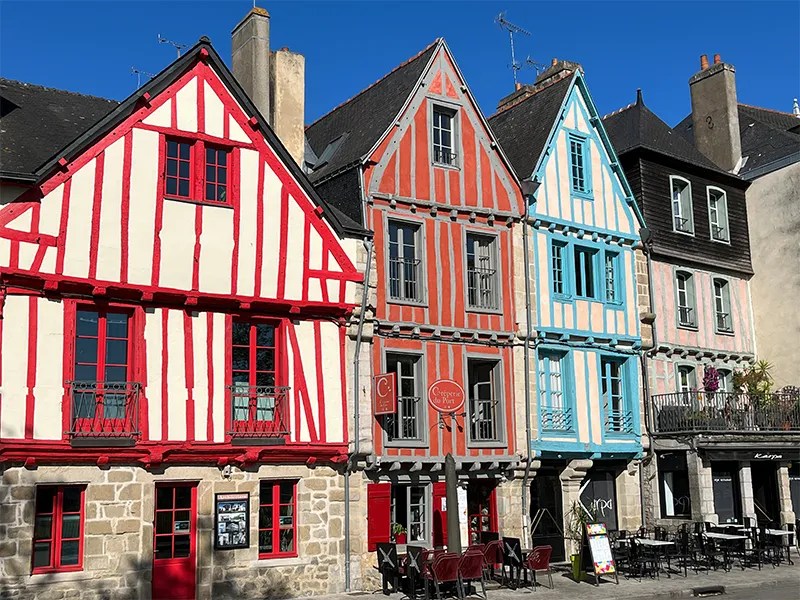
I start my exploration in Vannes, founded by the Romans in 56BC as Darioritum after their victory over the Veneti. In the 5th century AD, the town was renamed Venetis and the old hilltop site – today’s district of St Patern – was abandoned as a new town grew up inside fortifications. But it was in the Middle Ages that Vannes began to take on its present aspect, and today it is one of Brittany’s most enchanting medieval towns with rampart walks, winding streets, and half-timbered buildings.
I’m booked into La Villa Garenne, (chambredhotes-vannes.fr) a stylish B&B in a 19th century property with individually themed rooms. Located on a narrow street leading down to the ramparts, the house is just 150 metres walk from the marina with a free public car park just up the hill and the station a 15-minute walk. With Paris only two hours away by train, Vannes makes an attractive choice for a city break with added coast.
What to see in Vannes
Tempting though it is to dive straight into the walled city – the Intra Muros – I head first through Place Gambetta to Quai Taberly beside the marina to visit the Tourist Office. Here you can pick up maps and walking routes as well as book guided visits or cruise excursions. The café-fringed semi-circle of Place Gambetta stands between the marina and Porte St Vincent, the town’s main gate. But hug the eastern side of the city walls to enjoy the full-on effect of those impressive ramparts. Built and rebuilt over several centuries, the existing walls and towers are largely from the 15th to 17th century and almost three-quarters of the fortifications still stand.
The eastern and northern sections are the most imposing, the view unfolding as you pass Château de l’Hermine, once owned by the Dukes of Brittany, and now standing proud above formal flowerbeds in the dry moat beside the Merle river. Keep to the pavement for a high level view, or take the steps by the Poterne Gate to access the restored 19th century washhouse and the lawns and floral displays of the Garenne gardens beneath those lofty ramparts.
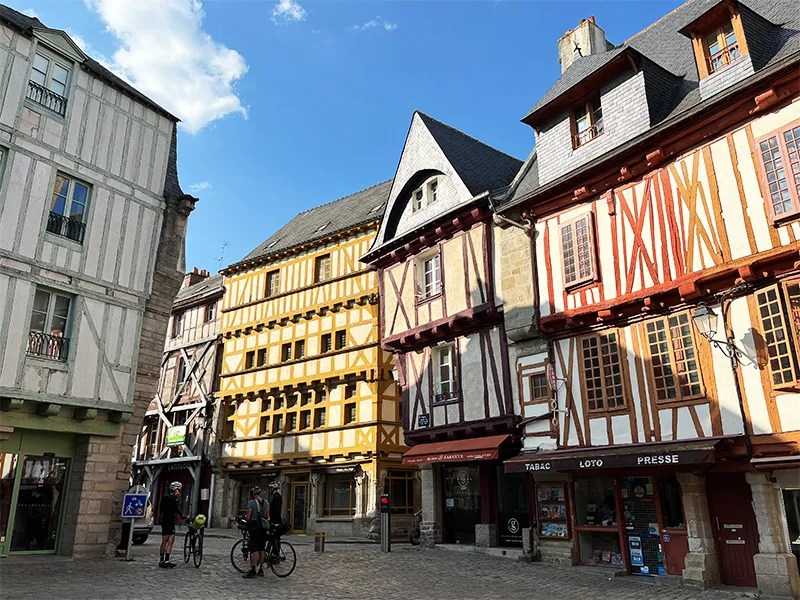
Turn left inside the Prison Gate behind the Joliette Tour to access the oldest part of the city walls, dating from the 3rd century. Or just follow the maze of winding streets. It’s not hard to imagine the medieval scene as you wander from one picturesque square to another beneath half-timbered houses and slate roofs. Place Henri IV beneath the Cathedral is a photographer’s delight, whilst Place des Lices near the ducal castle now hosts the Wednesday and Saturday market, but was once the town’s tournament venue.
Close to St Pierre Cathedral with its tall spire is La Cohue, named after the Breton word for ‘market’. In the 13th century, stallholders plied their trades on the ground floor with the court of justice – and later, the Breton Parliament – upstairs. Today it houses the Museum of Fine Arts whilst Château Gaillard, a grand 15th century stone house, is home to the Archaeological Museum.
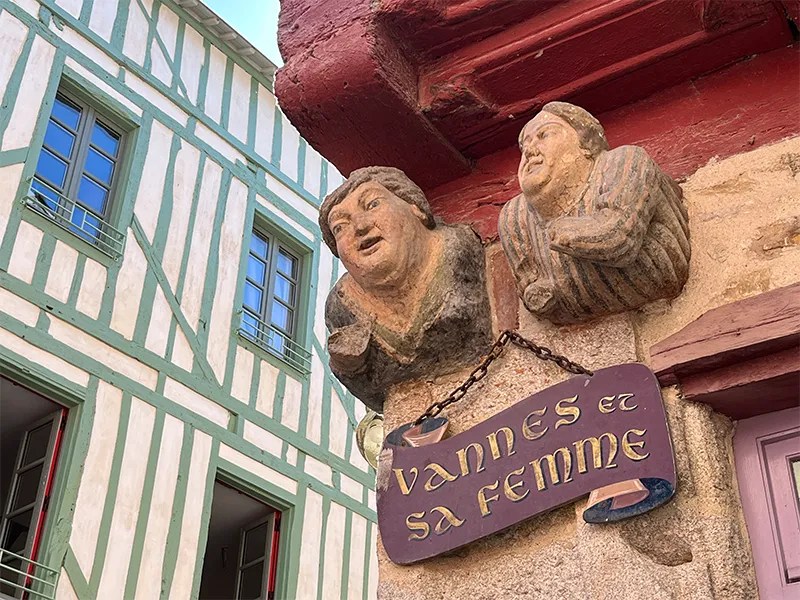
Every turn reveals some new surprise. Look out for the carved wooden heads adorning house number 13 in Rue St Solomon, and don’t miss ‘Vannes et sa femme’, two painted heads on the corner of Place Valencia, perhaps a medieval marketing exercise for a local shop.
Refuel at one of Vannes’ many restaurants and then, if you’re feeling energetic, maybe follow the walking trail from the marina in Vannes to the harbour at Conleau. Or take a cruise excursion round the Gulf, perhaps with a stop on the Ile d’Arz or Ile-aux-Moines.
What to see near Vannes
For a different perspective on this tranquil inland sea, I drive out of Vannes and down the eastern shore towards Sarzeau and the beautiful Rhuys Peninsula that forms the Gulf’s southern boundary. Boat excursions leave from Port-Navalho at its tip for Vannes, Auray and the offshore islands of Belle-Ile, Houat and Hoedic, or you can simply watch the currents race through the narrow channel into the Gulf.
Criss-crossed with walking and cycling trails, the Rhys Peninsula offers sheltered inward-facing beaches and a wilder, ocean-facing shore. I book a stay at the nearby Manoir de Kerbot, (hotelrestaurantkerbot.com) a 4-star country hotel with 9 bedrooms and spa, although sadly the gourmet restaurant is closed on Monday when I visit. But instead I enjoy a delicious al fresco fish supper on the ocean coast at Côte Plage in Le Roaliguen.
Chateau de Suscinio
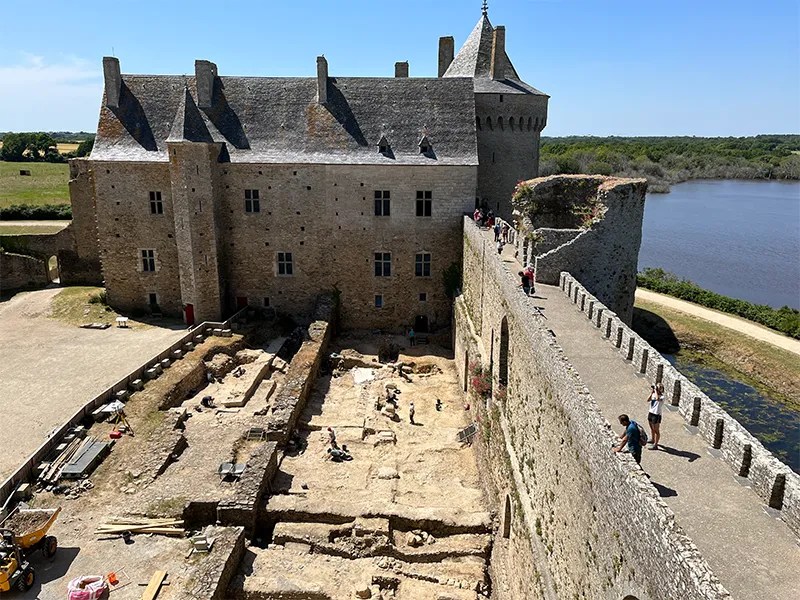
Next morning, I head back towards the Atlantic to visit the Domaine de Suscinio (suscinio.fr). Another former home of the Dukes of Brittany, this magnificent moated castle with two huge towers was built in the late 14th century for Duke John IV on a large estate created by the family in the early 13th century.
A state-of-the-art des res with large mullioned windows and wide fireplaces for maximum light and warmth, the Logis Est or ‘Duke’s House’ even included a second-floor steam room. The Logis Ouest or ‘Marvellous Lodging’ was added by Duke John V to house important guests, but over the centuries, the castle fell into disrepair.
Restoration began in earnest in 1965 when the estate was purchased by the Department of Morbihan, and in 2023, Suscinio unveiled a brand new interactive visitor experience. The year is 1450 and, with the aid of video projections and reproduction furnishings, Isabella of Scotland, widow of Duke François I, guides visitors around the ducal lodgings to witness negotiations for the marriage of Anne de Bretagne. Eight-year-old daughter of Duke François II, Anne would later become Queen of France and thus bring Brittany into the French kingdom.
Meanwhile, across the courtyard, Merlin the magician guides visitors through the Logis Ouest to explore the story of King Arthur and his reputed links with Brittany. Don’t miss the high level view over courtyard, coast and countryside from the northern curtain wall, nor the nature trail around the Suscinio marsh. Once a natural protection for the castle, today the wetland is itself protected as a nature reserve rich in waterfowl. Two other trails offer castle views, wildlife and historical background.
Visit between April and September to take a leisurely row around the castle moat. And in July and August, enjoy a spectacular evening show every Tuesday and Thursday when 800 years of history are projected on the castle walls, followed by a spectacular firework display. The perfect finale to any ducal day out!
Useful website: golfedumorbihan.co.uk
By Gillian Thornton, one of the UK’s leading travel writers and a regular writer for The Good Life France Magazine and website.
Want more France?
Discover more fabulous destinations in France with our free magazine The Good Life France
Love France? Have a listen to our podcast – everything you want to know about France and more!
All rights reserved. This article may not be published, broadcast, rewritten (including translated) or redistributed without written permission.


