If you have a taste for history, the pint-sized town of Cognac, with its royal castle and famous distilleries, will satisfy your soul, says Janine Marsh.
My dad used to say that the ancient gods would drink a small glass of Cognac when they finished feasting and needed to end with something special. And my dad wasn’t alone in his opinion. The great French writer Victor Hugo also declared, ‘Cognac is the liquor of the gods.’
So what is it about Cognac that makes it not just fit for celestial beings but one of the world’s most prestigious drinks? I headed to Cognac, deep in the glorious countryside of Charente, southwest France, to explore a fascinating world in which wet dogs, wet cellars and angels have something in common and where a drop of the good stuff could set you back a week’s wages!
Cognac – the town
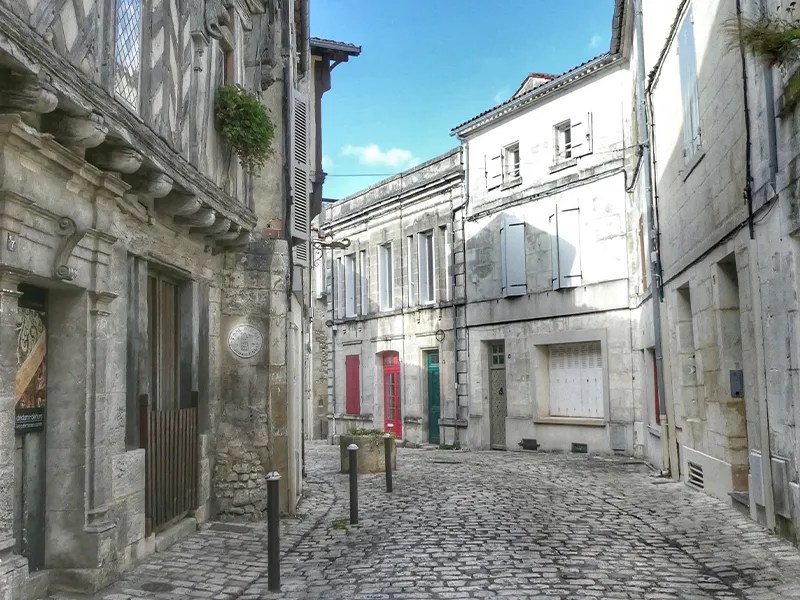
Cognac lies around 30 miles inland from the Atlantic coast port of La Rochelle and roughly the same distance from Bordeaux. It’s a classified town of ‘Art and History.’ The old district has a village atmosphere, criss-crossed by hilly cobbled streets lined with shops, bars and medieval buildings, dominated by a formidable-looking castle. It’s here that France’s Renaissance King, Francois I, was born in 1494, some 50 years before the drink named after the town was invented, though his former home is now a distillery.
Cognac the liquor of the Gods

Some say that the town’s most famous export was born in the 15th century when canny wine merchants distilled their product to save freight charges on wine exports to England and Holland – just add water, they reasoned – instant wine! But the truth is that Dutch traders turned to distillation to preserve the wine for the long journey home. They called it brandwijn, burnt wine, and the term eventually became brandy.
Those early Dutch traders may have invented the process, but local French winemakers took the primitive distillation process further, perfecting the double distillation method, resulting in a divine eau de vie.
What’s the difference between brandy and Cognac
So, what is the difference between brandy and Cognac? Top producer Remy Martin says it’s all down to “organoleptic complexity and aromatic finesse” and that “all Cognac can be considered as brandy, but not all brandy is Cognac.” Basically, Cognac is always made with grapes, not other fruits like some brandies. It has a very specific distillation, and production is contained within a small, protected area.
The Cognac/brandy difference is pretty much along the same lines as “not all sparkling wines are champagne.” But unlike champagne, where the master blender is the key to ensuring quality, with Cognac, the Maitre de Chai – the cellar master – is the key to the drink’s unique aromas and taste, blending, refining and maturing each precious drop to produce VS, VSOP and XO Cognac (see bottom of article for an exaplanation).
Cognac – savoir-faire in a bottle
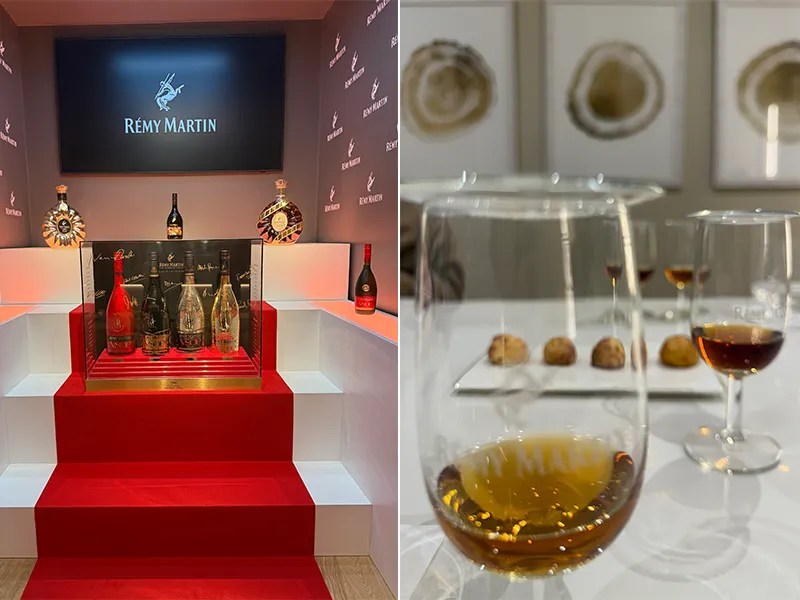
Several museums in Cognac are dedicated to the amber nectar, including the newly opened Remy Martin Historic House, which opened in 2024 to celebrate the company’s three centuries of production. Here, you can tour the house and cellars, where you’ll spot secret codes on barrels that only the cellar masters understand. Their tours include tastings and a cocktail masterclass, and even an initiation into Remy Martin’s prestigious Louis XIII Cognac – which is always served at state banquets in France, or head to their vineyards and estates in Grand Champagne for tours including a Petit train ride through the vines.
Find out more and book a tour at: remymartin.com
The town has several famous name producers, with glitzy domains and cellars filled with liquid gold. A great time to go is outside of the peak summer months: autumn, when the leaves on the vines turn to gold; winter, when nothing beats a seat by a fire in a cosy bar as you gently swirl your glass of Cognac; and spring when the air starts to warm up, and the treasured vines start sprouting new leaves and teeny-tiny grapes.

One of the best places to enjoy a snifter is at the 5* hotel Chais Monnet & Spa in what was Maison Monnet – the 19th-century warehouse of one of the area’s most eminent Cognac producers. Now transformed into an elegant, luxurious hotel, with two restaurants, the Michelin-starred Les Foudres, bistronomique La Distillerie, plus Café Angelique and a summer rooftop bar – there’s also the legendary 1838 Bar. Housed in the former cooperage, the décor made me think that if Harry Potter was grown up and looking for a bar with plenty of magic, this would be it. Dark wood, comfy chairs, an air of history, and 300 Cognacs to choose from. Unmissable.
Details: chaismonnethotel.com
Angels, wet cellars and wet dogs
The Cognac region has six distinct growing areas: Grande Champagne, Petite Champagne, Borderies, Fins Bois, Bons Bois, and Bois Ordinaires, and although the same grape is grown across all areas – Ugni blanc – the terroir, the growing conditions from soil to weather, is quite different and produces a difference in the taste of the Cognac.
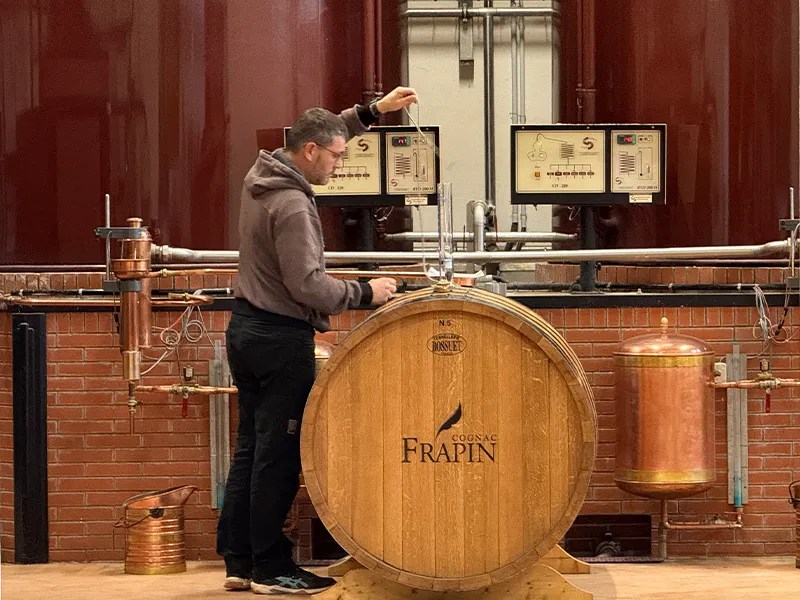
I headed to the Grand Champagne vineyards to find out more – Champagne in this instance, referring not to the sparkling wine but ‘campagne’, the French word for the countryside. The village of Ségonzac, in the heart of this area, is home to Domain Frapin, 21 generations of winemakers and distillers. Founded in the 12th century, the Frapin family have in their family tree one Francois Rabelais (born circa 1483), the famous medieval author and son of Anne-Catherine Frapin and Antoine Rabelais. The Frapin logo reflects their illustrious ancestor – a feather representing Rabelais’s quill.
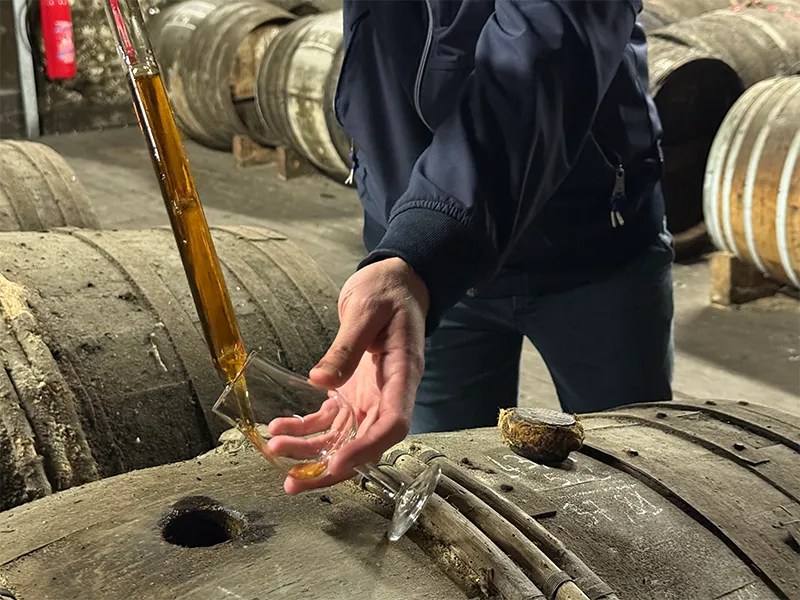
My morning tour with guide Thomas included several cellars, where I learned the difference between a wet and a dry cellar, it’s all about the evaporation rate of the alcohol in the barrels, known as the ‘angels’ share (up to 3% of the liquid), which is represented by a black fungus that creeps over the walls. Wet cellars mean more evaporation of alcohol creating a mellow, softer taste; dry cellars create more evaporation of water leaving a spicy, intense finish. This was followed by a tasting session 11 a.m. (apparently, this is the best time—because you have a fresh palette).
“Sniff and say the first thing that comes into your head,” Thomas urged. “Erm, earthy?“ I offered, earning a smile. “Close,” said Thomas, “wet dog. It smells like a wet dog!”
Of course, that’s not all it smells of – after all, this is a premium cognac we’re snuffling, but deep inside the aroma is, Thomas assures me, a whiff of wet dog. And what’s more, this is a good thing “very distinctive, an indication of age and how the Cognac has developed over the years.”
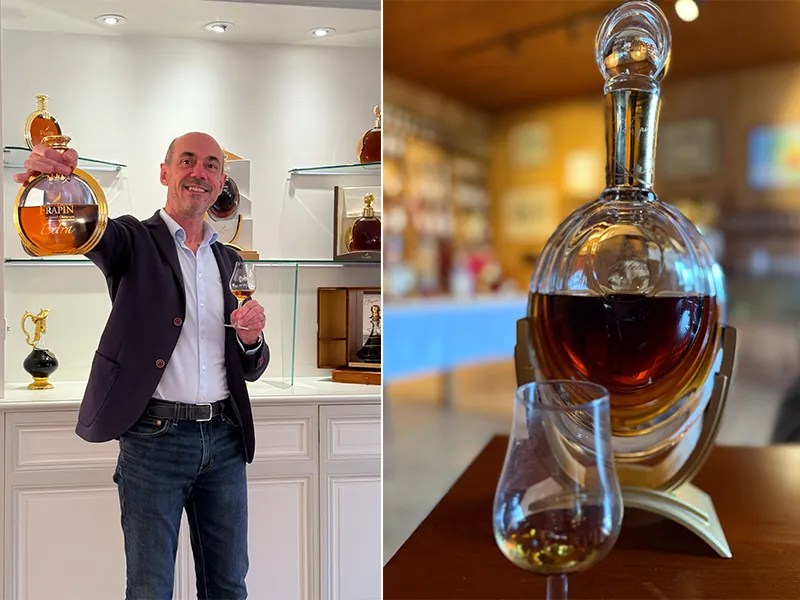
Later, cellars master Patrice Piveteau explains that Cognac is a sensory experience. “What do you smell?” he says, passing me a glass of Frapin VSOP. “Melon?” I suggest. “Candied peel,” he says, “not just melon. It’s never just orange or clementine; it’s spicy, aromatic notes of orange.“
“Cognac is almost like a condiment. It goes perfectly with cheese, not too strong though, maybe stilton or mature comté. Try it with Roquefort – mixed with a little salty butter,” he kissed the air at the thought. “It’s classic to serve it at room temperature – but you can chill it too! Keep it at 20 degrees for several days and then pour. The taste sensation explodes in your mouth.”
My tasting tour included a cocktail in the exquisite Chateau and a drop of their premium Cuvée Rabelais, which, at a shade under €10,000 per bottle, is definitely a tipple worthy of gods and goddesses.
Find details of all their tours and more information at cognac-frapin.com/en
The Cognac hunters
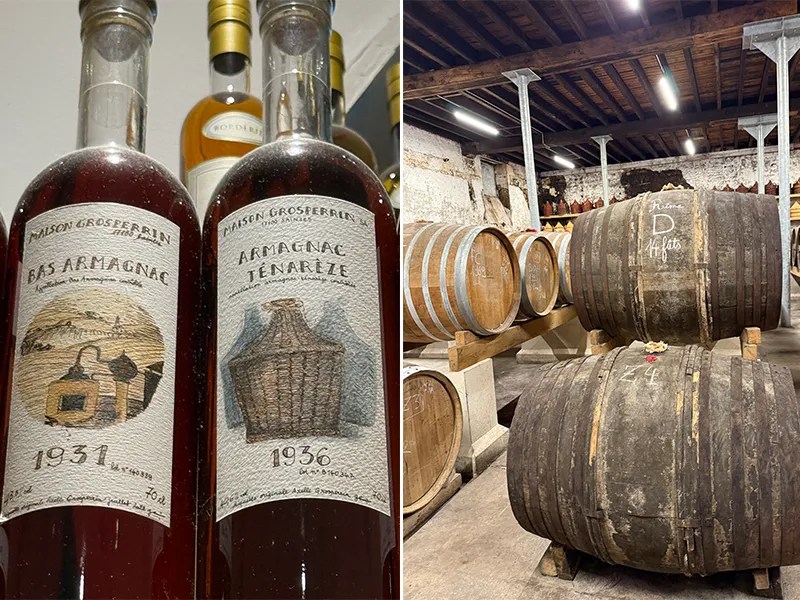
Cognac is, to some, what gold is to others. And at Maison Grosperrin in Saintes, you can take a tour to learn how a small group of Cognac experts ‘hunt’ for treasured Cognac barrels left for decades in the cellars of farmhouses or aged in the sea, rare and unique vessels that are coveted by connoisseurs around the world. Their fascinating tours explain the secrets of ageing and anecdotes about the origins of the barrels of Cognac in their cellar, and include a tasting of some of the most remarkable and rare Cognacs in the world.
Find out more and book a tour: cognac-grosperrin.com/en
Where to stay
The Quai des Pontis Hotel in the centre of Cognac, on the banks of the River Charente, has oodles of charm.
Find out more: Tourist office explore-cognac.com
Get there: There are direct flights to Bordeaux and La Rochelle from the UK.
Trains from Paris take from 2h 41m.
7 fascinating facts about Cognac
- Chestnut wood bands are fastened around the cognac barrels to attract spiders that would otherwise harm the oak barrels.
- Barrels must be made from a specific type of oak from Limousin or Allier’s forests, creating a distinctive golden colour.
- Remy Martin created a miniature bottle for space travellers (though it’s not yet been tested).
- Vintage casks of Cognac have wax seals applied by the National Office of Cognac.
- Napoleon Bonaparte gave Cognac to his troops to lift their morale.
- A whopping 95% of Cognac produced in France is exported – America is the biggest market, boosted by marketing deals with rappers.
- It takes 10 litres of white wine to make one litre of Cognac.
What does the VS mean on bottles of Cognac?
VS : Very Special – aged for at least two years.
VSOP : Very Superior Old Pale – aged for at least four years.
XO : Extra Old – aged for at least six years.
Janine Marsh is the author of several internationally best-selling books about France. Her latest book How to be French – a celebration of the French lifestyle and art de vivre, is out now – a look at the French way of life. Find all books on her website janinemarsh.com
Want more France?
Discover more fabulous destinations in France with our free magazine The Good Life France
Love France? Have a listen to our podcast – everything you want to know about France and more!
All rights reserved. This article may not be published, broadcast, rewritten (including translated) or redistributed without written permission


