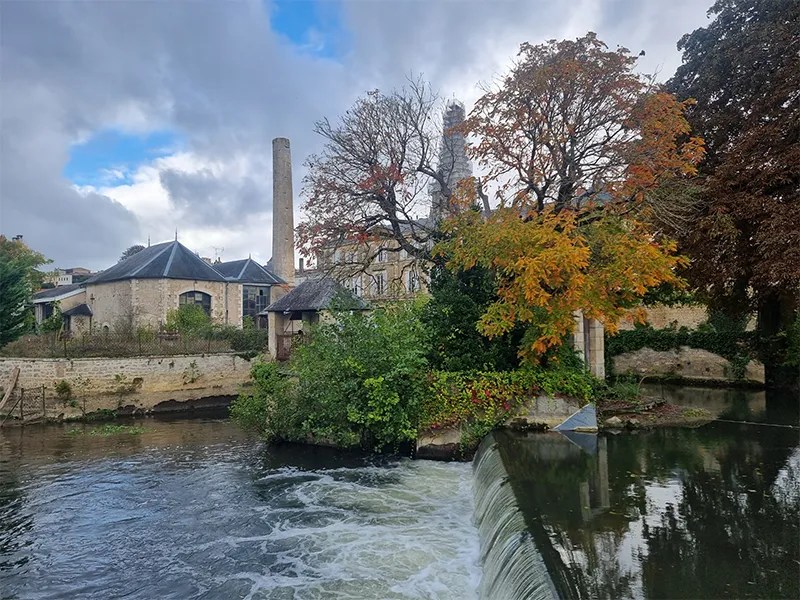
St Maixent l’École is a small town in the Deux-Sèvres region of Nouvelle Aquitaine (about 1 ½ hrs drive from La Rochelle). But for a small town, it packs quite a cultural punch!
The town was founded in 459 by a monk, Agapit and originally called Saint Saturnin. Maixent, a fellow monk, came to the town in 480. During the Wars of Religion between 1562 to 1598, St. Maixent marked the border between the Protestant / Huguenots strongholds to the west and the Catholics to the east. At this stage in its history, the town was a bustling centre producing fabric, leather and mustard. These days, it’s a town with some beautiful architecture and a fascinating past, and it’s well worth an afternoon spent exploring.
Stepping through the gates of time
If you arrive via the main D611, you might at first think St Maixent is a rather unremarkable town but turn off the road via the majestic Porte Chalon and the town starts to reveal itself. Porte Chalon was built in the 18th century to replace the former gates into the fortified part of the town and as an entrance, it is surprisingly grand.
Once you’ve parked (there is parking on Rue de la Marne), start with a quick visit to the Tourist Office (walk down the main road west to east – Avenue Gambetta and Rue Denfert Rochereau which run parallel – and you’ll see the tourist office on your right). They have some useful information including a map with the main attractions marked. Look out for the English phone box as you head off to explore which signifies the towns twinning with the English market town of Horsham.
The Abbey
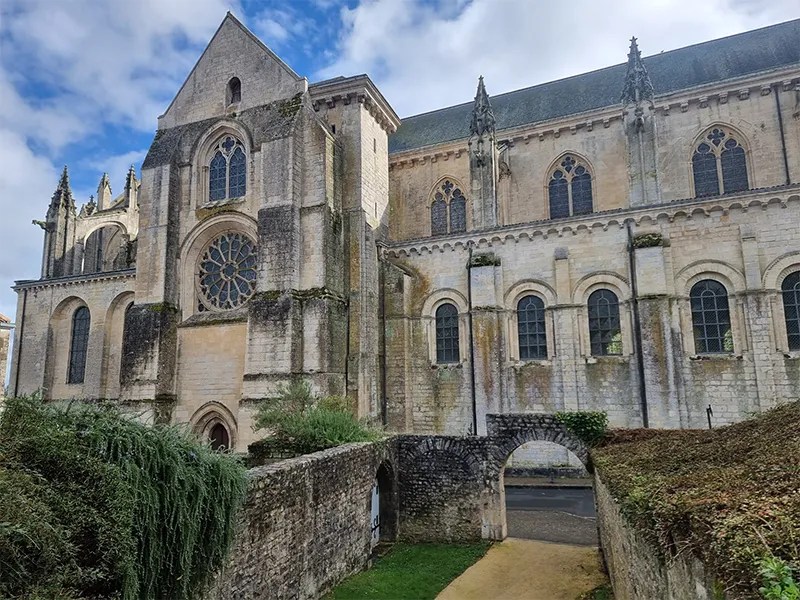
The inescapable central point of St Maixent is the Abbey which was built after the death of St Maixent (c 515). In 653, Léger was appointed abbot of the monastery. The monks left when the Normans arrived but later returned and the town was fortified. The Abbey was rebuilt in Romanesque and Gothic styles and is open to the public. It was declared a Royal Abbey in 1204.
The Abbey spire stands proud over the town but once inside, there is an impressive nave and as well as a 17th century screen, a huge pulpit, cloisters and the crypt with the empty 6th and 7th century tombs of St. Maixent and St. Leger. The church of St Léger opposite the Abbey was built in 7th century but was closed in the 17th century and not rediscovered for 200 hundred years.
From the end of the 19th century right up to 2011, the Abbey was also home to military barracks, and you can visit the Non-Commissioned Officers Museum in the Marchand Quarter. It has a collection of uniforms, weapons and decorations. There is something rather haunting about the vast barracks and the empty square and archway at the back of the Abbey and you can almost hear the marching of soldiers from the different wars that once raged in and around the town.
Exploring the town
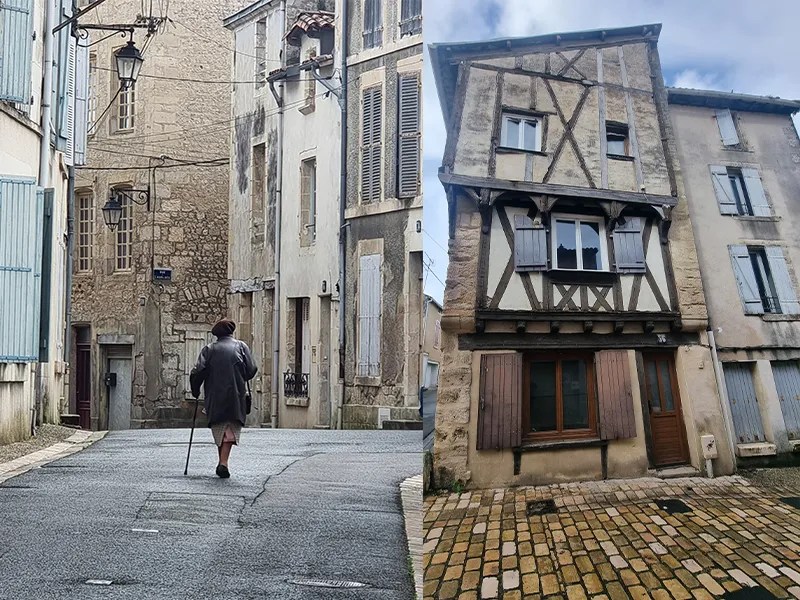
Once you’ve visited the Abbey, it’s time to explore the rest of the town. It’s a pretty town with cobbled streets, ancient half-timber houses leaning tiredly over the roads, grand limestone buildings shimmering in the heat, interesting doorways and gates, and shuttered windows. It’s also a green town too with plenty of wisteria, honeysuckle and bougainvillea dripping over its walls. Although this is the most northern part of southern France, you can feel a distinctly southern vibe and influence.
Be sure to climb one of the small narrow footpaths that wind up Le Peux Saint Martin (a small hill) to the southwest of the town and look back across the landscape and then go in search of interesting buildings.
Mason de l’Apothicaire was built in about 1442 and has a sign that says Hic Valetudo which means Health Here! Hotel Balizy was built in 1530 in Renaissance style and used to be a courthouse. Apparently, Catherine de Medici once visited.
Beyond the Abbey, you arrive at the Quai des Tanneries. During the Middle Ages, this was the heart of the town with a canal built by the monks that drove water to the Abbey mill and the tanneries. Today, it’s picturesque with narrow canal side pathways and houses reflected in the water. There are four little footbridges along the canal which take you to a wooded area. At the other end, is a large, shaded park. If you’re visiting in the summer, they have an ongoing programme of events that take place here.
Time to reflect
When you’ve explored the town, you might fancy a spot of shopping in the elegant Rue Chalon or lunch in one of the cafés and restaurants there. Or head to the Place du Marché (Market Square) where there’s a large indoor market and a cluster of cafés in the shade of the trees. There has been a market held here since 1469 and today the market building built at the end of the 19th century has a distinctly Parisien air.
The Haut Val de Sèvre
The area surrounding the town is known and the Haut Val de Sèvre and is a hilly landscape with plenty to discover whether you want riverside walks, history (and even a 15th century Scottish castle) or to experience one of the local festivals. The historic town of Niort is to the south west of St Maixent, whilst to the north is Parthenay an equally historic town and to the east is Poitiers, making St Maixent a good base from which to explore the Deux Sevres.
by Lucy Pitts, travel writer and editor of Sussex Exclusive
Want more France?
Discover more fabulous destinations in France with our free magazine The Good Life France
Love France? Have a listen to our podcast – everything you want to know about France and more!
All rights reserved. This article may not be published, broadcast, rewritten (including translated) or redistributed without written permission.


