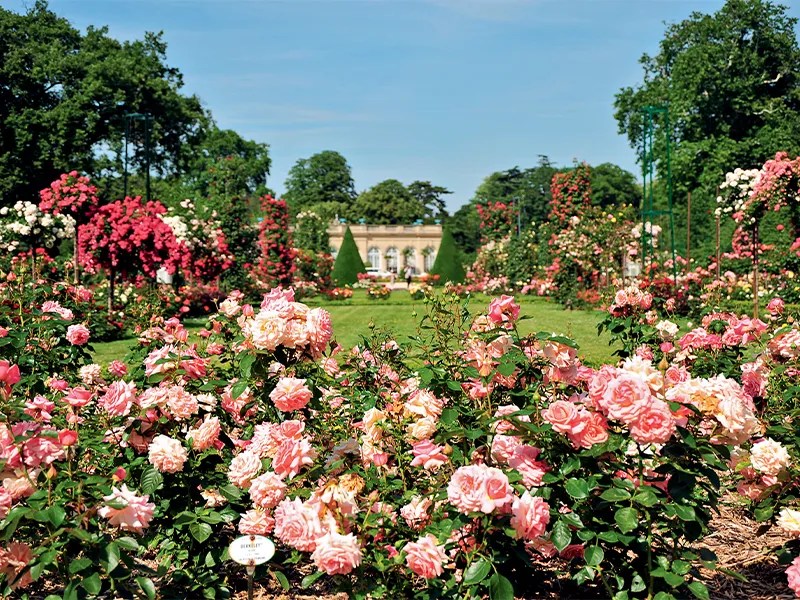
“Bagatelle: these long hours spent in a garden are perhaps the best thing that we will ever have had in life” – Henry de Montherlant
What is now Parc de Bagatelle in Paris, was once the site of a lodge that was used during royal hunting parties. In the 18th century, during the reign of Louis XV, it was purchased by Marechal d’Estrées and became popular with libertines: members of the nobility indulged in frivolous leisure at extravagant parties held in this lush setting hidden from view.
In 1775, the Count of Artois, Louis XVI’s brother and the future King Charles X, acquired it. Two years later, Queen Marie Antoinette set him the incredible challenge of building a new residence there in less than 100 days. In the end, he succeeded in just 64 days with the help of architect François-Joseph Bélanger and 900 labourers. The Château de Bagatelle is the epitome of a folie—a type of small building that wealthy aristocrats built on a whim, with no regard for cost.
The estate went through several different owners who enlarged the château, expanded the gardens, and built an orangery. It was purchased by the city in the early 20th century. After years of neglect, the estate was restored and remodelled by Jean-Claude-Nicolas Forestier, custodian of Bois de Boulogne, who turned it into the delightful botanical garden that welcomes visitors today. He also created the large rose garden, which is famous among flower enthusiasts throughout Europe.
The Rose Garden
The rose garden in Parc de Bagatelle, is one of the largest and most beautiful of its kind in France, with more than 1,200 varieties spread over 4 acres (1.6ha). Established in1905 by Jean-Claude-Nicolas Forestier, the garden continues to evolve, year after year. Originally, the flowers were largely presented in uniform beds. Today, the gardeners experiment with other compositions by using a range of cultivated and wild roses, including rosebushes, climbing or ground-cover roses, and roses winding around arches or shrubs. Depending on the variety and the weather, the roses bloom between early summer and November. But the best time to admire them is in June, at the International Competition of New Roses. Since 1907, this event has awarded prizes to recently created roses – three for their beauty and one for its fragrance. During the competition, the flower candidates are displayed in the presenters’ garden, which was specially designed for this purpose, and the park’s gardeners give out valuable advice to enthusiasts.
The Name “Parc de Bagatelle”
This park is steeped in so many stories that it can be difficult to untangle fact from fiction, even when it comes to its name, which has various connotations in French. It may refer to the park’s low purchase price. Or perhaps to its modest size, compared to nearby properties. Or else to the amorous activities enjoyed by aristocrats at parties held in the garden during the ancien regime.
Eighteenth-Century Manifesto
Parc de Bagatelle encapsulates 18th-century garden fashions, which included nature in both a luxuriant and skilfully composed state; grottos; ruins that appear to be straight out of antiquity; and architecture inspired by an imagined East. When the park was built, English gardens prevailed in Europe. The aim was to recreate the spontaneity of nature in opposition to the symmetry of French gardens, which were considered too strict. But some found this imitation of nature too simplistic and decided to add complexity in the form of elements borrowed from China. Few architects in the 18th century had actually been to Asia, though, and the pagodas that cropped up in European parks have little in common with the originals. In Parc de Bagatelle, the Chinese pagoda and the Kiosque de L’Impératrice are primarily decorative buildings, but they provide advantageous views of the park.
A Flower-Filled Walk
While the rose is without doubt the star of the show at Parc de Bagatelle, many other plants flourish here throughout the year. The collections include 160 varieties of flowering bulbs that form colourful, ever-changing flowerbeds. Snowdrops kick things off in February, followed by crocus, narcissus, spring snowflake, tulips and hyacinths into June.
The Mediterranean garden is wilder in appearance than the rest of the park. It was created in 2000, after more than 300 trees were uprooted by a storm in 1999. It features species that are adapted to a dry, sunny climate, such as fig, heather, privet and various aromatic plants. It is a precious source of inspiration for composing gardens that will be more adapted to future droughts. Chrysanthemums and clematis can be seen winding around trees or climbing walls, geraniums in the summer and fall, and, a little later in the year, asters, most of them from North America. Water lilies thrive in the lake, where a splendid weeping willow is reflected. The largest plane tree in Paris, towering 148 feet (45 m) high, stands a little further away. Only the luckiest visitors are likely to spot a kingfisher near the coots, moorhens, and barnacle geese that frequent the lake. But no one can miss the peacocks – about 50 of them live in the park and enjoy the attention of visitors.
Getting there: Pont de Neuilly (Metro line 1), Avenue Henri-Martin (RER C)
Extract from THE MOST BEAUTIFUL GARDENS OF PARIS By Stéphane Marie. From the most famous gardens – Versailles, Luxemburg, or Tuileries – to the hidden leafy gems – such as the Château de Saint-Jean-de-Beauregard vegetable gardens, the Bourdelle museum’s sculpture garden, or the Albert Kahn Japanese-style garden – this guide takes readers on a cultural tour of France through twenty-five spectacular gardens in and around Paris.
Want more France?
Discover more fabulous destinations in France with our free magazine The Good Life France
Love France? Have a listen to our podcast – everything you want to know about France and more!
All rights reserved. This article may not be published, broadcast, rewritten (including translated) or redistributed without written permission.


