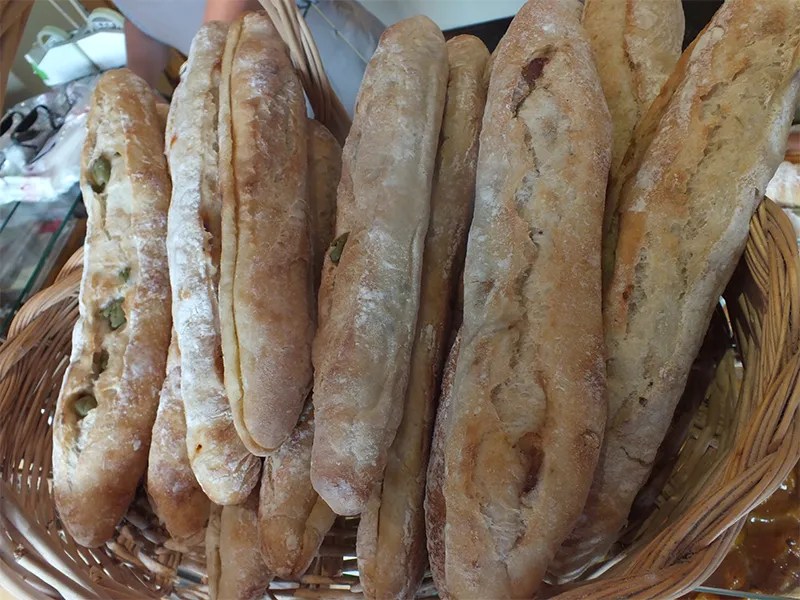
Crispy baguette laced with olives, Pain aux olives, are delicious on their own, filled or dipped. This recipe for olive baguettes creates a taste of the Mediterranean, a delicious rustic bread that features just a few simple ingredients but is teeming with flavour.
Makes 3 loaves, weighing about 14 oz. (400 g) each
Active time: 1½ hours
Pâte fermentée fermentation time: Overnight
Bulk fermentation time: 1 hour + 10–12 hours in the refrigerator
Proofing time: 45 minutes
Cooking time: 30–40 minutes
Storage: Up to 2 days wrapped in a clean dish towel
EQUIPMENT
Stand mixer + dough hook
Instant-read thermometer
Bread lame
INGREDIENTS
Pâte fermentée
1½ cups (6 oz./180 g) white bread flour (T65)
Scant ½ cup (112 g/112 ml) water
½ tsp (3 g) salt
0.2 oz. (3 g) fresh yeast
Olive mixture
1.75 oz. (50 g) pitted black olives, roughly chopped
1.75 oz. (50 g) pitted green olives, roughly chopped
0.25 oz. (5 g) basil leaves, chopped
Scant 2 tbsp (25 g/27 ml) extra virgin olive oil
Olive bread dough
4 cups + 2 tbsp (1 lb. 2 oz./500 g) white bread flour (T65)
1⅓ cups (325 g/325 ml) water
2 tsp (10 g) salt
0.25 oz. (5 g) fresh yeast
10½ oz. (300 g) pâte fermentée (see above)
Olive mixture (see above)
METHOD
Preparing the pâte fermentée (2 days ahead)
Mix the flour, water, salt, and yeast together in the bowl of the stand mixer and knead on low speed, or by hand, for 10 minutes until smooth. Place in a bowl, cover with plastic wrap, and let ferment overnight in the refrigerator.
Preparing the olive mixture (1 day ahead)
Combine all the olive mixture ingredients in a bowl.
Preparing the olive bread dough (1 day ahead)
Knead all the olive bread dough ingredients, except the olive mixture, in the bowl of the stand mixer on low speed for 5 minutes until well combined. Increase the speed to medium and knead for 6 minutes. With the mixer running on low speed, add the olive mixture and continue to knead for 2 minutes until well distributed. Make sure the dough temperature does not exceed 75°F (24°C). Place in a clean bowl, cover with plastic wrap, and let ferment for 30 minutes at room temperature. Fold the dough once, then cover with plastic wrap and let ferment for 10–12 hours in the refrigerator.
Shaping and proofing the dough
The next day, divide the dough into 3 pieces weighing 14 oz. (400 g) each. Shape each one into a bâtard measuring 8 in. (20 cm) in length and place on a baking sheet lined with parchment paper. Let proof in a steam oven set to 75°F (24°C), or on a rack in a turned-off oven above a bowl of boiling water, for 45 minutes.
Baking the loaves
Place a rack in the center of the oven and another rack directly below it. Place a heavy-duty rimmed baking sheet on the bottom rack and preheat the oven to 480°F (250°C/Gas Mark 10). Bring 1 cup (250 ml) water to a simmer. Using the bread lame, score each loaf lengthwise down the center. Place the loaves on the baking sheet in the oven and carefully pour the simmering water into the rimmed sheet on the lower rack to create steam. Quickly close the oven door and bake for 30–40 minutes. Immediately transfer the loaves to a rack and let them cool completely at room temperature.
Extracted from French Boulangerie: Recipes and Techniques from the Ferrandi School of Culinary Arts by FERRANDI Paris (Flammarion, 2024).
Want more France?
Discover more fabulous destinations in France with our free magazine The Good Life France
Love France? Have a listen to our podcast – everything you want to know about France and more!
All rights reserved. This article may not be published, broadcast, rewritten (including translated) or redistributed without written permission.


