
Angers in the Loire Valley is a mix of contrasts – old and new. Trams whizz around the city with its mighty medieval castle, there are museums galore, a vibrant cultural life, and it’s one of France’s greenest cities. It’s also home to a unique cutting-edge theme park dedicated to plants, and a mysterious island that you can only reach by hand-pulled cable ferry. Discover what to see and do in Angers…
Angers – a city of Secrets and surprises
Angers began as a Gallic settlement before becoming the Roman town of Juliomagus. Its strategic position made it a key stronghold throughout the centuries, but the city really came into its own in the Middle Ages as the seat of the powerful Plantagenet dynasty. In the 13th century, King Louis IX (AKA Saint Louis) ordered the construction of the formidable Château d’Angers, still one of the most impressive fortresses in France, which dominates the city today as it has for centuries.
What to see and do in Angers
With 17 huge bastion towers, and enclosed by walls 600m long, the castle looks fearsome, but it was even more imposing before two storeys were demolished in the late 1500s. King Henri III actually ordered the whole building to be destroyed but the job was delayed, the king died before it was complete, and so the castle was saved. The walls have an interesting striped appearance due to the use of local shale and white limestone. And the dry moat, where once animals roamed during the reign of Good King René (who was actually never a King of France but was King of Naples, Sicily and Jerusalem, and was considered a good ruler of his provinces) is now planted with gorgeous gardens.
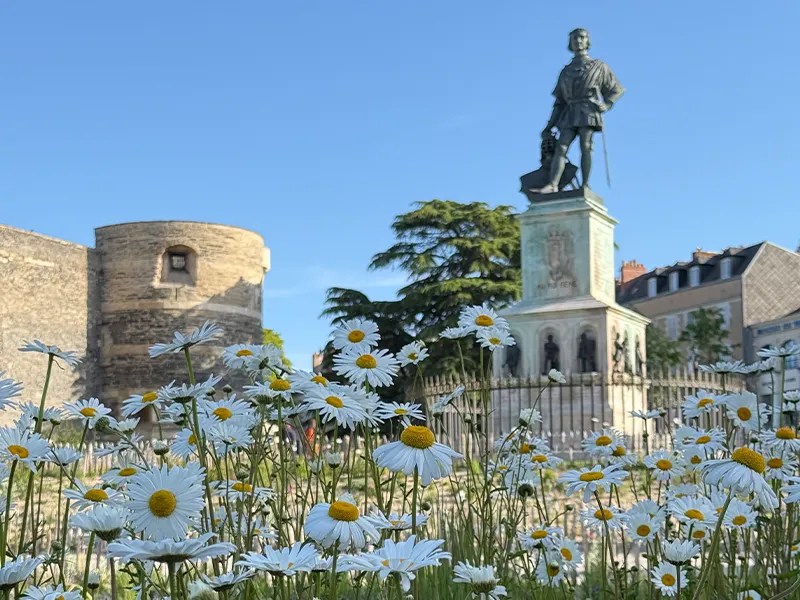
Inside the castle, the world famous “Apocalypse Tapestry” portrays the apocalypse as described by Saint John in the Bible. It was commissioned by Good King René’s grandfather, Duke Louis I of Anjou. Created between 1373 and 1380, it is an amazing medieval artwork with an astonishing history. When René left Angers for Provence, turfed out by his nephew King Louis XI in 1471, he donated the tapestry, 130m long originally, to the Cathedral of Angers, who later tried to sell it without success. During the French Revolution the Cathedral was ransacked, the tapestry was thrown onto the streets and the locals cut bits off to use as carpets, bedspreads, even horse blankets and cart covers. In 1843 a search for the remnants began and around 60% was recovered – most of it in a local rubbish dump!

Opposite the entrance to the castle is the old town of Angers, La Cité – a maze of cobbled streets and beautifully preserved ancient buildings from the 12th century onwards , and well worth a wander though most are private dwellings and can only be glimpsed when their wooden carriage gates are open!

The Cathedral of St Maurice, built in the 12th and 13th centuries (the one which tried to sell the tapestry) has glorious stained-glass windows dating back almost 900 years, plus a 15th century rose window that’s breathtakingly beautiful. A monumental organ with some 4600 pipes, was being tuned the day I visited, the mournful lament of the notes and the wonderful acoustics are hauntingly unforgettable. A modern stone canopy has recently been erected over the front of the Cathedral to protect the magnificent façade – not everyone loves the new addition, but then not everyone loved the Eiffel Tower when it was built.

Behind the Cathedral is the Maison d’Adam which has been recently restored and looks as it did 600 years ago, its wooden posts decorated with around 50 carved figures including an apple tree on a corner turret. Adam and Eve, who were also featured, disappeared in the French Revolution. I can’t help thinking that somewhere in this town someone has a room with 15th century wooden figures hanging on the wall overlooking a carpet made of 13th century tapestry!

Close by is the Fine Arts Museum which has a lovely collection of medieval paintings and Renaissance furnishings. Next to it is the Galerie David d’Angers. Pierre-Jean David d’Angers (1788–1856), commonly known as David d’Angers was called the Michelangelo of Paris by Victor Hugo, and his commissions graced the Chateau of Versailles and towns all over France. A mould of the pediment he created for the Pantheon can be seen in the museum, representing the allegory of the French Revolution, it features men who contributed to the progress of the nation – including a youthful looking Napoleon Bonaparte. The artist gifted a collection to the town in gratitude for the scholarship he received in 1810. The vast display is on show at the former 13th century Toussaint Abbey church which now features a wonderful glass roof that casts light over the monumental work. Moulds of statues that adorn cemeteries and city squares throughout France include an outsize King René and a giant Jean Bart, a popular French pirate, plus busts, medallions and working drawings. It’s an extraordinary museum (and if you go an hour before closing, entry is free).
La Doutre, Angers

Often missed by visitors, La Doutre – from d’Outre-Maine, ‘beyond the Maine’ – is the district on the ‘other side of the river’ – easily reached on foot across one of the bridges. Once inhabited by the aristocracy and wealthy bourgeoisie, it fell on hard times after the French Revolution but is now an affluent area undergoing a regeneration. It has a countryside air to it, tree-lined avenues, green squares, and fine houses – some dating from the 16th century including no. 67 rue de Beaurepaire which once belonged to an apothecary. Here you can open one of the shutters to see the amazingly well-preserved 17th century check carvings.
Doutre is home to the former St Jean Hospital, founded by King Henry II of England and Anjou in 1174, now the Lurcat Museum, where “Le Chant du Monde’ (the Song of the World) tapestry by Jean Lurcat is displayed. The artist, visiting Chateau d’Angers in 1938 was inspired by the Apocalypse Tapestry and later created his own contemporary masterpiece, a work of hope and peace against the fear of the atomic bomb.
Where Cointreau is made
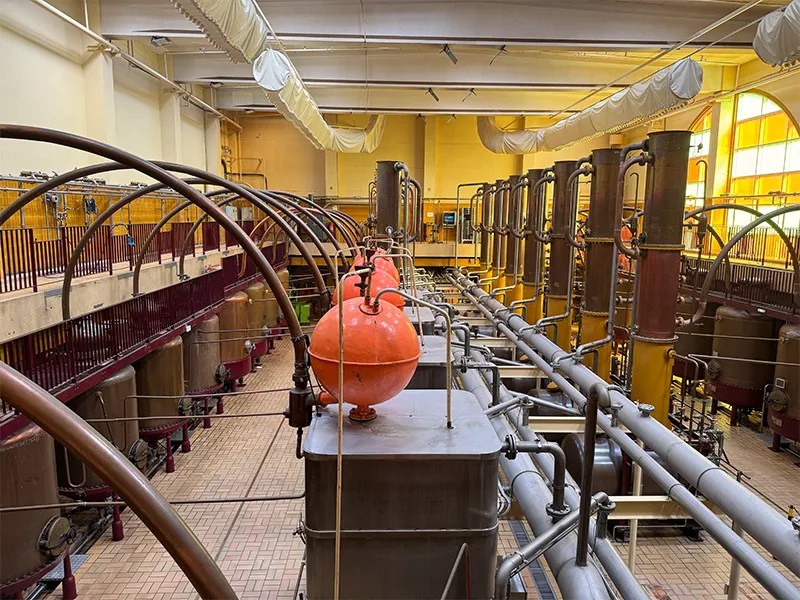
Cointreau fans (yes, I am!) will love a tour of the Cointreau factory and museum. Established more than 175 years ago in Angers, Cointreau is one of the world’s most famous crystal-clear spirits and the distinctive amber square-shaped bottle is a global icon. Made from bitter and sweet orange peel, every bottle of Cointreau comes from this site. A slew of famous cocktails feature Cointreau, some of the best-known include the Sidecar, London 1922 (Cointreau, Cognac and lemon), the Cosmopolitan 1934 (Cointreau, gin, lemon and raspberry syrup), and the Margarita 1948 (Cointreau, tequila blanco, fresh lime juice, and a salt rim).You can find lots of cocktail recipes, and book a cocktail masterclass at Cointreau via their website!
Angers is also home to La Maison Giffard who have been producing the famous pastille-menthe liqueur since 1885. They also offer a tour, tasting and workshops.
Terra Botanica

You may never have heard of this theme park but if you are ever in Angers or close by – put it at the top of your list. A short tram ride from the city brings you to Terra Botanica – dedicated to the life of plants. You can easily spend an entire day here amongst the butterfly houses and themed areas which range from the discovery of plants around the world, huge greenhouses of exotic plants and orchids, Siberian-cold sheds, and everything in between. There are rides through the treetops, on tractors and in boats, plus superb animations – a 4D film about the life of a raindrop will have you staring in wonder next time it rains! This has gone on my list of top theme parks in France, not just because I love gardens and plants but it’s a really fabulous way to relax and spend a day. There are restaurants on site but also plenty of places for picnics.

Just down the road from Terra Botanica is one of Angers’ secrets and the locals’ favourite – the mysterious island of Île Saint-Aubin. You can access it from April to October (it floods each winter) via a hand pulled ferry. It’s a little bit of paradise, fields of wildflowers and an enchanting little café – I felt as if I was in an Impressionist painting here.
What to see close to Angers
A little further afield, the massive seven-storey Chateau Brissac is the country’s tallest castle, built in 1502 and still occupied by the Ducs of Brissac. It stands in the midst of 500 acres of beautiful parkland.
As you might know, this is wine country thanks to the Romans who first planted vines in Anjou, and vineyards are never far away in the Loire Valley. Chateau d’Epiré, run by Paul Bizard, the 5th generation of the family of wine makers, offers a tour and taste visit (in French/English) in their magnificent cellar – in a former church.
Gastronomy of Angers
They take their food seriously here, there’s even an artisan chocolate vending machine on the corner of rue St-Aubin (an old Roman road). There are markets on Wednesdays and Saturdays and a huge choice of restaurants including the popular Halles Coeur de Maine alongside the river, with more than a dozen food retailers under one roof – and outdoors.
Best for cocktails: Central square, Place du Ralliement is popular for apéritifs, as is Rue St-Laud, a sort of ‘rue de la soif’ (thirsty street), lined with bars and cafés. My favourite apéro secret is Port d’Angers on the banks of the Maine River, a mooring spot for boats and departure point for river cruises (aperitif, wine tasting, cocktails, dinner and discovery cruises). From this idyllic location, there are guinguette style bars (open-air tavern) andyou have fabulous views over the castle.
Where to eat: Les Petit Pres in Place du Ralliement has a fabulous wine list, and utterly delicious, innovative cuisine (when I was there, a Banksy exhibition was on and one of the dishes paid homage to the artist). And Carmine (2 Rue Larrey), a lovely restaurant with a big terrace overlooking the river. An open kitchen, great ambiance, classic dishes with a twist and generous portions (including the divine desserts).
Where to stay: The Hotel Markus (Bd du Maréchal Foch – right in the centre), is superb, an elegant old building with glamorous rooms, huge beds, and lots of lovely details from a yoga mat in the room to the gorgeous little jam pots at breakfast.
Go by train: Barely an hour and a half from Paris.
Find out more about Angers, things to do and see, events and much more: destination-angers.com


