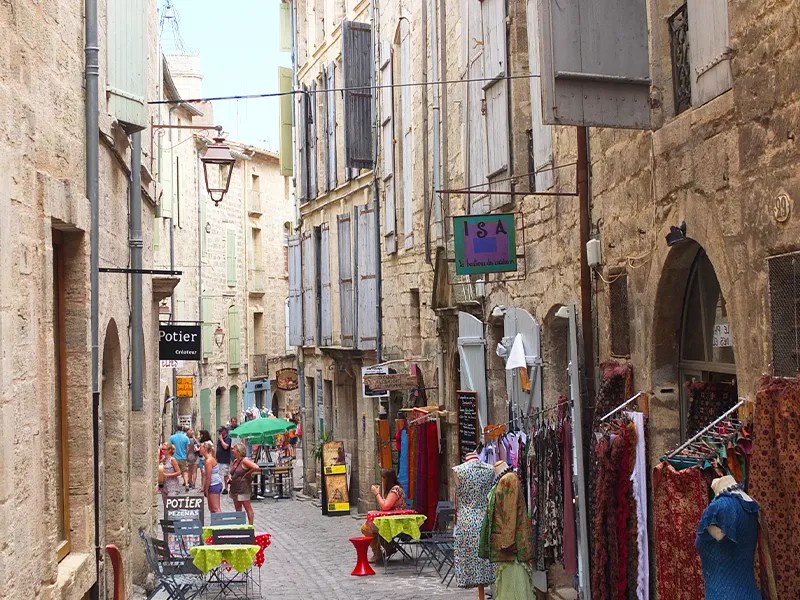
Discover the pickled-in-the past village of Pézenas sits between Beziers and Montpellier in the Hérault department in the Occitanie region in southern France.
It’s hard to beat strolling through the charming cobblestone alleys of Pézenas on a sunny summer’s day. The narrow winding streets, flanked by tall honey-coloured stone buildings, with those faded green shutters that are so evocative of the south of France, are full of independent shops. Alongside artisan crafts such as leatherware and pottery or the local Berlingots sweets and petits pâtés de Pézenas pastries, you’ll find artwork, homewares, gifts, jewellery, clothing and more. I challenge you to walk these streets without ducking into at least one boutique and coming away with a lovely souvenir!
Place Gambetta, the main square, is a lively spot with cafés and a fountain – when I was last there, they were setting up stage for the weekend’s entertainment. Restaurants tucked away in pretty corners of the town or with large bustling terraces are the perfect place to linger over a meal or a cup of coffee or glass of wine while people watching. You can easily spend a relaxing day here just wandering around, browsing the shops and admiring the architecture. But as those historic buildings suggest, Pézenas has a fascinating past and its story is written on the facades.
Diverse history of Pezenas

You’ll notice many of the buildings have large burgundy doors; maybe you’ll catch a glimpse of a vaulted stone courtyard beyond. Look up and you’ll see flourishes of carved stone and wrought-iron balconies. These were not the humble homes of the poor; they hail from Pézenas’ golden age, when trade was thriving and so were the town’s inhabitants.
Having previously existed as a Roman outpost, a medieval stronghold and an important trade centre, home to prestigious annual fairs, it was during the Renaissance that the town really came into its own, and many of the most beautiful buildings date from this time.
In 1456, Pézenas became the seat of the governors of Languedoc, the political capital of the region. A prosperous period followed, as evidenced by the hôtels particuliers – grand townhouses – that still remain today. Built in the 16th and 17th centuries by wealthy merchants and nobles, they include the Hôtel de Lacoste, Hôtel de Malibran and Hôtel d’Alfonce. Large mullioned windows, grand stone staircases and internal courtyards were typical, and some have beautiful gardens. Today they make ideal spaces for cultural events and boutiques as well as sought-after private homes – in one, the Musée de Vulliod St-Germain showcases Pézenas’ history, while in the Hôtel de Lacoste I visited a wonderful silk shop, complete with historic loom. Guided tours of the town often include stops at hôtels particuliers, and during September’s European Heritage Days some are open to the public.
The town was home to the formidable Christian knights, the Templars, although they left less of a lasting mark. On Rue des Chevaliers, on a building with an impressive, corbelled turret, a sign proclaims a ‘former 17th-century commandery built on the site of the 11th-century Templar house’. Opposite, the imposing Église Collegiale Saint-Jean, largely built in the 17th/18th century, occupies part of the site of a complex built by the Knights Templar in the 12th century – head inside the church to admire the stained-glass windows and magnificent organ.
Although the medieval walls which once surrounded the old town no longer exist, you can see an original gate, the Porte Faugères, an important remnant of the town’s defensive past. Beyond it are the wider boulevards of the 17th and 18th centuries. Inside, the old town is now pedestrianised but once carts would have trundled through the medieval streets, which tended to be crooked or irregular – look out for a slanted doorway on the Hôtel d’Agde de Fondousse; the arched stone surround was sharply angled to give access to the courtyard through an equally slanted passageway.
I love spotting the ‘mascarons’ of Pézenas – keystones with a sculpted, half-relief face, dating from the 18th-century on, representing themes such as the four seasons, ancient gods and unusual figures. Over 100 of these characterful faces watch passersby from the walls of the tall townhouses.
Molière town
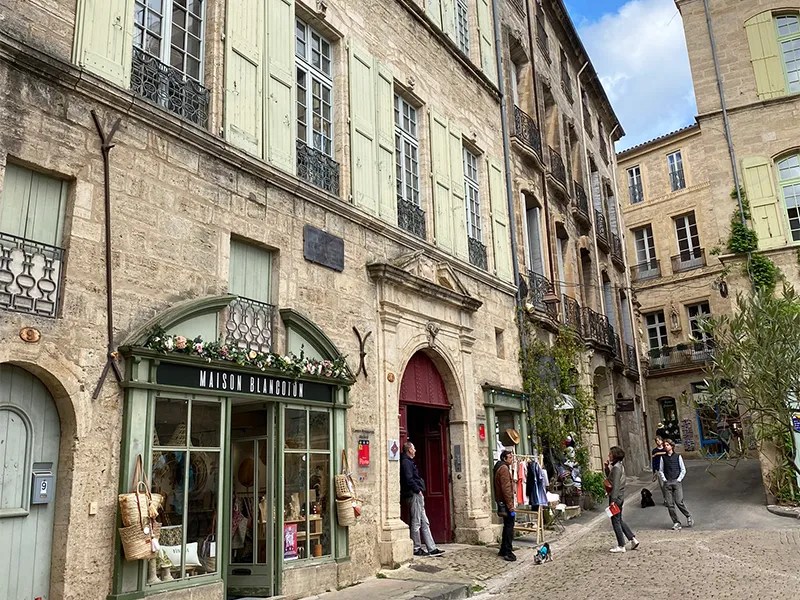
You can’t talk about Pézenas without mentioning Molière, France’s celebrated 17th-century playwright and actor – indeed, it’s often called the ‘Molière Town’. So, it may come as some surprise to hear that the revered wordsmith did not hail from Pézenas, although he did spend time here, under the patronage of the Prince of Conti (then the governor of Languedoc, based in Pézenas).
In the 1650s, Molière travelled through southern France with his theatrical troupe. Pézenas was thriving and its wealthy residents demanded entertainment, so Molière staged plays for the nobility and townspeople. The inspiration for some of his famous characters are said to be drawn from people he observed in Pézenas.
Molière later moved to Paris where his career flourished, but the town continues to celebrate its connection to him, with statues and plaques and performances throughout the year, including the Molière Festival in June. The Scénovision Molière museum offers an interactive multi-media show; it’s on the upper floors of the tourist office, the Hôtel Peyrat, which once housed the town prison. The tradition of theatre continues today, and the small but beautifully preserved 18th-century Théâtre de Pézenas is one of the oldest in France.
Although Pézenas’ political status declined in the 17th century when the governors moved to Montpellier, the area continued to thrive due to its vineyards and Pézenas became a hub for the wine trade.
Old and new
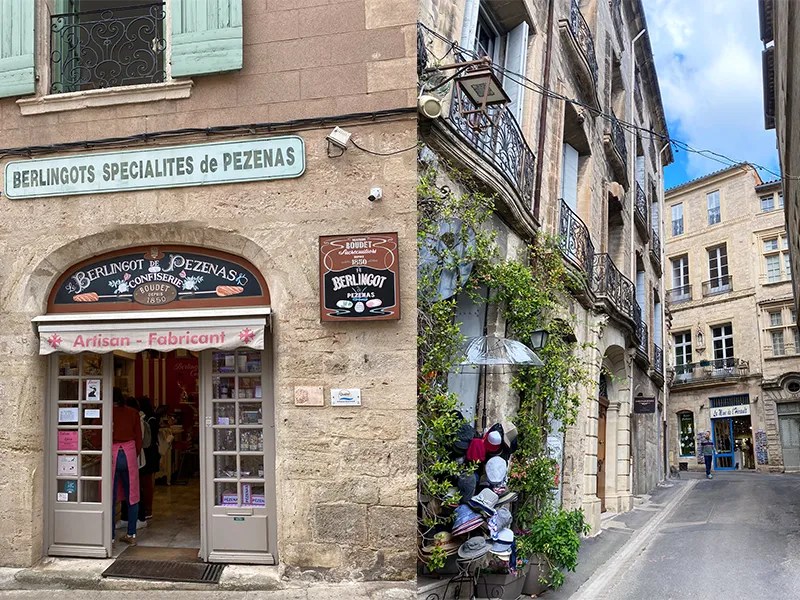
Alongside Pézenas celebration of its heritage, it has also carved something of a niche for itself in the antiques trade. There’s something to delight every kind of brocanteur, from fine furniture to flea market finds, delicate bedlinen, colourful 70s items, vintage clothing, huge stone urns for the garden and even an entire wooden and glass Art Deco shopfront – I was tempted to start a business just to use it, until I looked at the price tag!
If this piques your interest, you may want to coincide your visit with the twice-yearly Foire à la Brocante (May and October). This huge antiques market attracts people from far and wide.
If you prefer modern masterpieces, make your way to the Maison des Métiers d’Art, where you can choose from contemporary creations by 150 craftsmen, housed in a beautiful 17th-century building.
Of course, any French town worth its salt has a magnificent market and Pézenas is no exception – its Saturday market is said to be the best in the region, taking over the whole of the town centre with a profusion of stalls selling fresh produce, local crafts, flowers, clothing and more.
This is one town where you’ll never get bored! As a cultural hub, Pézenas has several museums, including one dedicated to doors, and one full of vintage toys (Musée de Jouet). Then there are all the festivals and events. In summer, the Estivales de Pézenas evening markets feature live music, local cuisine and wine tastings, while in late winter the Carnaval de Pézenas is a colourful cornucopia of parades, costumes and traditional celebrations.
Pézenas also makes an ideal base to explore the wider region. From day trips to the beaches of the Med to wine tasting in the local vineyards or walking and cycling in the countryside, there’s plenty to keep you occupied.
You could come to Pézenas and simply enjoy a few hours exploring the charming streets, shops and restaurants, but I would recommend fully immersing yourself in this most charming of southern towns, and taking a stroll through the past.
Karen Tait is a freelance journalist and editor with a penchant for France!
Want more France?
Discover more fabulous destinations in France with our free magazine The Good Life France
Love France? Have a listen to our podcast – everything you want to know about France.
All rights reserved. This article may not be published, broadcast, rewritten (including translated) or redistributed without written permission.


