Georges-Eugène Haussmann ripped up the rule books to transform Paris, Mike Rapport, author of City of Light, City of Shadows, looks at his legacy and how he transformed Paris in the Belle Epoque.
Haussmann’s Paris
‘Where is it now?’ lamented a popular song in 1926 of a lost Paris; ‘the assassination of Paris’ wrote the great historian Louis Chevalier in 1977 of post-war urbanisation; and now a social media hashtag cries ‘Saccage Paris’ against litter and some new urban innovations. Change in a city with a beauty, history and variety of neighbourhoods such as Paris will always provoke both anger and nostalgia. Yet the novelties of the past hundred years have inescapably acted on a cityscape that was to a great degree shaped by the most dramatic transformation of all: the renovations driven by Baron Georges Haussmann in the nineteenth century.
Commissioned by an Emperor
Emperor Napoleon III appointed Haussmann as Prefect of the Seine in 1853 with a sweeping brief: nothing less than the transformation of the city itself. Until his dismissal in 1870, the Baron deployed a veritable army of labourers, levelling old tenements, driving through new avenues and boulevards; digging the Paris sewers, constructing markets and disengaging great historic monuments from the obscuring clutter of buildings around them. In the process, he added two hundred kilometres of new streets and 34,000 new buildings, totalling 214,000 apartments. The aims of this startling programme were both practical and symbolic.
Practically, Haussmann and the Emperor wanted to solve the long-acknowledged problems of the capital: the narrow, medieval streets clogged with carriages, handcarts, horses and people, the shocking conditions in the overcrowded quarters in the city centre (it is hard to imagine that today’s quaint Île Saint-Louis was in the mid-nineteenth century one of Paris’ most teeming slum districts), dirty water, disease (especially the horrors of cholera), the lack of green space and fresh air. Haussmann’s mission was to create broad, straight avenues and boulevards, to ease the flow of traffic, to allow clean air to circulate, to ensure a ready supply of fresh water and accessibility of food markets, to open up new spaces within the old city and to create parks as the capital’s green lungs.
Symbolically, Napoleon III wanted to make Paris a fitting capital for his empire, a showpiece for the modern France that he was working so hard to create. He calculated that the renovations would make Parisians more prosperous (meeting with mixed results) and (correctly) that the city would become more of a magnet for visitors than ever before. As Haussmann explained, ‘Paris, capital of France, metropolis of the civilised world, favourite destination of leisured travellers…should be a centre of intellectual and artistic activity’, as well as France’s beating economic and political heart. Earlier regimes had tinkered, but Haussmann and Napoleon III came to these challenges with an over-arching plan for the entire city.
Paris transformed
Ultimately Haussmann created a coherent, integrated network of broad, straight streets that made rapid movement through the city a possibility and connecting its disparate quarters. His boulevards were a vital link in la grande croisée (‘the great crossing’) which sought to connect the different parts of the city with a north-south axis along the Boulevards Sébastopol and Saint-Michel, crossing the great west-east axis of the Rue de Rivoli and Rue Saint-Antoine. Of all the streets envisaged by Haussmann, the Avenue de l’Opéra connecting the Louvre with Charles Garnier’s opera house is probably the most iconic, although both street and theatre were, in the end, completed in the 1870s after Haussmann’s political fall.
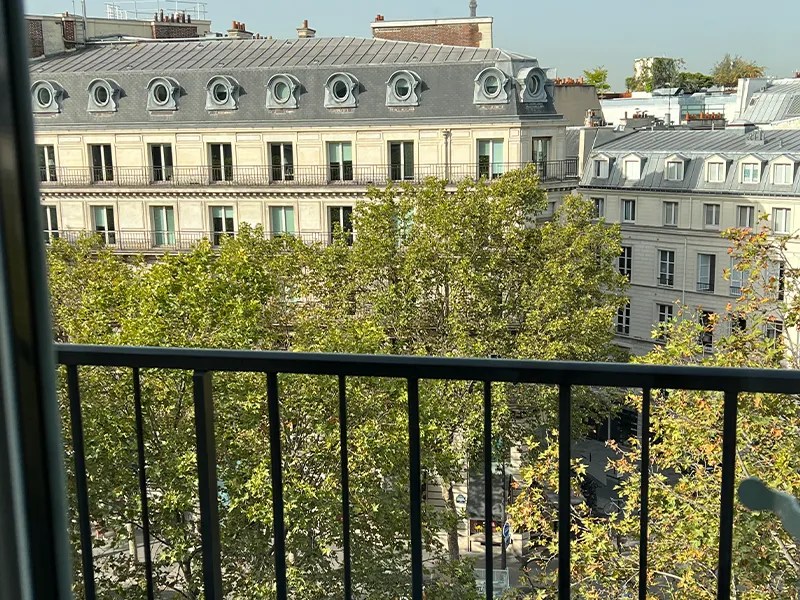
Admire the view up the broad, angled thoroughfare and Garnier’s ornate building stands proudly at the far end, presenting a spectacular vista. To line the boulevards, a host of architects designed apartment buildings according to stringent guidelines on height and form that now make them so characteristic of Paris, with their balcony windows, their ornamented façades in light yellow sandstone and their zinc mansard roofs that from above give the impression of an undulating light grey sea.
Parisians complained that Haussmann was converting Paris into a ‘ville-caserne’, a barracks city with regimented streets marked by a dreary sameness. Look closer, however, and the designers added a myriad of individual touches. Haussmann’s purpose overall was to ease the flow of traffic, to bring light and air to the inhabitants and, in this age of railway expansion, to connect train stations with each other: look up the Boulevard Sébastopol and you will see the Gare de l’Est with its iron and glass canopy peering distantly back at you.
The parks of Paris
Haussmann also created Paris’ green lungs, such as the Bois de Boulogne to the west and the Bois de Vincennes with their decorative lakes inspired by the Serpentine in London’s Hyde Park. Within the city, he landscaped the Parc Monceau, the Parc de Montsouris and the Buttes-Chaumont, this last spectacular for its crags from its days as a quarry for the gypsum that gives the exterior plaster on older Parisian buildings their grey-tinted whiteness.
Fresh water was to be delivered to Parisians by a series of aqueducts from the rivers of the Paris basin, while wastewater was disposed of through a new underground sewage system, a subterranean network which became fashionable to visit once they had opened to the public in 1855: ever since, it has been possible to take a tour. Food markets were given modernised premises: Victor Baltard built the capacious iron-and-glass pavilions for the food halls at Les Halles: dismantled in the early 1970s, they became part of Chevalier’s lamented ‘assassination of Paris’, and were replaced by a subterranean shopping complex. A surviving pavilion has been reconstructed at Nogent-sur-Marne.
Old Paris was demolished
To turn Paris into a statement of imperial grandeur, Haussmann created vistas on the city’s historic monuments by levelling the buildings clustering around them. The Prefect demolished the warren of streets and old houses in front of Notre Dame, creating the parvis, the open space from where one can truly admire the cathedral’s Gothic towers and façade. Sometimes, Haussmann’s work reveals some pleasant surprises: walk down the Boulevard Henri IV from Bastille towards the Île Saint Louis, and you will also be on a direct bearing for the distant dome of the Panthéon.
There was some suspicion that the boulevards served a military purpose in a city that had risen in revolution as recently as 1848. Broad avenues are harder to barricade than crooked, narrow streets and they lend themselves to troop movements and to the straight aim of cannon and musketry. Certainly, in paving over the southern segment of the Canal Saint-Martin, Haussmann literally bridged an obvious obstacle defending the radical artisanal neighbourhoods of the east. Moreover, the placing of barracks on or near the new boulevards – most notably the casernes on today’s Place de la République – was just too convenient for the deployment of soldiers around the city.
The interwar philosopher Walter Benjamin suggested that Haussmann’s renovations were therefore a ‘strategic embellishment’. The Prefect himself was (perhaps unsurprisingly) coy about spelling out any such counter-revolutionary motives. Even so, by easing communication within the city, Haussmann strengthened the reach of the state and the forces of order in the capital.
Haussmann’s Paris was for yuppies
There was a heavy price to pay for the glories of Haussmann’s Paris. Haussmannisation (the term dates to the 1890s) drilled through old, long-established neighbourhoods. The magnificent type haussmannien apartment buildings commanded much higher rents. So the artisans and poor fled northwards and eastwards to the outskirts of city – to places like La Chapelle, La Villette, and the slopes of Belleville and Ménilmontant. Haussmann formally incorporated these onetime villages into the city in 1859 when he added eight new arrondissements to the already existing twelve (Paris has had 20 arrondissements ever since). Yet they were almost literally a world apart from the more prosperous central and western areas.
The striking images of Charles Marville, whose photographs documented the disappearing Paris, also captured the shanty towns – bidonvilles – that grew up on the fringes: in all, 350,000 Parisians were pushed out from city centre to the eastern and northern outliers. These areas would explode in anger, hope and revolution in the Paris Commune of 1871. Just as later urbanisation would evoke strong criticisms, so too did those of Napoleon III’s Prefect. Born in Paris but raised in Alsace, Haussmann was dubbed the ‘Alsatian Attila’ for his ruthlessness. Charles Baudelaire devoted a series of poems to Paris in Les Fleurs du Mal lamenting the rigid geometry of Haussmann’s city and the disappearance of the rich diversity of human life from its renovated neighbourhoods.
Modern Paris was born
Yet Haussmann also laid the foundations for modern Paris. People can still wander along his boulevards. The café terrasse dates to Haussmann’s day. Speedier travel shrank the distance between historic neighbourhoods. This dramatic, even bewildering, transformation intensified the process of segregating rich and poor districts along geographical lines, but it also made more feasible such symbols of modern consumerism as the department store, which drew on customers from across the city and beyond. The creation of new neighbourhoods, the shrinking of distance, the acceleration of movement, the creation of new social spaces, the fostering of a consumer society and the stress on the beauty and grandeur of an imperial capital set the pattern for the growth of Paris into today’s city.
Mike Rapport’s book City of Light, City of Shadows: Paris in the Belle Epoque, is a brilliant account of Paris’s Belle Epoque revealing a city at war with itself as well as a golden age for Parisian culture. (Published by Basic Books, 2024 ISBN 9781541647497).
Want more France?
Discover more fabulous destinations in France with our free magazine The Good Life France
Love France? Have a listen to our podcast – everything you want to know about France and more!
All rights reserved. This article may not be published, broadcast, rewritten (including translated) or redistributed without written permission.


