
Despite its name, the Petit Palais Museum in the heart of Paris is a rather large building! Sitting just off the Champs-Elysées, opposite the Grand Palais (which lives up to its name), it was commissioned as a venue for the Universal Exhibition of 1900. This world fair showcased the best of France and many buildings were created to demonstrate the flair of France’s architects though most of the buildings were sadly destroyed after the fair ended.
The Petit Palais didn’t get completed until 1902 and it was then repurposed as a museum – it’s real name is Musée des Beaux-Arts de la Ville de Paris (City of Paris Museum of Fine Arts). The building surrounds a stunning inner court and covers two levels which contain a magnificent collection of art which are free to visit, and frequent temporary exhibitions are hosted here.
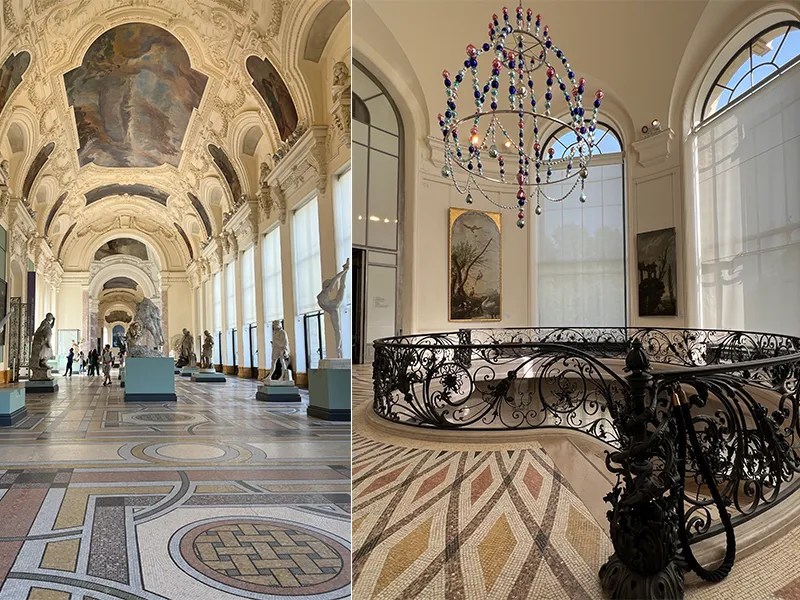
For my money, this is one of the must-see’s of Paris and yet it’s often left off of the top ten for visitors. And talking of money – it’s free to enter to see the main collections or to access the fabulous café – and more on that in a minute. You do have to pay if there is a special exhibition on. And they do appreciate a donation if you enjoy the permanent collection.
The Petit Palais has a dazzling collection of artworks ranging from Ancient Greek artefacts and medieval manuscripts through to 19th century paintings. Many of the works in the museum were gifts including a collection donated by wealthy American francophile, banker and collector Edward Tuck in 1930, after whom Avenue Edward-Tuck in Paris is named (it runs from Place de la Concorde to the Petit Palais).
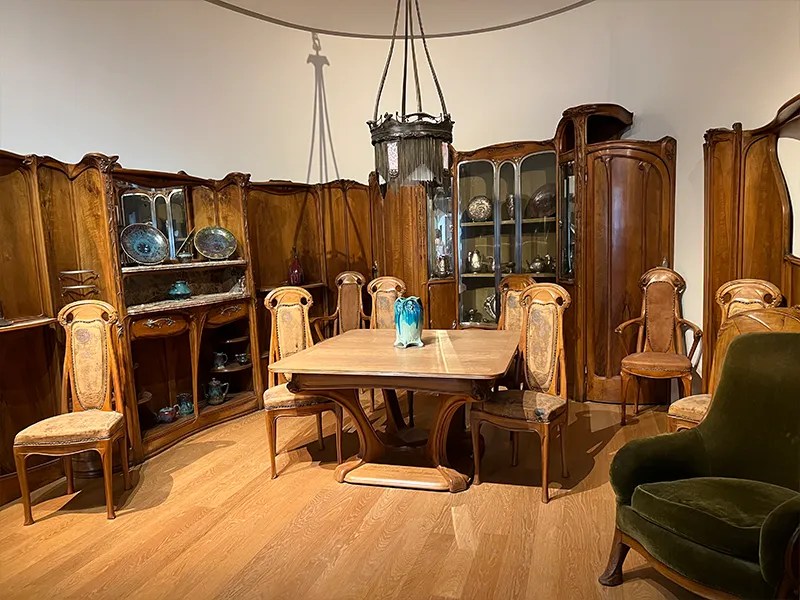
There are several superb works by Monet, Cezanne, Fragonard, Gaugin, Degas and many more of the most well-known artists. Sculptures, religious figurines, pottery, furniture – including a dining set Hector Guimard designed for his own house, glassware by Gallé, jewellery by Fouquet and Lalique, even an artist’s easel and equipment for painting en pleine air in the late 1800s – it’s an amazing collection that spans centuries.
The building really is a work of art in itself. The floors, walls and ceilings are richly decorated with paintings, frescoes and carvings. The staircases feature intricately forged wrought iron, mosaics decorate the floor of the entrance, stained glass windows top the rotunda, painted ceilings are throughout the building, including on the cupola above the staircase, painted by Maurice Denis just after the end of World War I.

Now – that café I mentioned. It’s the perfect place to relax, a tiny oasis in the centre of Paris and hard to believe you’re a stone’s throw from the busy Champs-Elysées. There’s a garden portico decorated with a huge vista of vines interspersed with medallions featuring The Months of the Year and The Hours of the Day and Night. The three large sections of the vaulted ceiling are punctuated by the feminine allegories of the Seasons. And in the centre lush planting creates a feeling of privacy with deck chairs for lounging. Café 1902 serves light meals, snacks and drinks including wine, plus luxury pastries by a top Paris pâtissier. It’s open from Tuesday to Sunday from 10 a.m. to 5:45 p.m., and until 7:40 p.m. on Friday and Saturday. Entry is via the main entrance to the permanent collections.
Discover more secret Paris gems
Janine Marsh is the author of several internationally best-selling books about France. Her latest book How to be French – a celebration of the French lifestyle and art de vivre, is out now – a look at the French way of life. Find all books on her website janinemarsh.com
Want more France?
Discover more fabulous destinations in France with our free magazine The Good Life France
Love France? Have a listen to our podcast – everything you want to know about France and more!
All rights reserved. This article may not be published, broadcast, rewritten (including translated) or redistributed without written permission


