
The Roman Empire in France has some real big hitters, but smaller surprises can be magical too. Their rule lasted from the 1st century BC to the 5th century AD and their legacy remains not just in buildings but in the French lifestyle from the language to the planting of vines and garlic, and the creation of roads. We look at where to find the best Roman sites in France…
Where to find the best Roman sites in France – Arles

Whichever way you look at it, the Roman amphitheatre in Arles packs a serious punch with its towering walls and high tiers of seats, right in the heart of the modern city. A marvel of Roman Gaul, this UNESCO World Heritage Site is just as impressive today as it was 2,000 years ago.
No matter how many pictures you have seen, reality is something else. Stand in line at the entrance and you cannot help but share the same excitement as the citizens of Roman Arelate. The ingenuity of Roman architects and builders is humbling, as too is the fact that so much of their work still stands across 21st century France, once a key part of the Roman Empire.
The Roman sites of Le Mans

Many of the largest sites in the ancient Roman province of Gaul are clustered close to the Mediterranean coast and along the strategic trade route of the Rhône Valley, but artefacts and masonry pop up in the most surprising places. The lofty city walls at Le Mans in Pays de la Loire, for instance, with their round towers and geometric brickwork, and the triumphal arch and amphitheatre at Saintes in the Charente Valley. All provide tangible links with an ancient civilisation that still reverberates today.
Roman entertainment venues in France

The Romans loved their public spectacles, from bloodthirsty gladiatorial contests in front of animated crowds to open air theatre and poetry readings. An amphitheatre is generally oval, the word ‘arena’ referring to the central performance area, whilst a theatre is semi-circular.
Every major city had an amphitheatre and whilst many were dismantled after the fall of the Western Roman Empire and their stone redeployed, many are still in use today. Buy a ticket for your favourite rock band, a classical concert, or Roman re-enactment in Arles or nearby Nimes, and you are following in a tradition going back two millennia.
Several theatres are also still in use, one of the best known being Orange in Provence (Roman Arausio). Regarded as the best preserved in Europe thanks to its high stage wall, the theatre is home to the Chorégies d’Orange, an annual opera and classical music event launched in 1869 and the oldest festival in France.

The modern cities of Lyon (Roman Lugdunum) and nearby Vienne (Vienna) in the Rhône Valley are unusual in having twin theatres. The main theatres were used for large productions such as plays and cultural events, whilst the secondary venues hosted poetry readings and small concerts. Summer city break? Buy a ticket for Lyon’s Nuits de Fourvière festival of arts, or the popular Jazz à Vienne.
At Autun in Burgundy – Roman Augustodunum – the ancient theatre, built around 70AD, is thought to have been the largest in the Empire, able to accommodate 20,000 spectators. Look out too for the impressive section of city walls complete with round towers, and two of the original four towering gates.
The Roman legacy – Urban Living

In settlements around the Rhône Valley, you get a real feel for the layout of Roman towns as you wander amongst the foundations of buildings from everyday life. Across the Rhône from Vienne, St Romain-en-Gal is one of the largest archaeological sites in France from the Gallo-Roman period. Discover the back story at the museum that stands at the heart of a 7-hectare park where 21st century visitors can walk amongst the remains of thermal baths, workshops and private homes.
But the largest site is the ancient city of Vasio Vocontiorum – Vaison-la-Romaine near Avignon. Here the extensive Roman remains are spread across two main sites. At Villasse, discover the main square of the forum and a street lined with shops, as well as a thermal bath complex and grand houses. More wealthy homes stand on the nearby hillside of Puymin, some with mosaics, sculptures and inscriptions, all conveniently close to the theatre and shops.

Sometimes however, a little imagination is required. In north-eastern France, in the department of Vosges, the well-preserved amphitheatre at Grand once held up to 17,000 Roman citizens. An intriguing thought for a small town that today numbers barely 400 residents.
Monuments and Museums

Large buildings such as arenas and theatres usually survived because they remained in use after the Roman Empire collapsed. The Vienne forum temple dedicated to Augustus and Livia was begun around 20BC and later transformed into a church.
Even better preserved is the monumental Maison Carré in Nîmes (Nemausus), listed by UNESCO as one of the earliest examples of a Roman temple connected to imperial worship in the provinces of Rome. Visit the city’s vast amphitheatre and opposite, the Musée de la Romanité which brings Roman times vividly to life through interactive multimedia devices. Don’t miss the 360° view from the rooftop.
Then there is the extraordinary Pont du Gard, a lofty limestone bridge with three tiers of perfectly symmetrical arches that span the river Gardon. Built in the 1st century AD, the world’s highest Roman aqueduct bridge is part of a 50-kilometre construction that once carried life-giving liquid from Uzès to Nîmes in the modern region of Occitanie. (More on this unique monument coming up in our Summer issue).

In the far west of the Mediterranean, Narbonne (Narbo Martius) was the first Roman colony to be founded in Gaul in 118BC. No grand buildings remain although a cobbled section of the ancient Via Domitia – complete with cartwheel ruts – is exposed in the city centre. Head to the edge of town however and Narbo Via museum has an exceptional collection of more than 6,000 pieces of Roman sculptures and mosaics found in the area.
Surprises
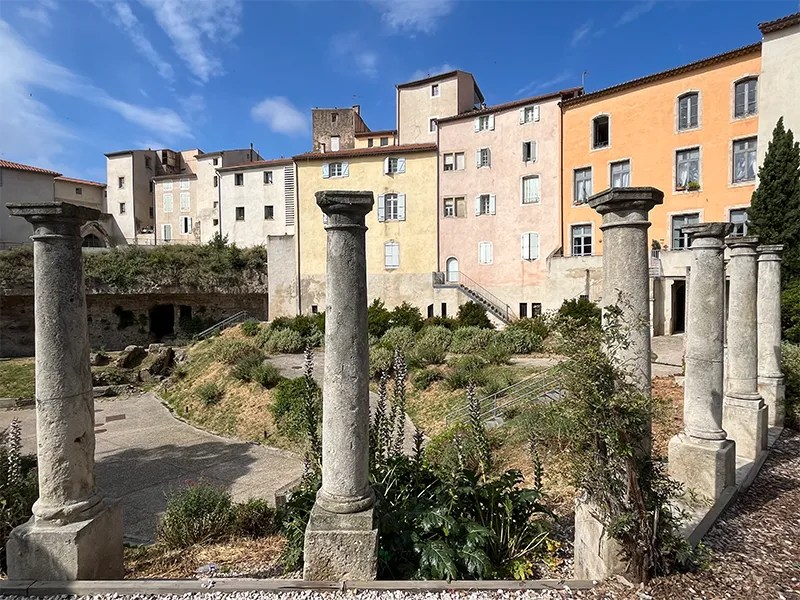
Glimpses of the Roman Empire pop up in some surprising places. The Tourist Office in Beziers, for instance, stands on Place du Forum which now exists only in name, but tucked in amongst some nearby buildings is the distinctive shape of the 1st century amphitheatre.
Head north through Occitanie and nestled within a loop of the Lot Valley, the heritage city of Cahors reveals little of its importance as the Gallo-Roman town of Divona Cadurocorum, but look carefully. A section of the public baths and the amphitheatre wall are visible through glass on the first floor of the Amphitheatre Car Park. Above ground, look out for the Arc de Diane, the main vestige of the city’s Roman baths.
North again to Dordogne and a museum of Roman art and archaeology surround the remains of a wealthy urban villa that now lies beneath a glass roof in the centre of Périgueux, previously the Gallo-Roman town of Vesunna. The nearby Vesunna Tower is all that remains of an important temple.
Few Roman remains exist in modern Poitiers to show that the ancient town of Limonum once had an amphitheatre seating more than 30,000 people. The amphitheatre and public baths were demolished in the 19th century, small sections of masonry being incorporated into other buildings. But at Sainte-Croix museum, a section of Roman foundations are visible beneath the floor, whilst rare fragments of gladiator helmets bring the drama of the city’s arena tangibly close.
And looking on is a marble statue of Athena, discovered barely a century ago during construction work and proving that Roman treasures may still await lie beneath our feet. Spine-tingling stuff!
By Gillian Thornton, one of the UK’s leading travel writers and a regular writer for The Good Life France Magazine and website.
Want more France?
Discover more fabulous destinations in France with our free magazine The Good Life France
Love France? Have a listen to our podcast – everything you want to know about France and more!
All rights reserved. This article may not be published, broadcast, rewritten (including translated) or redistributed without written permission


